










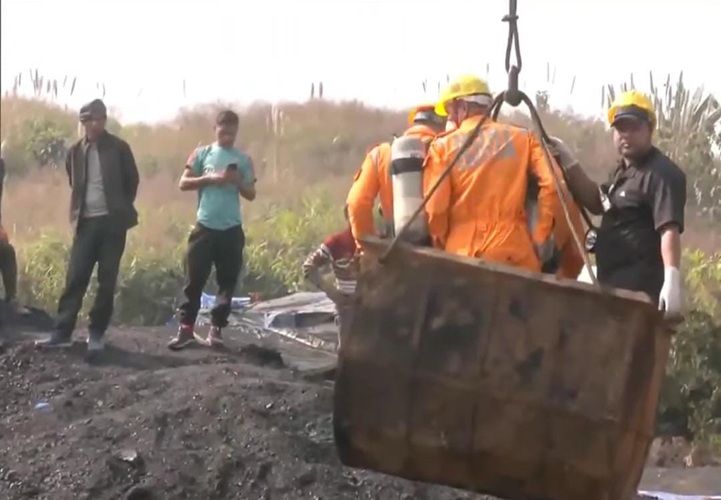
Shillong: The Meghalaya High Court on Monday came down strongly on the state machinery over its inability to stop illegal rat-hole coal mining in East Jaintia Hills district, calling the situation “distressing” and warning that responsibility would be fixed if lapses continued.
The remarks were made by a Division Bench of Justices H.S. Thangkhiew and W. Diengdoh while hearing matters linked to the February 5 explosion at an illegal coal mine in Thangsko area of Mynsngat village, an incident that left 27 people dead and exposed the scale of unlawful mining operations in the district.
Deputy Commissioner Manish Kumar and Superintendent of Police Vikash Kumar appeared before the court in connection with the case.
A status report submitted by the district administration cited manpower shortages but confirmed that a criminal case had been registered and two arrests made.
The Bench, however, said the report reflected serious enforcement failures and raised troubling questions about ground-level monitoring.
Without issuing detailed directions immediately, the court ordered the authorities to submit a comprehensive report within 10 days, outlining district-wide action taken to identify and shut down illegal mines, seize equipment, and arrest those involved in unlawful operations.

The report must also include the status of investigation into a separate mining incident on January 14 in the same area, in which a labourer from Assam was killed.
The court also took note of the Thirty-Sixth Interim Report of the judicial committee headed by retired judge Justice B.P. Katakey.
Based on site inspections, the report documented widespread illegal mining not only in Thangsku but also in nearby villages such as Mopala and Sakhain, allegedly in open defiance of court orders and statutory bans.
Terming the findings alarming, the Bench observed that the situation pointed to dereliction of duty by authorities and warned that further directions could include the initiation of an independent or central agency probe, if necessary, to ensure accountability.
Illegal rat-hole mining has continued in Meghalaya despite a blanket ban imposed by the National Green Tribunal in 2014, which declared the practice unsafe, unscientific and environmentally destructive.
The method involves narrow vertical pits dug deep underground, often without basic safety measures, making it one of the most dangerous forms of mining.
East Jaintia Hills has been the epicentre of repeated fatal incidents over the years. In December 2018, 15 miners died after an illegal mine flooded at Ksan village, triggering national outrage and judicial intervention.
Since then, the district has witnessed multiple explosions, cave-ins and flooding incidents, many involving migrant workers operating in remote, inaccessible locations.
ALSO READ: Meghalaya CM Conrad Sangma honoured at CBCI National Awards 2026
The February 5 blast, which triggered a fire inside interconnected underground pits, is among the deadliest in recent years and has once again raised questions over the effectiveness of enforcement mechanisms, despite continuous court monitoring.
Rescue operations at the site have involved teams from the National Disaster Response Force and the State Disaster Response Force, with officials acknowledging the extreme difficulty of operations due to underground connectivity and hazardous conditions.
The High Court directed that a copy of the Katakey committee’s interim report be provided to the Advocate General.
It also exempted the Deputy Commissioner from further personal appearance, while directing the Superintendent of Police to remain present at the next hearing scheduled for February 19.
As Report
Mentioned in the Hindustan Times