









By Enayet Kabir
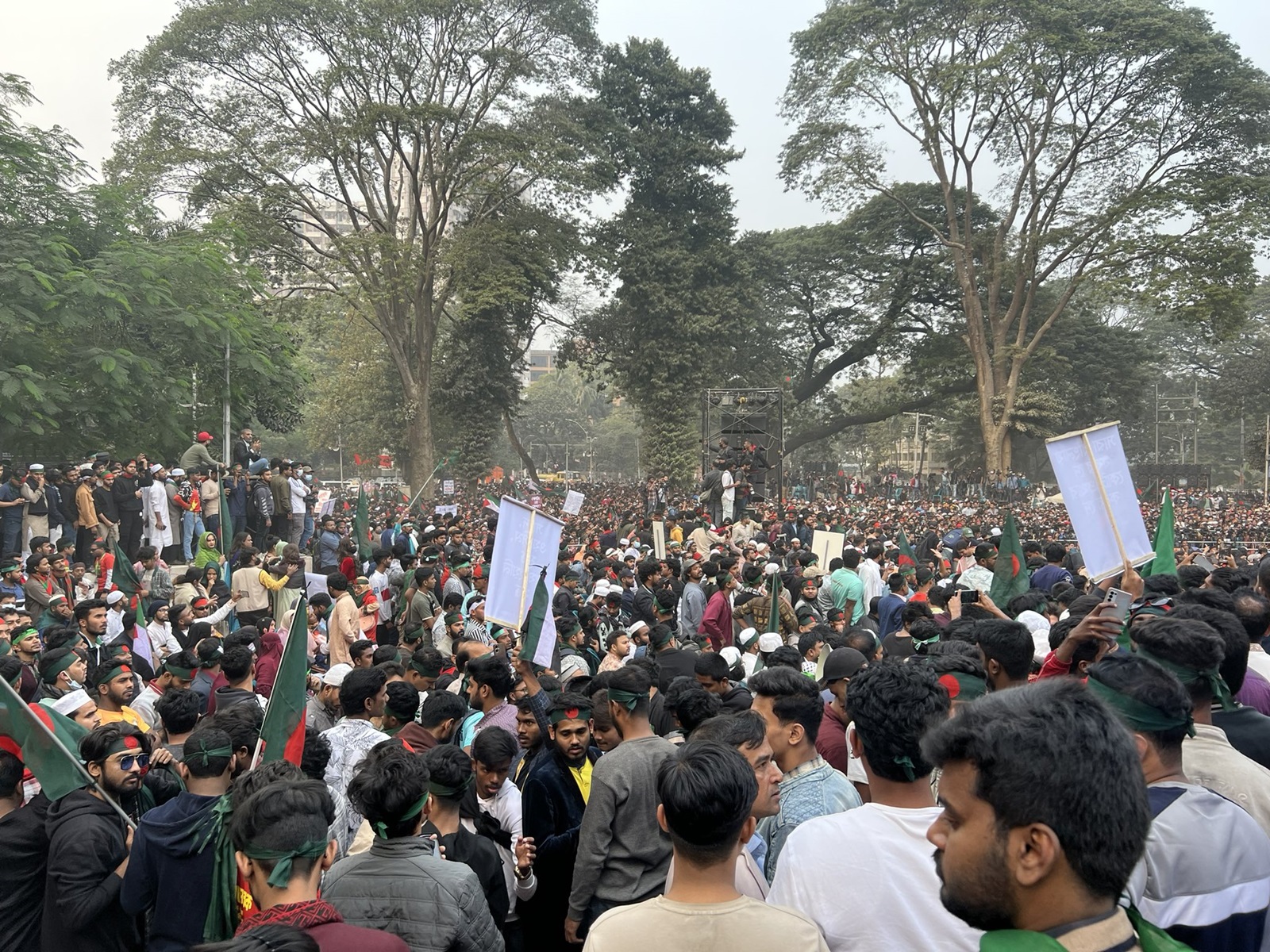
Before uncovering the identities of those behind the seemingly “innocent” regime-change narrative of the slogan “Quota or merit? Merit, merit,” and before revealing the mystery of the 7.62 bullets used in the July–August 2024 riots, Bangladesh’s “sovereignty” will remain under threat.
Former Home Affairs Adviser of the interim government, Brigadier General (Retd.) Sakhawat Hossain, repeatedly urged the disclosure of the mystery of the sniper rifles and 7.62 mm ammunition, but attempts to suppress the matter are still ongoing.
The question is: how did sniper rifles and 7.62 mm ammunition, used by the military, end up in the hands of civilian assailants and “merit” movement activists? Who assisted DGFI Director General Major General (Retd.) Hamidul Haque and the Prime Minister’s Military Secretary Major General (Retd.) Kabir—both of whom played important roles at the time—in leaving the country?
Immediately after forming the government, BNP Secretary General and Minister for Local Government and Cooperatives Mirza Fakhrul Islam made it clear that no white paper on the “interim government” would be published.
Prime Minister Tarique Rahman, in his address to the nation, mentioned the “fragile economic challenges” left behind by the “subservient and fascist” government but did not utter a word against the interim government.

This indicates that the BNP government will run the country in continuity with Muhammad Yunus’s government, effectively owning that administration.
To ensure that continuity and take responsibility for the post–regime-change situation, the BNP government appointed former “National Security Adviser” Khalilur Rahman as Foreign Minister and former Attorney General Asaduzzaman as Law Minister. Controversial Home Secretary Nasimul Ghani has been made Cabinet Secretary.
It goes without saying that the unconstitutional interim government will once again be indemnified for constitutional violations, and the BNP government will grant retrospective legal validity to all ordinances and notifications issued by that government. But the crucial national question now is the “constitutional rights of the people.” Bangladesh’s Constitution is meant to safeguard fundamental rights. Yet the people repeatedly fall under unconstitutional usurpers.
On August 5, 2024, the military allegedly played an unconstitutional role and brought about regime change through a military coup.
On August 8, an unconstitutional interim government was formed. In effect, indirect military rule continued until February 17.
Even though a political government has been formed, the military has not yet returned to the barracks. Can the public now seek remedy from the government and judiciary for violations of their constitutional rights? The prime minister offered no such assurance in his address.
Prime Minister Tarique Rahman mentioned establishing the rule of law, yet even one week after the election, journalists and political detainees arrested in what are described as “laughable murder cases” have not been released.
Before the election, the outgoing Yunus government ordered retrospective promotions and benefits for 143 “deprived” former military officers known for anti-Awami sentiment—including Abdullahil Aman Azmi, son of convicted war criminal Ghulam Azam, and Hasinur Rahman, infamous for extrajudicial killings during Operation Clean Heart.
At the initiative of former National Security Adviser Khalilur Rahman, a national committee composed of former military officers recommended these retroactive promotions and benefits. The BNP government did not cancel them.
It is believed that military-civilian mafia groups and “foreign invisible hands” are behind Khalilur Rahman, Asaduzzaman, and Nasimul Ghani assuming key roles in the BNP government.
The BNP’s “political” government is the ultimate beneficiary of the unconstitutional interim regime. Therefore, despite public demand, they will not prosecute its “anti-constitutional” role.
It can be said with certainty that the public will not receive redress for violations of their fundamental constitutional rights. Tarique Rahman’s government will not take initiative to uncover the mystery behind the “Quota or merit? Merit, merit” regime-change slogan or the 7.62 ammunition used in the July–August 2024 riots. Tarique assumed office on the condition of implementing all unconstitutional “foreign” agreements made by the Yunus government.
Regarding the Jamaat-e-Islami–controlled illegal International Crimes Tribunal, Law Minister Mohammad Asaduzzaman has said its activities will continue.
The law originally enacted to try the 1971 war criminals has been amended to conduct “other trials” in the same court. Even 25 serving military officers have been summoned to court hearings multiple times. There is resentment within the armed forces over this. The BNP government may be compelled to maintain the continuity of this illegal “court”.
By including the controversial Khalilur in the cabinet, what message did Tarique send? Khalilur also has critics within the BNP. Many generals still view him with suspicion. By keeping him in the administration and granting promotions, Tarique Rahman may be signaling something bigger than mere continuity in foreign policy.
He is keeping someone close who is familiar with the corridors of an unstable US administration, and perhaps he aims to assert an independent position outside the military establishment. For now, it is difficult to predict what move the military generals will make in response.
Tarique Rahman may realise that he has received direct patronage and support from Bangladesh’s military, aided by “foreign invisible hands.” In the Dhaka-17 constituency election, he won by only about 4,500 votes.
In the cantonment polling centers, a relatively unknown Jamaat-e-Islami candidate received significantly more votes. The Islamisation of the military is evident.
In other words, the war-criminal Jamaat-e-Islami has been kept “on standby.” If Tarique does not maintain the continuity of the Yunus government, the threat of another “regime change” remains.
Which path will Tarique choose? Will he establish the people’s fundamental constitutional rights and the “so-called rule of law”? Or will he appease his patrons and preserve the continuity of Yunus-style governance? Will he confront the opposition of the waiting-in-power Jamaat-e-Islami?
The writer is a political and economic analyst