










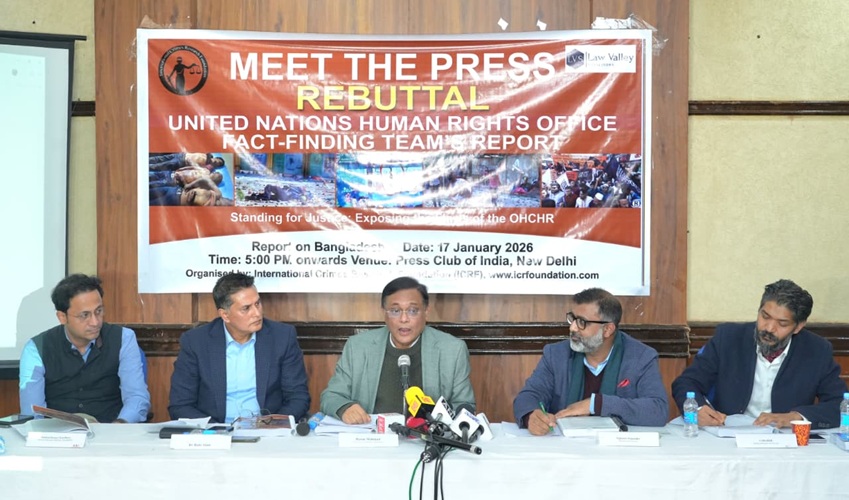
A press conference held at New Delhi’s Press Club on January 17, which was addressed by at least two in-exile Awami League leaders, was not approved by party supremo Sheikh Hasina, who has been living in the Indian capital since August 5, 2024.
This has caused a major flap in the Awami League with Hasina expressing her anger against the two leaders — former Foreign Minister Hasan Mahmud and Education Minister Mahibul Hasan Chowdhury Naufel.
The press meet was organised by the International Crimes Research Foundation (ICRF) along with a legal solicitor and sought to “present an independent legal rebuttal to the Office of the United Nations High Commissioner for Human Rights (OHCHR) report on the July–August 2024 unrest in Bangladesh”.
Responding to questions from reporters on the Mohammad Yunus-led interim regime’s demand for an apology by the Awami League for the deaths that occurred between July and August 2024, Naufel said, “We certainly regret the loss of lives at that time”.
While this does not quite tantamount to an apology, it nonetheless has miffed the party’s apex leadership. Hasina has so far refrained from apologising for the deaths, even as other party leaders, including Naufel, have pointed to the brutal killing of policemen in the second phase of the violence in early August 2024.
Sources close to the party’s apex leadership told Northeast News today that while Hasina was miffed after not being consulted by Mahmud and Naufel, she was upset as the press conference took place with the nod of Indian officials closely associated and familiar with the political and security developments in Bangladesh and the South Asian region at large.

More importantly, the sources said, the content of the addresses made by Mahmud and Naufel — in the context of the Mohammad Yunus-led regime’s recent demand that an Awami League apology must be a necessary condition for any reconciliation — was against the views held by Hasina.
“If this was a move by forces external and internal to the Awami League, it could have serious implications for domestic politics in Bangladesh,” the sources cautioned, adding that “efforts to undercut Hasina and even obliquely spelling out an apology could have serious implications for a country where elections are scheduled to be held on February 12”.
The sources said they have strong reasons to believe that “forces external to the Awami League appear to have cut a deal with the BNP with little or no effort to include the Hasina-led party in the elections”.
They said the Awami League leadership expected these “forces to work in ways to create conditions for an inclusive election”, which would have been in the spirit of the several statements to this effect by the Indian External Affairs Ministry.
The party leadership, the sources said, have taken a “negative view” of Naufel and Mahmud even as there are allegations of pecuniary benefits reaped by some former ministers and MPs.
The Awami League has been in a state of disarray since Hasina moved to New Delhi as a consequence of the US-backed regime change operation in Bangladesh, which led to the party’s ouster from power in August 2024.
Since then, several senior party leaders have been living in exile in Kolkata, a few in Delhi and some others in the UK, continental Europe and the US.
Despite the reverses in the Awami League’s political fortunes, the party leadership has hesitated to undertake any large-scale organisational overhaul and reorganisation.
This has impacted morale and caused uncertainty and confusion among senior leaders insofar as returning to Bangladesh and getting involved in politics, leave alone contest future elections.