










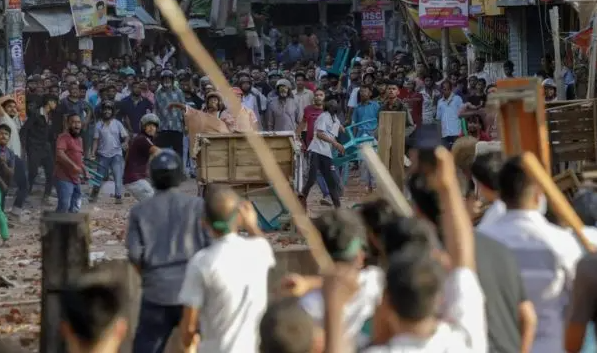
A coordinated campaign by two Bangladeshi online activists based in the United States and France has resulted in violent attacks on major media houses and cultural institutions in Bangladesh, highlighting the dangers of transnational online incitement.
Late on December 18, 2024, Elias Hossain, an activist and former journalist in Jackson Heights, New York, posted on Facebook: “Let not a single brick of Prothom Alo remain.”
The post was broadcast to more than 2.2 million followers of Hossain, amplified by Facebook’s verification badge and shared rapidly across WhatsApp, Instagram, and other Facebook pages.
Within hours, crowds gathered outside the Dhaka office of Prothom Alo, vandalising the building. Hossain, with collaborator Pinaki Bhattacharya in Paris, simultaneously directed attacks on The Daily Star and other institutions, including Chhayanaut and Udichi.
Social media amplified their messages to millions, mobilising mobs in real time.
According to a report by BoomLive, “Elias Hossain and Pinaki Bhattacharya have built what amounts to a remote-controlled mob apparatus, powered almost entirely by Meta’s platforms and YouTube’s recommendation algorithms. Together, they command nearly 15 million followers across Facebook and YouTube, a digital army larger than the population of several Bangladeshi cities.”

Also Read: India–Kyrgyzstan joint special forces exercise ‘Khanjar’ begins in Assam
Over the past year, they ran systematic campaigns against Prothom Alp and The Daily Star, alleging that these leading newspapers acted on behalf of India’s intelligence agency and spread misinformation, creating distrust and inciting violence. Previous attempts in October and November 2024 included surrounding newsrooms and targeting staff, with escalating online rhetoric.
The duo also orchestrated the demolition of the ancestral home of former Prime Minister Sheikh Hasina in Dhanmondi on February 5, 2025, timing the event with Hasina’s live Facebook address and coordinating followers through continuous posts and videos.
“On the night of December 18, as newsrooms were set ablaze, sections of the crowd openly called for a new government led by Hossain and Bhattacharya. This was not merely online posturing. Both men had developed direct links with government officials and publicly showcased these connections, lending real-world weight to their influence,” BoomLive reported.
Journalists and observers warn this represents one of the first cases where social media was used to direct mass violence across borders, raising urgent questions about platform accountability and the ability of governments to respond to remote, algorithm-driven mob mobilisation.