










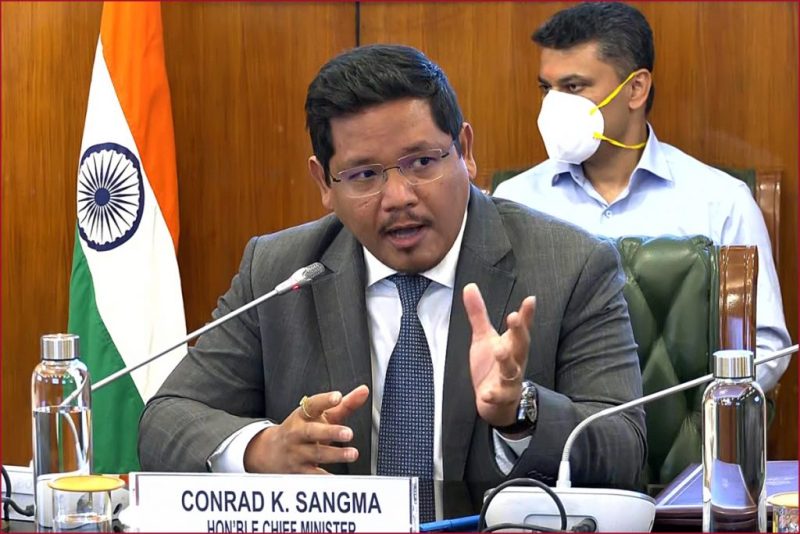
Shillong: A Meghalaya RTI activist has raised serious questions over the appointment of seven Officers on Special Duty (OSDs) in the Chief Minister’s Office (CMO), alleging a lack of transparency and favouritism in their selection, as well as the use of public funds for their salaries and allowances.
Manbhalang Phankon, an RTI activist from Madanrting, claimed that information obtained through the Right to Information (RTI) Act shows that seven contractual OSDs were personally appointed and attached directly to Chief Minister Conrad K. Sangma without any open recruitment process, competitive examination or public advertisement.
According to the RTI replies, each of the seven OSDs receives a monthly salary of Rs 1 lakh. The state exchequer has spent Rs 1,68,12,785 on their salaries since 2019.
The RTI documents also revealed that three of the OSDs alone claimed travel allowances (TA) amounting to Rs 1,49,93,374 during the same period, a figure that is nearly equal to the total salary expenditure on all seven appointees.
Phankon said, “The CMO is already staffed with senior IAS, MCS, IPS and MPS officers, as well as consultants, and questioned the need for additional OSDs on high pay when many educated youths in the state remain unemployed.
“This money could have been used to create genuine employment opportunities instead of benefiting a select few,” he said.

He alleged that the appointments lacked transparency and merit, and said this was in contrast to the Centre, where OSDs are usually senior civil servants on deputation and selected through proper procedures.
“These salaries and allowances are paid from public funds. If these positions require special expertise, they should be filled through proper recruitment channels and boards like other government posts,” Phankon said.
ALSO READ: Meghalaya: Pollution-hit Byrnihat sees protest as villagers shut industrial unit
He said he had made the information public to allow citizens to judge the matter for themselves. “As an RTI activist, I am placing the facts before the people and leaving it to them to judge,” Phankon said.