










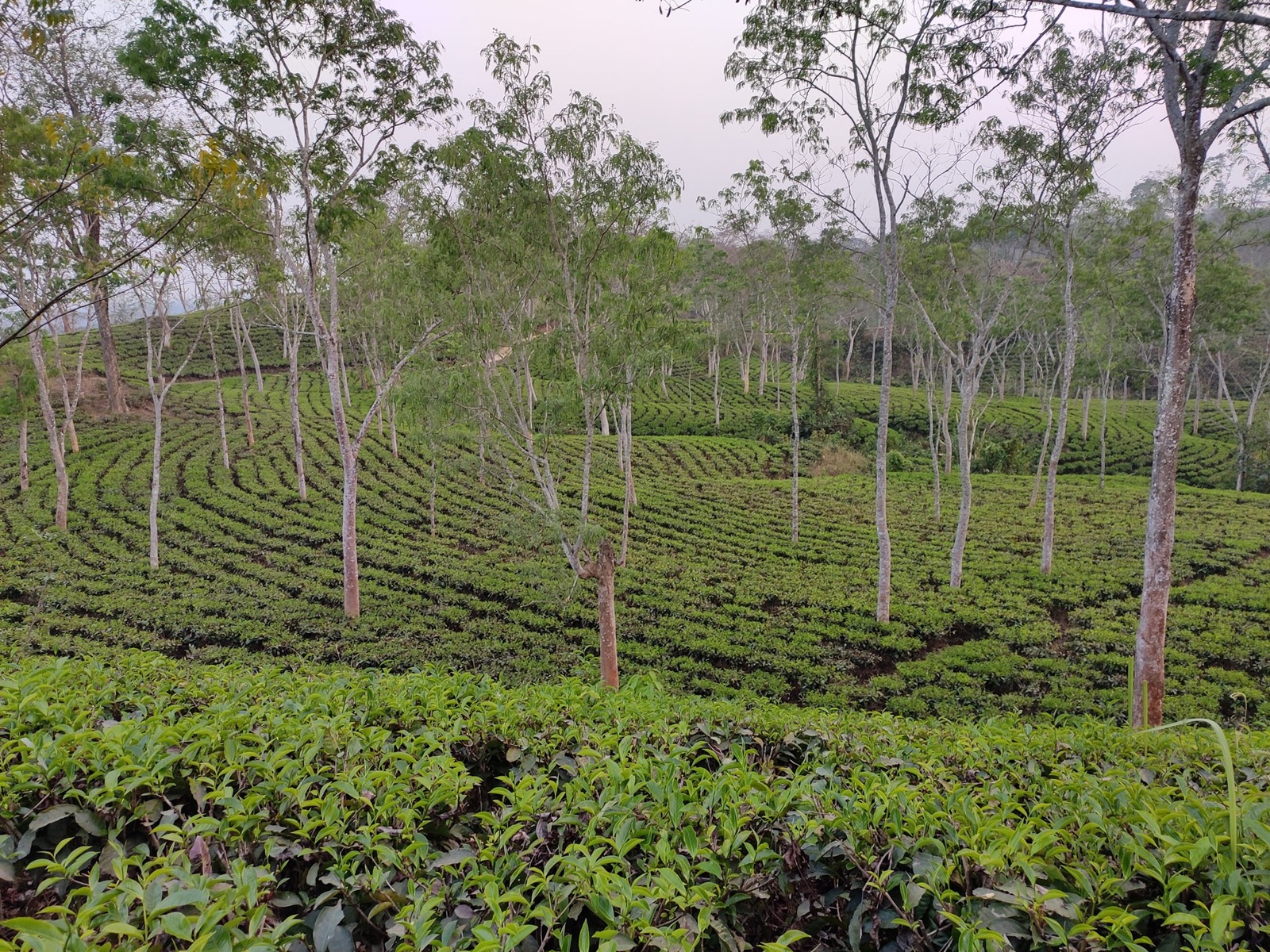
Guwahati: The Assam government’s decision to grant land ownership rights to more than 3.3 lakh tea garden worker families—a move hailed by many as the correction of a two-century-old injustice—has created a swell of emotion across the state.
In labour lines from Dibrugarh to Sonitpur, workers spoke of relief, pride and a long-awaited sense of belonging. But inside estate offices, among managers who have spent decades balancing statutory obligations, fragile finances and the rhythm of tea production, the mood is sombre.
“People think we are against workers,” said the manager of a large Upper Assam estate, glancing out at rows of ageing labour quarters.
“But this isn’t about sentiment. Emotion doesn’t run a tea garden. Structure does. If the land holding breaks, so does the garden.” He spoke softly, as if weighing every word, conscious of the political weight the bill now carries.
Passed on November 28, the Assam Fixation of Ceiling on Land Holdings (Amendment) Bill, 2025, removes “labour lines” from the category of land deemed essential for plantation operations.
This allows the state to resume these areas and distribute pattas to workers.

For many families who have lived for generations in company-built houses without ownership, the promised patta is more than a document—it is security, dignity, and a symbolic end to their precarious status.
But for tea producers, the relief felt in the labour lines is accompanied by an equally strong wave of anxiety.
In a detailed letter sent on November 24, CCPA secretary general Arijit Raha warned the state government that the amendment conflicts with the Plantation Labour Act (PLA) and the incoming Occupational Safety, Health & Working Conditions Code (OSH&WC), 2020.
Both mandate that employers must provide housing, sanitation, drinking water, health facilities and other welfare services to workers.
Raha’s argument is blunt: if the land on which labour quarters stand is taken over and transferred to individuals, estates lose the legal and physical space to meet obligations that the central and state laws still require of them.
The PLA makes workers’ housing conditional—tied to active employment.
A worker must vacate the house after leaving service, with some grace periods under specific circumstances.
“How does an estate enforce such rules when the land is no longer theirs?” a senior official of a tea company asked.
“The law says management must provide housing. The amendment takes away the land on which we can do that.”
Tea estates are compact ecosystems—plantation, factory, hospital, nursery, labour lines, stores and staff quarters all built in an interdependent layout.
Once pattas convert labour lines into private, inheritable plots, managers warn that this compactness will unravel.
Pleading anonymity a manager in Tinsukia described it as “a recipe for administrative chaos.”
“We already face difficulty when retired workers refuse to vacate houses,” he said. “Imagine when those houses are no longer ours at all.”
There is growing worry that pattas, being transferable, might eventually be sold or rented to outsiders.
If that happens, estates fear an influx of non-workers—a situation that would complicate security, movement, and even daily operations like sending factory vehicles across worker settlements.
“It is not hard to imagine parallel settlements growing inside garden boundaries,” said a Cachar estate official.
“We lose control over land, but remain legally responsible for the welfare of people living there.”
Beyond logistical concerns, the proposed change also shakes the financial foundation of tea estates. Labour quarters are part of the fixed assets of plantations.
These assets are routinely used as collateral when estates seek loans for replanting, factory upgrades or working capital.
“Removing labour lines from the estate is not a symbolic gesture—it alters the balance sheet,” a planter from Golaghat said.
“If the valuation drops, banks tighten credit. A weakened estate cannot support its workforce.”
Small and medium gardens—already strained by fluctuating tea prices, rising costs and unpredictable weather—say the bill could be a final blow. “When one pillar shifts, the whole structure starts to lean,” one manager said.
In Barak Valley, where geography forces worker homes to be scattered across hillocks rather than arranged in neat clusters, the consequences could be even more disruptive.
Worker quarters, non-worker residences and encroachments lie side by side, often making it difficult to define where estate land begins and ends.
Managers here fear that pattas could legitimise long-standing encroachments and permanently remove land from estate control.
“In the valley, boundaries are already blurred,” said a senior Cachar official. “The bill could formalise chaos.”
Over the past decade, Assam has encouraged tea estates to diversify—inviting them to develop eco-tourism, renewable energy projects, horticulture, educational institutions and processing units. Some gardens have begun generating employment and revenue through such ventures.
Planters worry that if labour line land is carved out for pattas, estates will lose the very spaces where these new projects were envisioned.
“Diversification is not a luxury anymore,” a Sonitpur manager said. “It keeps gardens alive. If land is lost now, we lose the chance to evolve.”
Producers also point to past committee recommendations—including the P.C. Barooah Committee and the 2007 Committee on Legislation for the Plantation Sector—which stressed the importance of maintaining compact estates, warned against resuming land suitable for tea cultivation, and suggested rehabilitating retired workers elsewhere through government schemes rather than estate land transfers.
These reports, once viewed as technical references, have now become ammunition in the industry’s plea for reconsideration.
Although the government has not outlined compensation for resumed land, industry bodies insist that acquisition must comply with the Right to Fair Compensation and Transparency in Land Acquisition Act, 2013.
The law mandates market valuation, severance loss, crop damage compensation and 100 per cent solatium.
But many estates fear that no compensation model can account for the long-term operational disruption the policy may create.
“Money cannot rebuild a fragmented garden,” a planter said. “You only know the loss once the land is gone.”
In the midst of this policy churn, workers themselves express a range of complex feelings.
At an estate in Dibrugarh, 42-year-old Lakshmi Kerketta held the corner of her saree as she spoke.
“We are happy. This is our home; we have lived here for three generations. But my husband keeps worrying—if new workers come, where will they live? If the garden suffers, we will suffer too.”
In Sivasagar, a young worker echoed the sentiment. “A patta gives dignity,” he said. “But if the garden loses strength, our future becomes uncertain.”
Their voices capture a quiet truth: the workers’ fate is still tied to the health of the plantations, even as the bill seeks to free them from dependence.
As the amendment moves toward implementation, the tea industry stands at a critical juncture.
The government promises justice and empowerment; the industry foresees fragmentation, statutory conflict and financial strain. And between them stand the workers—hopeful, proud, but anxious about what may follow.
For now, the vast green stretches of Assam wait in a tense stillness. Tea bushes continue to sway in the winter breeze, but beneath their calm lies a sector preparing for a transformation whose full impact no one can yet predict.