










By Enayet Kabir
After an 18-month period marked by general malgovernance in administration and uncertainty over the direction that the ‘men in olive greens’ would take, the Army can now return to the barracks. Barring just “one thorn”, the Army, over which loomed the shadow of the US and other global and regional powers, can be at relative ease.
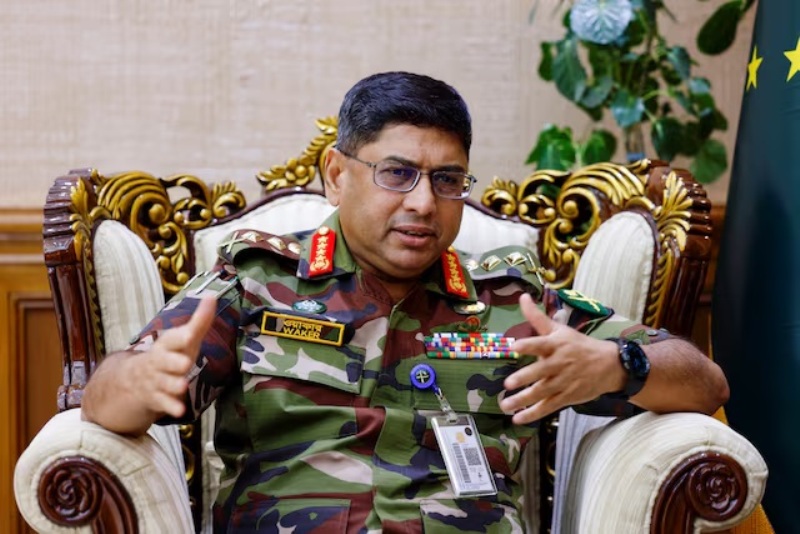
The ‘Spring cleaning’ in the officer corps, which was occasioned by the transfer of the then Principal Staff Officer in the Armed Forces Division, Lieutenant General S M Kamrul Hassan, Army chief General Waker-uz-Zaman’s bête noire, to the Ministry of Foreign Affairs was followed swiftly by other decisive action related to a bunch of senior officers.
Gen Zaman, who patiently waited for the February 12 election to be over before he acted in close coordination with the Tarique Rahman-led BNP government, can now hum ‘I did not fall in love; love fell upon me’.
Essentially, two “obstacles” to re-establishing full authority over the Army under Gen Zaman have been achieved: a political government has been established, and the “parallel” oversight and monitoring system imposed on the military by Muhammad Yunus’s interim regime through the National Security Adviser’s secretariat has been done away with.
The Army chief is relieved in seeing his trusted Lt Gen Mainur Rahman appointed to the second most important position in the force — Chief of General Staff (CGS). The constant “disorder” of the “Khalil-Kamrul” circle was a constant “threat” for Gen Zaman. On multiple occasions, decisions made at Army Headquarters were overturned by the NSA’s office.

In particular, blocking the promotion recommendation of Major General Moin Khan, former GOC of the 9th Infantry Division, and forcing him into retirement was embarrassing for Gen Zaman.
However, the most embarrassing issue for the Army chief was being compelled to present regular army officers accused at the civilian International Crimes Tribunal (ICT), allegedly controlled by the war-crimes-accused Jamaat-e-Islami.
In Bangladesh’s history, trying military officers in what was called a “bloody civilian” court is exceptional. Usually, charges against military officers are tried in military courts. Despite pressure from a large section of army officers, the Army Chief failed to persuade then ICT Chief Prosecutor Tajul Islam to withdraw from the decision requiring military officers to appear in civilian court.
Even after meeting former Chief Justice Rifat Ahmed at his residence and summoning Tajul to Army Headquarters, Gen Zaman could not prevent charges from being framed against military officers in civilian court.
The “parallel” oversight within the army by former NSA Khalilur Rahman and Lt Gen Kamrul Hassan created dissatisfaction within the military.
Khalil’s office had effectively begun functioning as an alternative Army Headquarters. Beyond promotions and transfers, Khalil used PSO Kamrul to interfere in military procurement and other policy matters.
Several attempts were made to destabilise Gen. Zaman. He had to manage the uncomfortable situation by frequently holding meetings with senior officers (GOCs and other commanding officers). At one point, Khalilur Rahman was unofficially declared persona non grata in Dhaka Cantonment. For now, Gen Zaman has been relieved from that embarrassing situation.
Another sensitive issue for Gen Zaman is the “massacre of Army officers” in the erstwhile BDR, now the BGB. The accused BDR members have already been tried in a court of law.
They were imprisoned with various terms of sentences. However, over the past 18 months, anti-Awami League groups have claimed to discover a connection between the Sheikh Hasina government and India and have tried to change the course of the “case.”
The Army chief had earlier declared, “The trial has been completed. The criminals are serving their sentences. There are no ifs or buts.” He was and remains firm against any attempt to alter the course of the verdict.
Immediately after Khalilur Rahman’s removal as NSA, significant reshuffles took place in the Army’s higher echelons. Lt Gen Mainur Rahman, previously GOC of ARTDOC, was appointed CGS.
Maj Gen Mir Mushfiqur Rahman, formerly GOC of the 24th Infantry Division, was appointed as the new PSO, AFD.
The outgoing PSO, Lt Gen Kamrul Hassan, was given an assignment as an ambassador at the Foreign Ministry. Brig Kaisar Rashid was promoted to Maj Gen and appointed Director General of DGFI.
This has largely reduced the “Jamaatisation” of the Army’s top posts, and Gen Zaman’s “command” has been restored.
Meanwhile, the removal of ICT Chief Prosecutor Tajul Islam has opened the way for resolving the issue of trying regular officers in civilian court.
Gen Zaman is popular among ordinary soldiers for his active efforts to transform the army into a professional force.
He has often said that he wants to quickly return soldiers — deployed to assist the civil administration — back to the barracks. However, due to the “fragile” law and order situation, the army has not returned to the barracks even after the formation of a political government following the “engineered election.”
In April, a large contingent of officers and soldiers is scheduled to join a UN mission in Africa. The list for this contingent was finalised last January. Members identified as belonging to the “Awami League family” have been included on that mission list.
After the fall of Sheikh Hasina’s Awami League government following the July–August 2024 “public scam” or mass deception, General Waker-Uz-Zaman emerged as the “centre of power” in Bangladesh.
A section of the public believes Gen Zaman prevented a “national disaster” by compelling the Yunus government to hold elections. But will his absolute control over the Army make him authoritarian? Quartermaster General (QMG) Lt Gen Faizur Rahman remains in his position. That sole thorn remains.
(The writer is a political and economic analyst)