










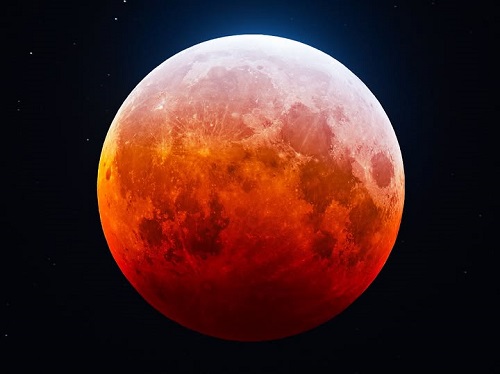
A total lunar eclipse, also known as a Chandra Graham, will occur on March 3, marking the last total lunar eclipse until late 2028 and early 2029.
The eclipse coincides with the vibrant Hindu festival of Holi. The rare celestial event will be visible across India and can be best viewed during early evening, making it a special opportunity for observers worldwide.
What is a total lunar eclipse?
A total lunar eclipse occurs when the whole Moon comes under the umbral shadow of the Earth and the partial lunar eclipse occurs only when a part of the Moon comes under shadow of the Earth.
As sunlight passes through Earth’s atmosphere, shorter blue wavelengths scatter. The remaining red and orange light bends toward the Moon. This filtered light gives rise to the famous “Blood Moon” effect.
Visibility across India
According to the India Meteorological Department (IMD), the lunar eclipse will have a magnitude of 1.155, making it a profound total lunar eclipse. This celestial spectacle will be visible in India, as well as in various parts of East Asia, Australia, and the Americas.
The IMD said, “Most of the places of India will observe the ending of the lunar eclipse at the time of moonrise except some places of North-East India and Andaman and Nicobar Islands where the end of the totality phase of the eclipse will also be visible.”
Timing of Eclipse in India
In India, the eclipse will begin at 3:20 pm on March 3 and end at 6:48 pm. This year’s first lunar eclipse will last 3 hours and 27 minutes.
Why This Eclipse Is Special
On the evening of March 3, 2026, astronomy enthusiasts across the country will have the opportunity to witness the final moments of this profound total lunar eclipse.
Astronomical calculations say that after tomorrow, there won’t be any total lunar eclipses visible from many places until 2029. This is due to the precise alignment required between the Sun, Earth, and Moon, which does not happen frequently. The long gap makes tomorrow’s event particularly important for enthusiasts, educators, and students who study astronomy.

Also Read: Pluto Day 2026: Remembering a historic space discovery
Enhancing the Viewing Experience
Though the moon can be visible to the naked eye, for a more captivating experience, using binoculars or a telescope is recommended. Magnification reveals the slow sweep of Earth’s shadow across the lunar surface during the partial phases, and during totality, craters, and mountain ranges are bathed in a warm, sunset-like glow – details invisible without optical aid.