










By Kaushalya Bajpayee, Avanindra Nath Thakur
India’s Budget 2026–27 was presented on February 1 with much celebration and described as a transformative step toward inclusive growth. Finance Minister Nirmala Sitharaman reiterated the government’s commitment to ensuring access to resources and opportunities for every family and community.
Health sector allocations were highlighted as a sign of social development. Yet, a closer reading reveals a troubling gap: primary healthcare—the foundation of any public health system—remains neglected.
The total allocation for the health sector (including health research) rose from Rs 99,858 crore (budget allocation) in 2025–26 (revised to Rs 96,852.5 crore) to Rs 1,06,530 crore in 2026–27. While this appears to be a 6.7 percent nominal increase, the real growth—after adjusting for inflation—is barely 3 percent. More importantly, the health sector’s share in the total budget has marginally declined.
If healthcare is a priority, why does its share stagnate? And more critically, why does increased spending fail to strengthen the most essential tier—primary healthcare?
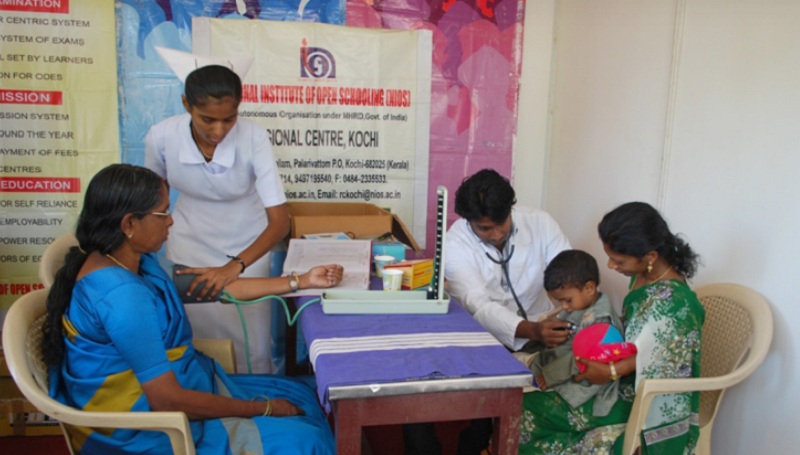
Primary healthcare is the first point of contact for millions, particularly rural and low-income populations. It encompasses preventive care, maternal and child health, immunisation, nutrition support and early disease detection. Yet, the budgetary emphasis tells a different story.

Rather than reinforcing primary health infrastructure, the budget leans heavily toward tertiary care expansion—trauma centres, cancer institutes, transplant units, robotic surgery facilities and AI-enabled medical institutions.
This is also reflected in the fact that the total budget allocation for centrally sponsored schemes (a large part of which is going to primary health care) showed only a marginal change (53,041.46 crore in 2025-26 to 53,305 crore in this budget), even in nominal terms. While technologically advanced healthcare is important, it benefits only a fraction of the population.
Lack of support
By contrast, primary health centres (PHCs), sub-centres and community health centres—which serve as the backbone of rural healthcare—receive no commensurate boost.
The government has announced the training of allied healthcare professionals, comprising technicians of various categories in 10 selected disciplines, including optometry, radiology, anaesthesia, applied psychology, operation Theatre technology, behavioural health etc. aiming to train 100,000 personnel over five years.
This translates to roughly 20,000 per year—less than 700 per state annually, assuming uniform distribution. Against a WHO-estimated shortage of 6.5 million health professionals in India, this figure is negligible.
More importantly, this initiative does not address the immediate crisis in frontline services such as shortage of doctors and nurses in PHCs, overburdened ASHA (Accredited Social Health Activist) and anganwadi or “courtyard shelter” workers under the Integrated Child Development Services programme, inadequate maternal and child healthcare infrastructure and poor rural access to essential medicines.
Without strengthening these primary systems, adding allied professionals—especially through public-private institutes—risks diffusing responsibility rather than resolving core gaps.
The most concerning signal lies in the reduction of allocations, in real terms, for key public health programmes such as the National Health Mission (US$ 4.27 billion or Rs 38,889.34 crore in 2024-25 budget estimates to US$ 4.5 billion or Rs 39,390 crore in this budget, amounting to an annual rise of merely 0.5 percent in nominal terms).
This reduction is even in nominal terms for family welfare schemes (US$ 71 million or Rs 645.48 crore in 2025-26 revised estimates to US$ 70.7 or Rs 643.46 crore) and the Pradhan Mantri Swasthya Suraksha Yojana (US$ 243 million or Rs 2,200 crore in 2025-26 budget allocation to US$ 221 million or Rs 2,005 crore) which was introduced in 2003 to correct regional imbalances in the availability of affordable tertiary healthcare services and to augment facilities for quality medical education.
These programmes form the backbone of India’s primary healthcare network. Budgetary cuts across these flagship programmes directly impact immunisation drives, maternal healthcare, disease surveillance and rural health outreach.
While customs duty exemptions on 17 life-saving drugs are welcome, the broader issue of medicine affordability remains unaddressed as in India nearly 70 percent of out-of-pocket expenditure is reported to be attributed to medicine. Primary healthcare depends not just on infrastructure but on accessible and affordable essential medicines. The budget remains silent on this front.
Favouring private sector
The budget signalled a continued push toward private sector participation—through bio-pharma promotion, medical tourism hubs and new Ayurveda (traditional medicine) institutes.
While medical tourism and AYUSH (Ayurveda, Yoga and Naturopathy, Unani, Siddha and Homoeopathy) integration may boost international appeal, they do little for the everyday healthcare needs of the poor.
Five proposed medical tourism hubs, integrated with AYUSH centres, are unlikely to serve vulnerable populations. Instead, they may further skew public resources toward market-oriented healthcare.
Similarly, digital initiatives such as the Ayushman Bharat Digital Mission remain inaccessible to large segments of the population, especially in rural areas where digital literacy and infrastructure gaps persist. Telemedicine and online consultations cannot substitute for functioning primary health centres staffed with trained professionals.
India is estimated to have more than 66 percent of the total population to be 35 years or below. India’s demographic dividend depends heavily on women’s health and youth wellbeing. With women having their prime fertility period in this age group, investment in maternal health is most crucial in reaping the benefits of demographic dividend.
Besides, high maternal and child mortality in adolescent girls, can also be addressed through investment in youth to derive a “triple dividend” by improving ‘health now, enhancing it throughout the life course and contributing to the health of future generations.’
Yet, the budget is strikingly silent on expansion of maternal health facilities, upgradation of child nutrition and immunisation programmes, and strengthening reproductive healthcare services.
Primary healthcare plays a central role in reducing infant mortality, maternal mortality and malnutrition. Neglecting it undermines long-term economic and social development.
India’s total public health expenditure as a proportion of GDP remains low compared to both developed and many emerging economies. Instead of moving toward the long-promised 2.5 percent of GDP target, the allocation signals stagnation.
A health system cannot be sustainable if its foundation is weak. Investing in tertiary hospitals while primary health centres struggle with staff shortages, medicine stock-outs and crumbling infrastructure reflects misplaced priorities.
Budget 2026–27 increases allocations to visible, high-technology healthcare sectors while leaving primary healthcare structurally underfunded. It promotes private participation and specialised care but does not adequately address preventive, community-based, and rural health services.
Primary healthcare is not a peripheral concern—it is the bedrock of public health equity. Without substantial investment in this foundational tier, promises of inclusive healthcare remain rhetorical.
The uncomfortable truth is that a healthcare system cannot truly serve the people when it neglects or deviates from its first line of care.
Kaushalya Bajpayee is Associate Professor, Jindal Global Law School, O.P. Jindal Global University, Sonipat, Haryana.
Avanindra Nath Thakur is Professor, Jindal School of Government and Public Policy, O.P. Jindal Global University, Sonipat, Haryana.
Originally published under Creative Commons by 360info™.