









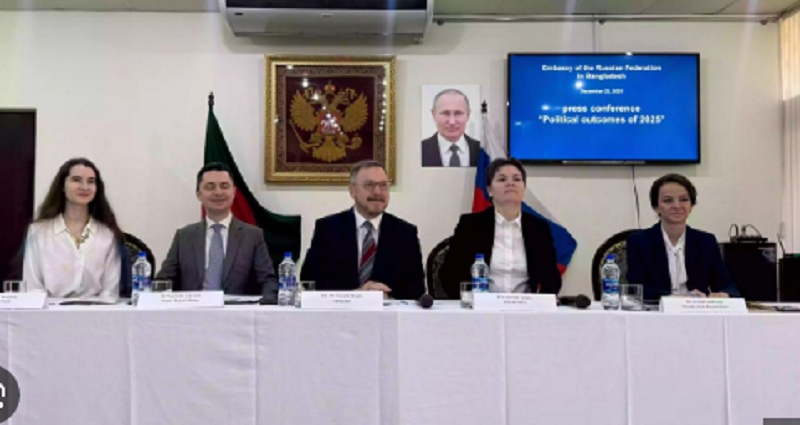
Russian Ambassador to Bangladesh Alexander Grigoryevich Khozin said Dhaka should reduce tensions with New Delhi at the earliest, stressing that easing ties would be in the interest of regional stability.
Speaking in Dhaka, Russian Ambassador to Bangladesh Alexander Grigoryevich Khozin underscored the importance of de-escalating tensions with India, “the sooner the better,” while stressing New Delhi’s crucial role in Bangladesh’s independence in 1971.
“The sooner you reduce the tension…the better. Because…historically, since 1971, when Bangladesh gained independence, [it was] mostly because of Indian help. And Russia also supported this in this regard. And shoulder to shoulder, India, Bangladesh, and Russia, we work together,” Khozin said.
He also warned against any further escalation of tensions, noting that Dhaka is already dealing with mob violence, minority protests and political uncertainty ahead of the February 12 national elections. He said Russia is not interfering in the bilateral relations between the two countries, but emphasised that Moscow believes it would be prudent to find a way to prevent the situation from deteriorating further.
Bangladesh has witnessed a fresh wave of unrest following the death of student leader Sharif Osman Hadi last week. Hadi was a prominent face in the anti-government protests that forced the collapse of the Sheikh Hasina government.
Hadi’s Inqilab Moncho group, which was formed after the ouster of Hasina last year, has been organising street protests and campaigns denouncing Hasina and India.

Last week, the Parliamentary Standing Committee on External Affairs, chaired by Congress MP Shashi Tharoor, warned that the unfolding situation in Bangladesh is turning out to be India’s biggest strategic nightmare in the neighbouring country since the 1971 Liberation War, citing concerns over political shifts, generational disconnect and growing influence from China and Pakistan.
ALSO READ: Assam on high alert amid fresh unrest in Bangladesh: CM
In the report, the committee also flagged the return of Islamist forces following the ouster of former Bangladesh Prime Minister Sheikh Hasina and the collapse of her Awami League party, along with the growing influence of China and Pakistan, as key turning points.