










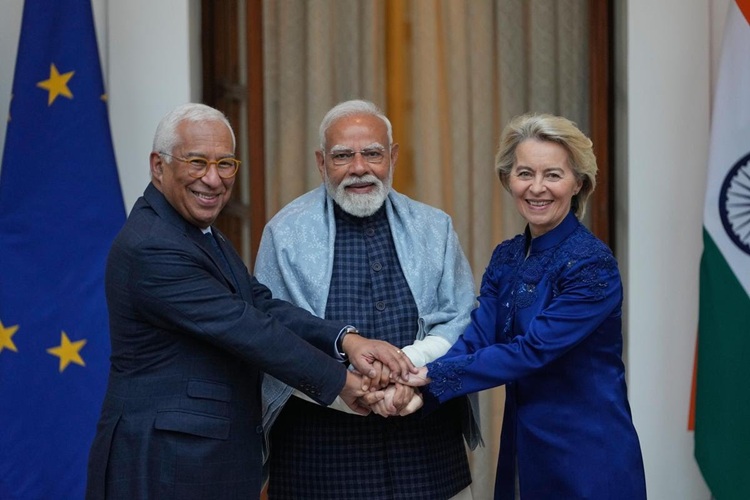
India and the European Union on Tuesday announced the conclusion of a long-negotiated free trade agreement, marking a major milestone in bilateral ties as leaders from both sides pledged to strengthen cooperation amid global geopolitical and economic uncertainties.
European Commission President Ursula von der Leyen described the agreement as the “mother of all trade deals” following summit-level talks in New Delhi with Prime Minister Narendra Modi and European Council President Antonio Costa.
The leaders agreed that the pact would create a vast free trade zone encompassing nearly two billion people, with significant benefits for both economies.
“Europe and India are making history today. We have concluded the mother of all deals,” von der Leyen said, adding that the agreement would serve as the foundation for an even stronger strategic partnership in the years ahead.
The summit followed the participation of the two EU leaders as chief guests at India’s 77th Republic Day celebrations at Kartavya Path on Monday, underscoring the growing political warmth between New Delhi and Brussels.
Officials said the free trade agreement is expected to substantially expand economic engagement by opening new avenues for cooperation across sectors.

While a formal document announcing the conclusion of negotiations is set to be signed shortly, the agreement itself may take at least six months to be formally concluded as both sides undertake legal scrutiny of the text.
Negotiations for the FTA were first launched in 2007 but were suspended in 2013 due to differences in ambition.
Talks were revived in June 2022, eventually gaining momentum amid shifting global supply chains and trade disruptions.
The European Union is currently India’s largest trading partner in goods.
During the 2024–25 financial year, bilateral trade stood at around USD 136 billion, with Indian exports valued at approximately USD 76 billion and imports at USD 60 billion.
Beyond trade, the summit focused on defence and security cooperation, climate action, critical technologies and the strengthening of a rules-based global order.
India and the EU are expected to unveil a defence framework pact and a broader strategic agenda alongside the trade agreement.
Strategic partners since 2004, India and the EU are now set to deepen defence ties through a proposed Security and Defence Partnership.
ALSO READ: Asian airports tighten health screening after Nipah cases reported in eastern India
Officials said the arrangement would enhance interoperability and create opportunities for Indian companies to participate in the EU’s SAFE programme, a Euro 150 billion financial instrument aimed at boosting defence readiness among member states.
The two sides are also preparing to launch negotiations on a Security of Information Agreement, which is expected to strengthen industrial defence collaboration.
In addition, an agreement facilitating the mobility of Indian workers to Europe is on the agenda, providing a framework for expanded labour mobility initiatives by EU member states.
France, Germany and Italy are among the European countries that already have migration and mobility partnerships with India.
Several other agreements covering cooperation in additional sectors are also expected to be signed, while leaders are likely to exchange views on major global challenges, including the ongoing Russia–Ukraine conflict.