










By Deepanshu Mohan
In less than a week the latest Gulf war has already triggered turbulence across global energy markets.
US natural gas futures climbed to around $3 per MMBtu (million metric British thermal unit) as escalating strikes between Washington, Tel Aviv and Tehran raised fears of supply disruptions. Brent crude briefly spiked before stabilising near $US 79 per barrel, WTI (West Texas Intermediate) rose 7.6 percent to $72.20.
The volatility persisted even after OPEC+ announced a modest 206,000 barrels-per-day output increase, a move analysts widely doubt will meaningfully cushion market instability.
Energy supply chains have already begun to adjust. QatarEnergy halted LNG production at its Ras Laffan complex following regional attacks, while tanker movement through the Strait of Hormuz slowed sharply as shipping firms rerouted vessels despite Tehran’s assurances that the waterway remains open.
These disruptions follow the coordinated US and Israeli military offensive launched on February 28, 2026, aimed at degrading Iran’s expanding nuclear enrichment and missile infrastructure after diplomatic efforts failed to secure limits on uranium enrichment or ballistic development.

The timing is economically sensitive. The global gas market is already operating at a 0.3 percent deficit relative to the five-year seasonal average, meaning even partial disruptions in Hormuz can amplify volatility.
The current escalation therefore reflects more than a geopolitical crisis. It represents a geoeconomic rupture in which military operations intersect directly with global energy security architecture and supply-chain vulnerabilities.
Interpreting Washington’s intervention solely through humanitarian or ideological lenses would miss the deeper economic calculus.
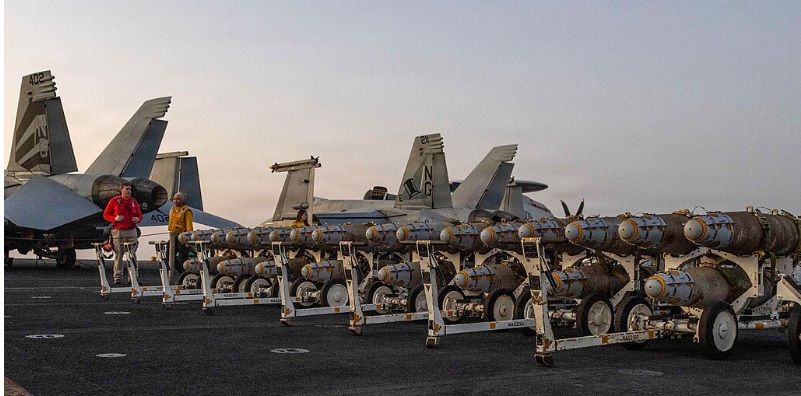
Viewed economically, the conflict activates two powerful engines of capital accumulation for the US: defence-industrial expansion and post-conflict reconstruction markets.
Historical precedents from the 1991 Gulf War to the 2003 invasion of Iraq demonstrate how high-intensity military engagements generate enormous demand for precision-guided munitions, advanced aerospace systems and logistical services.
This demand translates directly into revenue streams for defence contractors such as Lockheed Martin, Raytheon and Northrop Grumman.
Reconstruction historically produces even larger economic opportunities. Iraq’s post-2003 rebuilding effort channelled billions of dollars to US contractors, establishing a template that could scale significantly in Iran given its more developed industrial and infrastructure base.
Israel’s incentives differ. Its economic gains are largely strategic rather than commercial. Degrading Iran’s missile networks and proxy capabilities reduces regional risk premiums, stabilises maritime routes and strengthens Israel’s influence over emerging Eastern Mediterranean energy networks.
Past oil shocks
During the 1990 Gulf War, Iraq’s invasion of Kuwait pushed oil prices from roughly $20 per barrel in July to $40 by October, effectively doubling in four months. Yet, once Operation Desert Storm began, prices fell by nearly $10 per barrel in a single day, illustrating how market volatility often reflects uncertainty rather than actual supply loss.
Empirical estimates reinforce this sensitivity. A 10 percent increase in global oil prices typically raises headline inflation by around 0.4 percentage points on impact. Similarly, a 10 percent crude price increase raises global industrial costs by roughly 0.4 percentage points.
The 2003 Iraq invasion occurred in a different macroeconomic context, coinciding with strong Chinese demand and robust global growth. The result was a combination of inflationary pressure alongside increased investment in alternative energy and infrastructure.
Today’s structural environment is markedly different.
The US shale revolution expanded American oil production from roughly 5 million barrels per day in 2008 to about 13 million barrels per day by 2023-24, transforming the country into a net energy exporter. Simultaneously, LNG diversification and renewable energy integration have reduced direct dependence on Gulf oil.
Yet vulnerability has not disappeared; it has migrated.
Strategic exposure now lies less in raw hydrocarbon dependence and more in maritime chokepoints and trade-route security.
The Strait of Hormuz carries roughly 20 percent of global oil trade, including about a quarter of global seaborne crude flows and roughly one-fifth of global LNG trade. Other corridors remain critical: the Bab-el-Mandeb Strait and Suez Canal underpin trade flows between Asia and Europe, with Bab-el-Mandeb alone accounting for around 10–12 percent of global trade movement.
Asian economies bear the greatest exposure. Approximately 84 percent of the oil and 83 percent of LNG transiting Hormuz flows to Asian markets. China, India, Japan and South Korea together account for about 69 percent of all crude and condensate moving through the chokepoint.
Among these importers, India and China are the largest absolute recipients, while Japan and South Korea remain the most structurally vulnerable to supply disruptions. India still derives about 35 percent of its total energy consumption from imported fossil fuels, compared with roughly 20 percent for China.
Even if diversified supply dampens direct price shocks, risk premiums in shipping and insurance remain extremely sensitive to geopolitical conflict.
Maritime insurance costs illustrate this dynamic. During the 2025 Houthi attacks in the Red Sea, war-risk insurance premiums surged from around 0.3 percent of vessel value to nearly 1 percent. Ship arrivals in the Gulf of Aden fell by almost 70 percent compared with 2023 levels, demonstrating how relatively small militant forces can trigger large disruptions in global logistics networks.
Petrodollar system
Iran’s strategic importance extends beyond energy routes. The country sits at the intersection of competing financial and trade architectures shaping Eurasian connectivity.
The global oil market remains anchored in the petrodollar system, where crude transactions denominated in US dollars recycle revenues into American financial markets and Treasury securities.
Iran, however, has partially circumvented this system through yuan-denominated oil exports to China worth approximately $43 billion in 2024, alongside bilateral barter arrangements.
Simultaneously, the International North-South Transport Corridor (INSTC) linking Mumbai to Russia via Bandar Abbas offers an emerging alternative trade route. The corridor reduces transit times from roughly 45 days to 25 days and lowers transport costs by about 30 percent compared with the Suez route.
Any conflict targeting Iranian ports or rail infrastructure would immediately disrupt this corridor. This would directly affect India’s $120 million investment in the Chabahar port project, while also undermining regional connectivity with Afghanistan and Central Asia.
Energy modelling highlights the scale of potential disruption. Simulations by the Oxford Institute for Energy Studies, using the World Gas Model, show that a full-year closure of the Strait of Hormuz would produce severe LNG shortages globally: Europe: ~30 bcm (billion cubic metres), China: ~25 bcm, South Asia: ~16 bcm, Japan–Korea–Taiwan: ~14 bcm.
Iran’s strategic significance is also amplified by its vast natural resource base.
The country holds approximately 210 billion barrels of crude oil and around 1,200 trillion cubic feet of natural gas reserves. Beyond hydrocarbons, Iran is also rich in copper, zinc, iron ore and rare earth elements, with deposits concentrated in its central provinces.
In global mineral rankings, Iran holds sixth largest zinc reserves, seventh largest copper reserves, ninth largest iron ore reserves.
When Greenland’s rare earths, the Guyana Shield’s resources in Venezuela and Taiwan’s minerals dependent semiconductor supply chains shape great-power strategy, it is difficult to argue that strategic minerals are absent from geopolitical calculations in the Gulf.
The destruction of missile and defence facilities during conflict simultaneously erodes domestic industrial capacity while creating opportunities for external reconstruction investment.
Historical precedents such as the Iraq Relief and Reconstruction Fund (IRRF) and subsequent privatisation of state assets demonstrate that post-conflict rebuilding can open large profit channels for multinational firms.
In Iran’s case, potential reconstruction would not only involve hydrocarbon infrastructure, but also the extraction and processing of critical transition minerals essential for electrification and green technologies.
The multi-layered geoeconomic conflagration involves energy chokepoints, trade corridors, financial systems and mineral resources intersecting with defence spending and reconstruction markets. Together they generate both immediate disruption costs and longer-term strategic leverage.
The conflict’s outcome will not be determined solely on the battlefield. It will depend equally on who ultimately controls the infrastructures, resource networks and financial circuits that anchor West Asia’s integration into the global economy.
Deepanshu Mohan is Professor of Economics and Dean, O.P. Jindal Global University, Sonipat, Haryana. He is currently Visiting Professor, LSE, and an Academic Research Fellow, University of Oxford.
Saksham Raj, an undergraduate student at the Jindal Global Law School, O.P. Jindal Global University, Sonipat, Haryana, contributed with research for this article.
Originally published under Creative Commons by 360info™.