










By Manoj Pant & M. Rahul
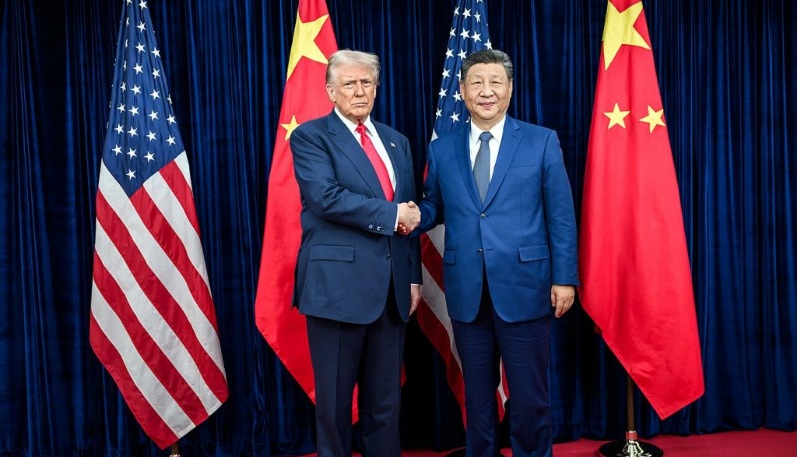
The latest US National Security Strategy document released by the Donald Trump administration has attracted the attention of commentators for how it talks — and doesn’t talk — about China. “Gone are the sweeping declarations about China being America’s most consequential geopolitical challenge”, CNN noted. “Instead, this latest document…emphasised the US-China economic rivalry above all”.
This change is one that challenges the framing of the US-China relationship as a second Cold War.
After World War II, communist USSR and the capitalist and democratic United States emerged as the two dominant global powers. The rivalry between these two super-powers was in terms of their starkly opposing ideologies, and the different economic systems under which both operated. The blocs led by them were largely separated by the flow of goods, finance and technology. While some limited exchanges did occur, particularly in commodities, the overall structure – while varying over time — remained one of high insulation.
That is not the case now.
The ideological faultlines that sustained the Cold War no longer exist. The same framework, therefore, no longer applies. Unlike the Cold War, the current global trend is more towards political and strategic fragmentation rather than economic decoupling.

A different landscape
Today, the world’s economic landscape is fundamentally different. Production happens in multiple stages, in several countries, through global value chains. Intermediate goods pass several borders before the final goods are produced and traded. This means that any economic decoupling between political groupings is very costly to achieve, at least in the short-term.
What is observable is a degree of fragmentation in trade. Recent research by Harvard university professor and economist Gita Gopinath and her co-authors documents this shift clearly. Their work shows a decline in trade and investment flows between political blocs relative to intra-bloc flows. However, this is far from the decoupling witnessed during the Cold War era. The evidence therefore points to a world of reconfigured linkages, not one of isolated blocs.
A key reason for this lies in the nature of the two main players. Unlike the Cold War rivalry between the US and the USSR, the present-day rivalry does not involve distinct economic systems. The economies of both the USA and China follow a system where production is dependent on private capital, international technological transfer and trade in intermediate goods.
The roles of these two countries in the whole value chain differ, creating inter-dependencies that are difficult to get rid of. The US is a provider of services, technologies and investment, while China is the factory of the world for merchandise products.
This interdependence is particularly evident in the trade relationship between the two countries.
The US being the major consumer of Chinese products is the market for the latter’s production. China currently faces challenges such as an aging population, deflationary pressures, and industrial overcapacity, combined with weakening domestic demand.
In this context, export-led growth continues to play a critical role in sustaining overall economic momentum.
Rivals with benefits
Growth, in turn, remains central to domestic political stability. China’s merchandise exports to the US stood at around US$ 525 billion in 2024, accounting for about a 15 percent share in China’s total merchandise exports. Even when direct trade from China to the US was restricted through tariffs, goods from China flowed indirectly through other routes.
Unlike the politically non-aligned countries of the Cold War era, there has emerged a set of non-aligned “connectors” such as Vietnam, Thailand and Mexico, which connect a portion of the reduced post-tariffs direct trade between the blocs. This role would have been impossible under the ideologically sealed blocs of the Cold War, although there are clear signs — such as the recent imposition of 50 percent tariffs by Mexico on Chinese goods – that the US would try to reduce this indirect trade resulting from “tariff shopping”.
The US, on its part, benefits from the cheaper products imported from China and other trading partners, which keep consumer prices in check. Capital inflows finance its persistent merchandise trade deficits. The effect of US tariff action on prices has already started showing. An estimate by the Federal Reserve Bank of St. Louis points to an increase in headline inflation in the US by around 0.5 percentage points owing to the increased tariff during the three-month period of June-August 2025.
With inflation remaining a central political concern, especially in an election cycle – US midterm polls are due in 2026 –the scope for aggressive and sustained trade confrontation is limited. Moreover, US trade deficits are structural in nature, arising from deep-rooted, long-standing systemic features of the American economy; these are not something that can be addressed through tariff measures.
Other players
The other player in the geopolitical fragmentation story is Russia.
Unlike the erstwhile Soviet Union, it is no longer a pole in the global scene. But it remains one of the world’s most powerful countries, militarily. Its economy is heavily dependent on energy and commodity exports, and its regime’s political survival is less directly tied to economic performance than in China’s case. Sanctions have imposed costs, but these have not translated into serious domestic political pressure. Russia therefore operates largely outside the economic logic that constrains both the United States and China.
India has an important role in the longer-term. Demography has a role to play. India’s large and relatively young population, combined with rising per capita incomes, potentially positions it as a major future market for goods and services, especially on the demand side. For India to translate this potential into production strength, deeper integration with Asian value chains will be essential. Asian economies now account for a larger share of global trade than their western counterparts, and engagement with regional production networks is essential.
The current rivalry between the United States and China is therefore better understood as a game of chess rather than a return to Cold War confrontation.
Unlike the ideologically driven conflict of the twentieth century, today’s rivalries are pragmatic and transactional. They are shaped by domestic economic constraints and are consequently more amenable to negotiation and adjustment. Strategic tensions will persist, and fragmentation will likely deepen in specific sectors, but the structural conditions required for a full-fledged Cold War are absent.
This assessment is consistent with the latest US National Security Strategy, which frames China primarily as an economic and technological rival rather than an ideological adversary.
Economist Dr Manoj Pant is Visiting Professor at the Shiv Nadar Institution of Eminence, Delhi-NCR, and a former Vice-Chancellor of the Indian Institute of Foreign Trade.
Dr M Rahul is currently an Assistant Professor in the TATA Chair on Information Technology at the Institute of Economic Growth.
Originally published under Creative Commons by 360info™.