










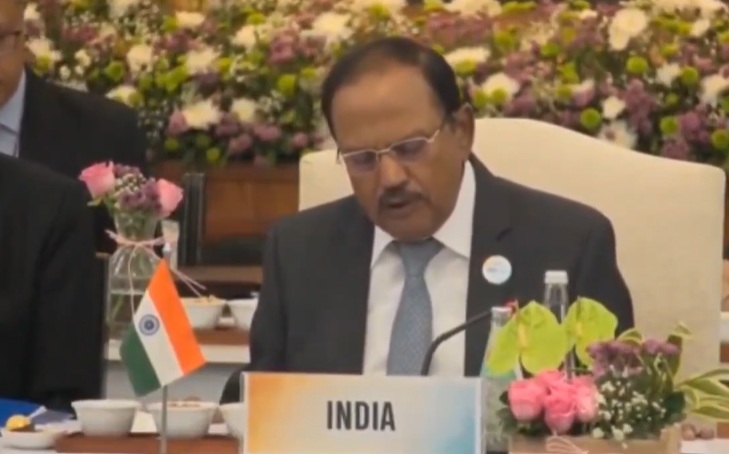
On November 20, 2025, India’s National Security Adviser Ajit Doval hosted the seventh meeting of the Colombo Security Conclave in New Delhi, bringing together security chiefs from the Maldives, Mauritius, Sri Lanka, and Bangladesh, with Seychelles joining as a full member and Malaysia as a guest.
This gathering of Indian Ocean nations marked a pivotal moment as Doval warned of mounting security challenges threatening regional stability and global maritime commerce.
The Indian Ocean facilitates approximately 80 per cent of global maritime oil trade and 70 per cent of world container traffic, making it a contested strategic space where multiple threats emerge.
Doval’s address illuminated threats from maritime insecurity to what he termed “grey-zone threats”—challenges operating below conventional warfare yet posing existential dangers to regional stability and prosperity.
These grey-zone threats encompass piracy, illegal trafficking, cyber-attacks, transnational crime, terrorism and radicalisation.
Drug trafficking networks and criminal organisations exploiting the ocean’s vastness demonstrate the multifaceted nature of contemporary security challenges.

Illegal fishing facilitates weapons smuggling and human trafficking, claiming thousands of lives annually across the Bay of Bengal and Arabian Sea.
These threats require coordinated responses transcending national boundaries.
The Colombo Security Conclave evolved from a trilateral maritime security grouping formed in 2011 into a comprehensive regional platform.
The signing of the founding documents in August 2024 transformed it from an informal dialogue into an institutionalised mechanism with a permanent secretariat in Colombo.
India’s appointment of the first Secretary General represents significant institutionalisation, moving toward continuous coordination.
The conclave operates through five critical pillars: maritime safety and security, counterterrorism, combating trafficking and transnational crime, cyber security and critical infrastructure protection, and humanitarian assistance and disaster relief.
China’s expanding presence in the Indian Ocean creates strategic concerns for regional nations.
Beijing’s military base in Djibouti, its 99-year lease of Hambantota Port in Sri Lanka, involvement in Pakistan’s Gwadar Port development, and investments in over 21 port infrastructure projects represent systematic efforts to project power and influence.
With 95 per cent of India’s trade by volume and 80 per cent of crude oil imports transiting the Indian Ocean, any disruption would have catastrophic economic consequences.
Chinese research vessels deployed near strategic locations have raised alarm bells across the region.
Doval’s call for a “rules-based maritime order” carries profound significance.
The Colombo Security Conclave represents India’s strategic response to Chinese expansionism through what analysts describe as a “minilateral” approach—flexible yet structured enough to enable meaningful cooperation among diverse nations.
By positioning itself as the primary security provider, India asserts regional leadership while offering alternatives to China’s Belt and Road Initiative.
The SAGAR vision—Security and Growth for All in the Region—announced by Prime Minister Modi in 2015, provides a philosophical foundation emphasising inclusive, cooperative, and sustainable regional development.
The counterterrorism pillar addresses persistent threats to regional stability.
Terrorist organisations exploit the maritime domain for smuggling weapons, drugs, and personnel across borders.
Bangladesh’s National Security Adviser emphasised his country’s “zero-tolerance policy towards terrorism,” reflecting shared commitment among CSC members to dismantle terrorist networks and prevent cross-border terror activities from destabilising the region.
Cybersecurity represents the most rapidly evolving threat vector.
Critical infrastructure increasingly relies on interconnected digital systems vulnerable to sophisticated attacks.
Bangladesh’s call for “collective action in facing cyber security, misinformation and disinformation” highlighted constant digital threats destabilising societies. Protection of critical infrastructure has become inseparable from the national security strategy.
The Strait of Malacca, through which nearly 90,000 vessels transit annually carrying 25 per cent of internationally traded goods, represents the most critical maritime chokepoint.
Any significant disruption would send shockwaves through global supply chains.
Similarly, the Strait of Hormuz, through which over 25 per cent of global seaborne oil flows, constitutes a vital passage whose security affects energy prices worldwide.
CSC nations, by coordinating maritime patrols and intelligence sharing, contribute significantly to keeping these critical passages secure.
Bangladesh’s participation carried particular significance given recent diplomatic tensions. National Security Adviser Khalilur Rahman’s bilateral meeting with Doval demonstrated that security cooperation provides a foundation for constructive dialogue.
His statement emphasising Bangladesh would be “guided by principles of sovereignty, equality, territorial integrity and non-interference” reflected the delicate balance all CSC members must strike between cooperation and autonomy.
The conclave’s discussion of the roadmap and action plan for 2026 indicates a shift from dialogue to implementation.
The appointment of the Permanent Secretary General represents an important institutionalisation.
The emphasis on joint exercises, training programs, and operational cooperation suggests member states recognise the need to move beyond statements toward concrete actions enhancing collective capabilities.
Looking at global implications, the success of the Colombo Security Conclave will influence cooperation patterns far beyond the Indian Ocean.
If the CSC demonstrates that regional security cooperation can be effective without formal alliances or great power subordination, it may provide models for other regions grappling with similar challenges.
The emphasis on consultation, consensus-building, and respect for sovereignty aligns with the preferences of developing nations seeking security cooperation without external constraints.
The humanitarian imperative underlying CSC’s work must not be forgotten. Beyond strategic calculations, the conclave exists to make ordinary people safer.
Fishermen, sailors, coastal communities vulnerable to disasters, and trafficking victims represent human faces behind policy frameworks.
When the CSC disrupts drug networks, prevents attacks, responds to cyclones, or dismantles smuggling operations, it saves lives in tangible ways.
As delegates concluded deliberations, the real work of the Colombo Security Conclave was beginning.
Agreements must translate into operational plans, joint exercises, intelligence protocols, and coordinated responses. The roadmap for 2026 must move from aspiration to implementation.
The nations gathered on November 20, 2025, sent a powerful message: despite differences and tensions, the collective security imperative can unite diverse nations in a common cause.
They affirmed that the ocean connecting them is stronger than the forces dividing them. Yet messages mean nothing without action.
This is the clarion call from the November 20 conclave: Indian Ocean nations must unite, not from fear but from recognition that fates are inextricably linked.
They must build an inclusive, cooperative security architecture. They must demonstrate that collective action defending shared interests prevails over division. The world is watching. The time to act is now.