










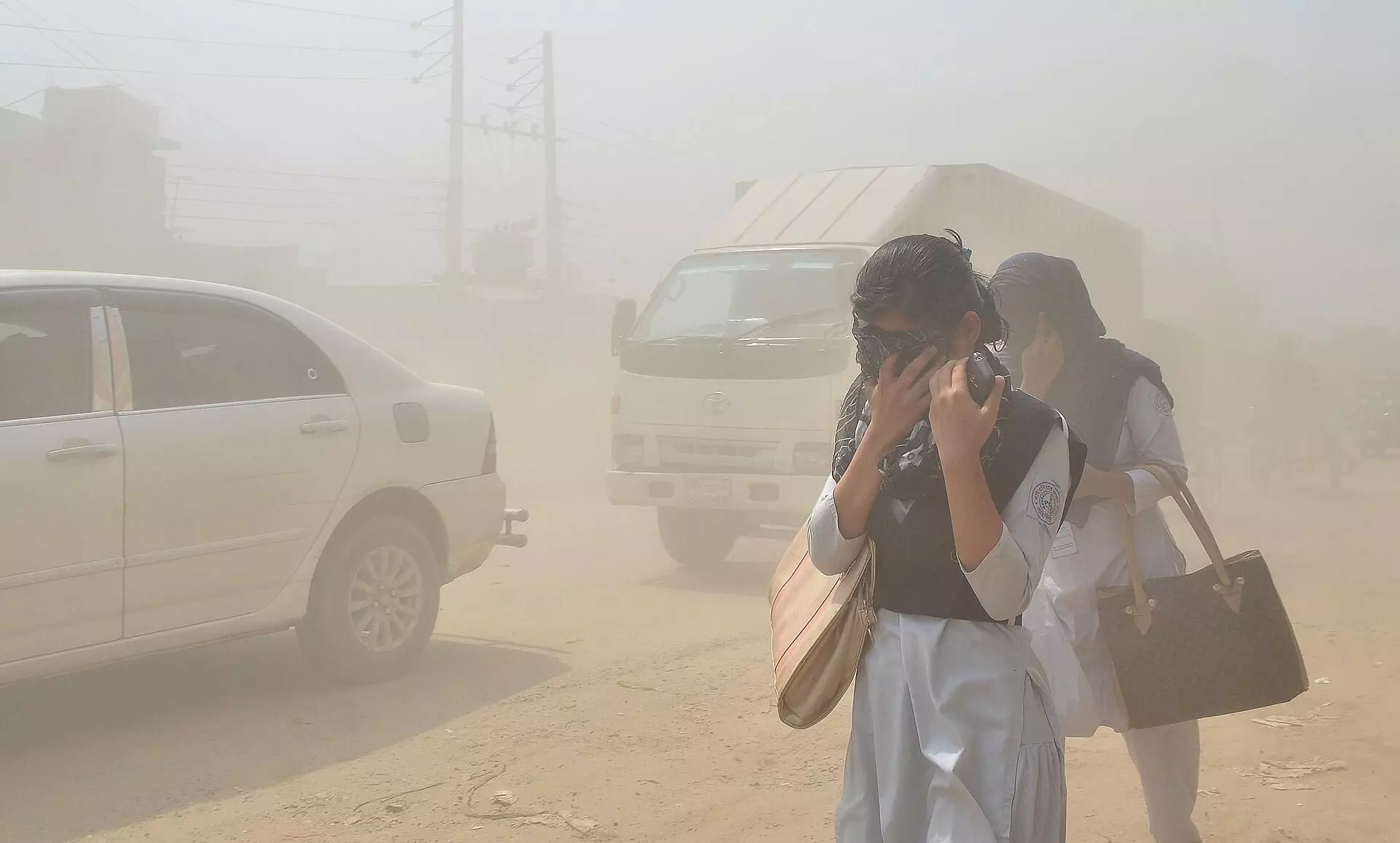
The skies over Assam, once celebrated for their misty serenity and emerald calm, now hang heavy with the invisible poison of particulate matter.
Guwahati, the gateway to the Northeast, breathes in laboured rhythm as its air turns increasingly hostile to life itself.
The irony could not be sharper—this land of rivers, rains, and lush hills, once a symbol of purity, has become a cautionary tale in how unbridled urban growth, institutional inertia, and public apathy can conspire to suffocate a city.
A new satellite-based assessment of India’s air quality has placed Assam among the country’s major pollution hotspots, challenging long-held assumptions that the Northeast enjoys cleaner air compared to other regions.
The Supreme Court’s recent deliberation on declaring severe air pollution a “disaster” under the Disaster Management Act, 2005, could not have come at a more urgent time. Assam’s capital, with an Air Quality Index (AQI) that often hovers above 150, and at times surges into “very poor” or “severe” categories, has become an epicentre of an unfolding health emergency.
The plea before the Court by environmentalist Vikrant Tongad of SAFE (Social Action for Forest and Environment) to classify any AQI above 250 as a national disaster offers not just a legal precedent but a moral compass.

It reframes pollution not as an environmental inconvenience, but as a catastrophe—an unnatural calamity that demands the same urgency as a flood or earthquake.
The statistics paint a grim portrait. Guwahati’s annual PM2.5 concentration—over 100 micrograms per cubic meter—is twenty times the level deemed safe by the World Health Organization.
Breathing this air is akin to smoking three cigarettes a day. Between 2020 and 2025, the city’s pollution levels spiked by nearly 50%, a staggering surge that leaves no lung untouched.
The geography of the city worsens the impact; nestled in a valley bordered by hills, Guwahati traps its own pollutants like a bowl of smoke, especially during still winter nights when the wind rests and the poison lingers.
The culprits are many, but their inter-linkage is what makes the crisis so insidious. The groundbreaking 2025 IIT Guwahati study revealed that road dust—not vehicular emissions as long believed—is the largest contributor to particulate pollution.
Nearly 28% of PM10 emissions rise from the city’s dusty arteries, where unpaved roads, broken surfaces, and endless construction churn up clouds that the city’s lungs can no longer process.
Vehicles, particularly the two-wheelers that form half the city’s traffic, remain significant offenders, spewing 5,000 tons of PM2.5 annually. Construction sites—often unbarricaded, unwatered, and unchecked—add their own thick haze to the urban cauldron, while the fires at the Boragaon waste dumping ground near Deepor Beel, Assam’s only Ramsar wetland, burn almost perpetually, releasing toxic gases into the very air that sustains the wetlands’ life.
Pollution in Guwahati is not merely homegrown—it drifts across borders and plains. Almost half of its winter smog originates in the Indo- Gangetic Basin, and another third floats in from across Bangladesh.
Geography, meteorology, and human neglect thus conspire to make the Assamese air a deadly cocktail that no local intervention alone can fix. Yet, inaction is no longer a luxury.
The human cost is already staggering. In the past five years, respiratory illnesses in Assam have risen by nearly 20%, and paediatric wards in Guwahati hospitals are filled with children gasping under the invisible weight of particulate matter.
The National Family Health Survey reports a more than twofold rise in acute respiratory infections among children under five, and doctors at Gauhati Medical College now speak of air pollution as the new silent epidemic.
Chronic bronchitis, asthma, eye irritation, and persistent coughs have become routine companions for many city residents, and each polluted breath quietly shaves months off the average life span.
Existing mitigation efforts, though ambitious on paper, have faltered in practice. Assam’s inclusion under the National Clean Air Programme (NCAP) brought the promise of a 40% reduction in PM levels by 2025, but the city’s action plan remains generic and recycled.
It repeats the mistakes of the past—addressing symptoms rather than causes. The Pollution Control Board’s capacity remains inadequate, with barely a handful of continuous air monitoring stations serving a population of over thirty million. Without precise data, policies drift in the dark.
To reverse this decline, Assam must move beyond incrementalism and adopt emergency reforms anchored in scientific evidence and legal force.
The first step should be to treat pollution as what it truly is—a disaster. Declaring AQI levels above 250 as a disaster under the Disaster Management Act would empower state authorities to deploy extraordinary measures: halting construction during severe episodes, restricting vehicle movement, closing schools, and channelling relief funds toward immediate mitigation.
Simultaneously, a localized version of Delhi’s Graded Response Action Plan must be implemented.
Dust management through mechanical sweeping and regular water sprinkling should become daily ritual, not token gestures before inspections. Construction sites must be fully barricaded, with mandatory dust control and penalties for noncompliance.
The Guwahati Municipal Corporation should invest in green infrastructure—massive roadside plantations, green walls around city peripheries, and rooftop gardens that serve both aesthetic and environmental purposes.
The transition to electric mobility must accelerate with conviction. Assam’s Electric Vehicle Policy of 2021 has shown promise with electric buses and green corridors, but the pace remains sluggish.
A city of 1.6 million people cannot rely on just a few hundred clean buses while over four lakh private vehicles crowd its narrow streets. Expanding affordable, reliable, and frequent public transport is as much a public health measure as an urban mobility one.
Equally urgent is waste management reform. The fires at Boragaon are not merely environmental offenses—they are crimes against public health.
The site must be remediated scientifically, with modern waste treatment facilities replacing open dumping. Composting units and recycling hubs across localities can reduce landfill pressure while creating green jobs.
Industries, though fewer in number, must not escape scrutiny. The refinery and small-scale units around Guwahati and Byrnihat should be compelled to adopt cleaner fuels like PNG and install real-time emission monitors.
Simultaneously, strict enforcement of vehicle emission norms, phase-out of 15-year-old vehicles, and a ban on open burning of waste can collectively trim down the particulate load choking the city.
But the fight for clean air is not a bureaucratic endeavour alone—it is a civic awakening. Public awareness campaigns must make every citizen conscious of their footprint: the vehicle they drive, the waste they burn, the tree they cut.
Schools should teach children about the air they breathe, and communities should track local air quality through low-cost sensors, turning neighbourhoods into watchdogs.
The youth of Assam, inheritors of its green legacy, must become its first defenders.
There are glimmers of hope. In the 2025 Swachh Vayu Survekshan, Guwahati climbed seventeen places, signalling that when governance aligns with public will, results follow.
Cities like Varanasi and Kanpur, once synonymous with toxic air, have halved their pollution levels through sustained policy execution. Assam too can script its own turnaround—if it chooses to treat clean air not as a privilege, but as a right.
The stakes could not be higher. Each smoggy dawn that settles over the Brahmaputra valley is a reminder that the crisis is not abstract—it is inhaled with every breath, etched in every heartbeat.
The air that once carried the fragrance of rain and tea now carries warnings of mortality. Yet even now, redemption remains possible.
With the Supreme Court poised to redefine air pollution as a national disaster, Assam stands at the threshold of transformation.
If the state acts decisively, the same winds that today carry dust and despair could tomorrow carry the promise of renewal.
Perhaps then, as dawn breaks over the Brahmaputra, the people of Guwahati will look up once more and see the sky as it was meant to be—clear, blue, and alive with the sound of breathing.