










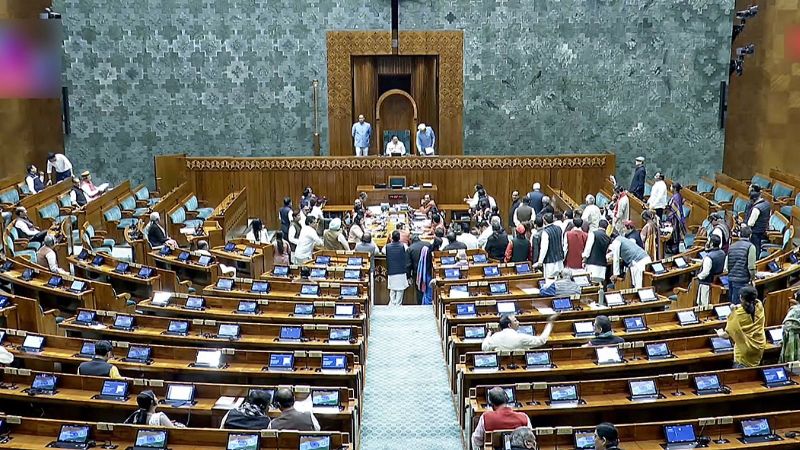
On 7 December 2025, Parliament assembled not to debate inflation, unemployment or any of the usual headaches, but to quarrel over a song. Not just any song, of course, but Bankim Chandra Chattopadhyay’s Vande Mataram, the lyrical mother of all patriotic numbers. This was supposed to be a dignified celebration of its 150th anniversary; instead, it quickly turned into a historical wrestling match in which everyone tried to prove that their version of patriotism was the most protein-rich. What could have been a day of nostalgia became a day of national melodrama, complete with rhetorical fireworks and hurt sentiments.
To understand why this innocuous-sounding ode still has Parliament in a twist, one must travel back to 19th-century Bengal. Bankim Chandra—civil servant by profession and literary crusader by vocation—was searching for a formula to boost the morale of a civilisation that had been trampled, taxed and lectured by the British. In the 1870s, possibly on the auspicious Akshaya Navami of 1875, inspiration struck. He produced Vande Mataram, a poem that began by serenading the natural beauty of India—green fields, cool breezes, golden harvests—before dramatically transforming into a devotional hymn invoking goddess Durga in her warrior mode. This stylistic evolution from ‘National Geographic’ to ‘Mythological Action Thriller’ would later become the root of political squabbles, but back then, it was perfect for stirring patriotic passion.
The song escaped the pages of literature and entered the bloodstream of an awakening nation. Tagore sang it at a Congress session in 1896, bestowing instant cultural legitimacy. The Swadeshi movement of 1905 practically adopted it as its ringtone. Protestors chanted it as if it were an anti-colonial password; the British, whose sense of humour was even drier than their administrative memos, deemed it subversive. Bhikaji Cama carried it on an early version of the Indian flag to Europe, signalling that imperialism had better watch its back. By the time India approached independence, the song had become the unofficial background music of the freedom struggle.
Yet even as it united multitudes, it quietly made some people uncomfortable. Thanks to its appearance in Anandamath—a novel featuring Hindu ascetics battling Muslim rulers—and thanks to the later stanzas’ invocation of Durga, many Muslim leaders found the full poem theologically challenging. A monotheistic community being asked to chant a hymn to a multi-armed goddess is, understandably, a theological hard sell. These murmurs grew louder in the 1930s as communal politics intensified.
By 1937, the Congress found itself in a pickle. Nehru wrote to Subhas Chandra Bose, lamenting how communal forces were exploiting the issue, but also acknowledging legitimate discomfort from Muslim colleagues. After much deliberation—and consultation with Tagore, who seemed incapable of appearing in history except as the conscience of the nation—the Congress decided on a compromise elegant enough to make diplomats weep: keep the poem intact, but sing only the first two, non-theological stanzas at official events. Nothing was deleted. Nothing was censored. It was simply a practical decision to prevent public meetings from spiralling into interfaith debates. This arrangement maintained unity in a painfully diverse anti-colonial movement.
Independent India inherited this balancing act like a fragile family heirloom. Jana Gana Mana became the national anthem, but Vande Mataram received a place of honour as the national song. Again, everyone understood the etiquette: sing the first two stanzas at official functions and feel free to unleash the goddess in cultural, social or personal spaces. It was one of those understated Indian compromises—neither shouted from rooftops nor written in stone, but woven into the fabric of civic life.

Fast forward to 2025. The government organised a special discussion to honour the song’s 150th birthday. But instead of reverence, the House witnessed a historical boxing match. The Prime Minister accused the Congress of having “removed” the goddess-centric stanzas in a desperate bid to please the Muslim League in 1937. According to this narrative, a single tweak in recital practice had supposedly set India on a slippery slope to partition. The treasury benches framed the day as a cultural reclamation project, a chance to restore the song’s full glory and simultaneously scold the opposition for past sins.
The Congress replied with a counter-punch worthy of political kabaddi. Leaders cited the same Nehru letter the PM brandished, pointing out that Nehru had criticised communal distortion even while trying to preserve unity. They emphasised, repeatedly and with escalating indignation, that the Congress did not remove or rewrite any stanza. They politely reminded Parliament that it was the Congress-led Constituent Assembly that gave Vande Mataram its national-song status—a detail that the ruling party sometimes treats as inconvenient historical furniture. Others accused the government of manufacturing cultural controversies to avoid discussing real-world problems like rising prices and shrinking job markets.
Just as the argument seemed to be reaching an operatic crescendo, regional pride made a dramatic entry. When the Prime Minister referred to Bankim Chandra as “Bankim Da,” a Trinamool MP bristled, insisting that “Bankim Babu” was the appropriate term. What might have been dismissed anywhere else as a harmless term of affection quickly escalated into a miniature cultural earthquake. Outside Parliament, the West Bengal Chief Minister accused the PM of disrespecting Bengal’s literary giants. It was a reminder, if any were needed, that in Indian politics, even nicknames can spark ideological thunderstorms.
Stepping back from the heat of the moment, one sees that the real battle was not about the song but about who gets to control its symbolism. No party dislikes Vande Mataram; all claim to love it as deeply as early freedom fighters did. The clash is over narrative real estate: Was the 1937 decision an act of noble inclusivity or a historic blunder? Does singing the full poem today restore cultural pride or shrink the secular space? Can one trace the partition of India to a dispute over poetic stanzas? The founding generation wrestled with these questions thoughtfully; today’s politics often prefers slogan-sized answers.
The historical record suggests that the leaders of the freedom struggle tried to honour both emotional devotion and social diversity. They treated Vande Mataram as a layered symbol—one that could soar in cultural spaces but had to remain accessible in official ones. They understood that patriotism need not be uniform; it can be devotional for some, poetic for others, and completely secular for yet others. That flexibility kept the song alive through the most turbulent chapters of Indian history.
If today’s political class wished, they could revive that wisdom. Those who feel spiritually uplifted by the full poem could continue to celebrate it with fervour. Those who feel theologically constrained could continue to sing the first two stanzas without anxiety. The state would not be an arbiter of devotional correctness but a guardian of shared civic space.
ALSO READ: Sanchar Saathi: Bridging Security and Privacy in India’s Digital Age
But that spirit was conspicuously absent on 7 December 2025. A poem meant to evoke devotion and courage became ammunition in cultural trench warfare. The irony is almost poetic: Vande Mataram, once the anthem of unity, is now a mirror reflecting the country’s divisions. Perhaps the most fitting tribute to Bankim Chandra would be not to argue over his creation but to rediscover the shared pride it once effortlessly inspired.