










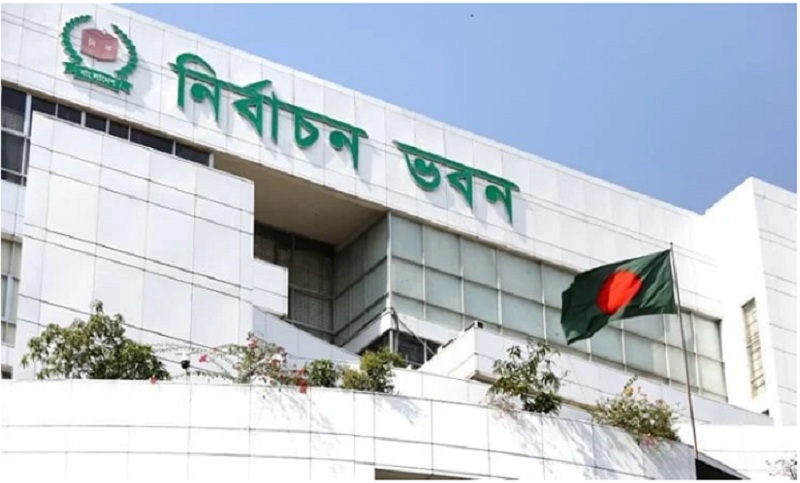
The chiefs of Bangladesh’s army, navy and air force met the country’s Chief Election Commissioner and his colleagues in Dhaka the other day, ostensibly to discuss election-related issues.
It is a good guess as to whether the meeting focused on a restoration of law and order, which has been deteriorating rather rapidly, in the run-up to the election scheduled for February 12.
No details have, however, emerged about the meeting. That leaves citizens a trifle concerned about the nature of the discussions, specifically, if the military chiefs were satisfied with the outcome of the meeting.
Was any emphasis placed by them on the need for an inclusive election at the meeting? One will perhaps never know.
But, yes, an inclusive and therefore fair election is the demand that has been growing both domestically and internationally, even as the Yunus regime and the Election Commission it put in place last year expect the electorate to make their way to the polling booths come February.
That an election which leaves out major political parties, and that is a clear reference to the Awami League, will not produce the degree of political pluralism in February so necessary for the future is the apprehension being voiced with increasing frequency these days.

Three US lawmakers, part of the House Foreign Affairs Committee in Washington, have made it clear that Bangladesh’s election will have little or no credibility if the inclusivity factor is not brought into the process.
Add to that the statement by four British members of Parliament, all of whom have zeroed in on the paramount need for the election to properly reflect the will of the nation.
And that reflection, as the MPs’ statement makes obvious, is for the February vote to be an unfettered choice for Bangladesh’s citizens to express their will freely in an exercise that will not leave any political party out of the process.
Questions therefore remain about the election. Will it be held as scheduled? Or will the ongoing crisis force a change in the political chessboard?
The recent spate of violence involving the murder of a young political activist, followed by a similar assault on another, raises questions of the extent to which the Yunus outfit is equipped to ensure a violence-free election campaign.
Mob rule has prevailed, as evident from the unprecedented attacks on two of the country’s leading newspapers, the Daily Star and Prothom Alo.
The offices of the newspapers were set on fire by frenzied mobs, putting the lives of journalists working within the premises at grave risk.
But should one be surprised? The surprise, of course, comes in the realisation that the management of the two newspapers has generally been sympathetic to Muhammad Yunus over the past decade and more.
And yet the fact that they were subjected to arson is indicative of a bigger malady for the country, which is that the Yunus regime is incapable of putting the leash on the mobs that have, in the last sixteen months, caused havoc all across Bangladesh.
Worse is the feeling that the regime has been losing steam over the past many months, with many of those enthused by its rise to power in August 2024 dwindling perceptibly in number of late.
The attacks on the Daily Star and Prothom Alo, notwithstanding the closeness of the management of the newspapers to Yunus, are but a continuation of the repressive measures that have been exercised both by the mobs and the regime since the fall of the Awami League government.
On the one hand, mobs have forced media establishments in a good number of instances to sack staff and have them replaced by journalists more to their liking.
There have been instances too of mobs sympathetic to the regime of taking over media organisations wholesale.
The mobs have been doing their work. On the other hand, and in its own way, the Yunus regime has gone out on a limb to pounce on any sign of free expression or dissent in the media.
Journalists languish in prison with little indication that they will have any recourse to the law, that they will be granted bail or released altogether.
The regime has developed the habit of seeing any criticism of its actions and policies as an instance of support for the Awami League.
The recent arrest of Anis Alamgir, a veteran journalist, has only added to the public feeling that despite Yunus’ protestations — and he does that during his trips abroad — that the press is free, the reality is quite different.
In court, Anis Alamgir was bold enough to tell the judge that he has always spoken truth to power, that he knows that Yunus might wish to turn the whole country into a prison. Alamgir was placed on a five-day remand.
And then comes the sad tale of the increasing slide in diplomatic relations between Bangladesh and India.
Mobs march toward the various Indian missions in Bangladesh. In retaliation, Indian protestors gather before the Bangladesh missions in India. Visa services are put on hold in Delhi and Dhaka.
The Indian and Bangladesh high commissioners are summoned by the foreign ministries of the host countries.
A Hindu man is killed in Bangladesh and his corpse is then burned by a mob. Diplomatic ties between the two nations are in free fall.
As all this goes on, the acting chairperson of the Bangladesh Nationalist Party (BNP) ends his seventeen-year exile in Britain and flies home to Dhaka.
To what extent he will be able to reinvent his party and play a role in a refashioning of national politics will depend on whether he is able to launch a mature campaign for an inclusive election and raise the banner of Bangladesh’s liberal, pro-liberation forces in order to beat back the communal elements that have been having a field day in the last sixteen months.
ALSO READ: Ahead of polls, BNP acting chief Tarique Rahman returns to Bangladesh after 17 years in exile
The crisis in Bangladesh is not over yet.
It will be the job of a secular, democratic leadership encompassing political parties ready and willing to campaign for, and win, the battle for a restoration of constitutional government that will be a first step toward reviving the idea of Bangladesh as it was forged through the War of Liberation fifty-four years ago.