










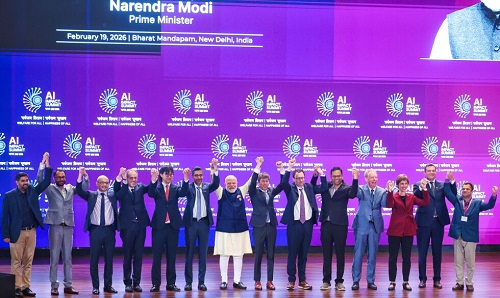
In the heart of New Delhi, from February 16 to 20, 2026, the sprawling Bharat Mandapam Convention Centre transformed into a pulsating epicentre of technological ambition and diplomatic intrigue. The India AI Impact Summit 2026, the first of its kind hosted in the Global South, unfolded over five intense days, drawing over 200,000 attendees to its 70,000-square-meter expo halls. What began as a grand showcase of artificial intelligence’s promise quickly ignited with a scandal that threatened to eclipse the event’s lofty goals—a misstep by Galgotias University (claiming sleek robotic dog named “Orion” as inhouse innovation later found to be of Chinese Unitree Go2 imitation) that exposed the raw tensions between hype and authenticity in India’s tech narrative.
Yet, even as the “Chinese robodog” fiasco dominated headlines, the summit pressed on, its gravitational pull attracting a constellation of global luminaries who elevated it beyond the controversy. Over 110 countries and 30 international organizations converged, with participation from 20 heads of state, 60 ministers, and 40 CEOs of tech behemoths. French President Emmanuel Macron, fresh from bilateral talks, shared the stage with Brazilian President Luiz Inácio Lula da Silva, whose delegation emphasized AI’s role in agritech and energy partnerships.
Finnish Prime Minister Petteri Orpo advocated for ethical frameworks, while Dutch Prime Minister Dick Schoof explored tech collaborations. Leaders from Bhutan, Bolivia, Croatia, Estonia, Greece, Guyana, Kazakhstan, Liechtenstein, Mauritius, Serbia, Slovakia, Spain, Sri Lanka, Seychelles, Switzerland, and the UAE added diverse voices, underscoring the summit’s role as a bridge for the Global South. UN Secretary-General António Guterres lent gravitas, warning of AI’s potential to accelerate sustainable development goals at tenfold speed—or exacerbate divides if mishandled. Swedish Deputy Prime Minister Ebba Busch highlighted the EU-India Free Trade Agreement’s promise to double exports by 2030, framing AI as a cornerstone of value-based relations.
The corporate titans were no less impressive, turning the event into a high-stakes arena of announcements and alliances. OpenAI’s Sam Altman, navigating India’s 100 million ChatGPT users—making it the company’s second-largest market—pledged to “build AI in India, with India, and for India,” emphasizing free access to democratize the technology. Google’s Sundar Pichai unveiled new fibre-optic routes linking India to Singapore, Australia, and the US, alongside an AI hub in Vizag. Microsoft’s Brad Smith discussed “Sovereign Enterprise AI” frameworks, while Anthropic’s Dario Amodei focused on “catch-up growth” for the Global South. NVIDIA’s Jensen Huang, despite a last-minute cancellation, was represented by executives showcasing 38,000 GPUs donated to the IndiaAI Mission, with 20,000 more pledged.
Meta’s Alexandr Wang promoted indigenous models trained on 22 Indian languages, and domestic giants like Reliance’s Mukesh Ambani integrated AI into 5G and retail, while Adani Group’s Jeet Adani committed $100 billion to a green-energy-powered compute ecosystem. Tata’s N. Chandrasekaran announced India’s first AI-based data centre, and startups like Sarvam AI stole the show with a “launch spree”: Sarvam Edge for on-device speech tasks, Bulbul V3 for accents, Sarvam Vision for image analysis, and more, achieving 93% accuracy on Indian dialects in benchmarks.
Also Read: Democratic Giants Realign: The Dawn of the India-EU Strategic Trade Era

Amid this whirlwind of innovation, India’s ethical AI initiative emerged as the summit’s philosophical anchor, a beacon that could reconcile the fractious debates swirling around AI’s unchecked growth. Rooted in the ancient Sanskrit principle of “Sarvajana Hitaya, Sarvajana Sukhaya”—for the welfare and happiness of all—India’s “AI for All” framework, first articulated in NITI Aayog’s 2018 National Strategy and bolstered by the 2024 IndiaAI Mission and 2023 Digital Personal Data Protection Act, positions AI as a public good rather than a profit-driven juggernaut. Prime Minister Narendra Modi, inaugurating the event on February 19, unveiled the MANAV vision: Moral, Accountable, National Sovereignty, Accessible, and Valid AI. This acronym encapsulates a human-centric doctrine that demands ethical assistance without deception, traceable human oversight, data sovereignty to thwart digital colonialism, inclusivity across languages and demographics, and verifiable practices grounded in unbiased data.
What sets India’s approach apart is its potential to bridge ideological chasms among experts. In the West, the US prioritizes innovation and market dominance, often at the expense of regulation, while the EU emphasizes rights-based safeguards like the AI Act. China’s state-led model chases dominance through surveillance and control. India, however, weaves development, democracy, and inclusion into a tapestry that appeals to the Global South, advocating AI as an equalizer rather than a divider. During panels, experts like OpenAI’s Altman, who predicts superintelligence within years, clashed with Anthropic’s Amodei on safety risks—the infamous “paperclip problem” where AI might ravage resources for narrow goals. Yet, India’s framework offers a middle path: “human-in-the-loop” models for critical sectors like healthcare and law enforcement, ensuring transparency and accountability without stifling progress. The summit’s seven “Chakras”—focusing on science, human capital, safe AI, inclusion, democratization, social good, and resilience—produced deliverables like Knowledge Compendiums for health and agriculture, fostering collaborative guardrails.
This ethical pivot resonates globally because it addresses real fears. Inclusivity ensures AI benefits rural farmers via precision tools in local dialects, preventing digital exclusion. Fairness combats biases in gender, caste, and socio-economic lines, aligning with India’s constitutional equality. Transparency allows grievance redressal, while data sovereignty under the DPDP Act protects privacy amid sovereign infrastructure pushes. Sustainability ties AI to climate goals, promoting green computing. As Modi analogized AI to nuclear energy, emphasizing “right decisions at the right time,” India’s model challenges technological colonialism, urging AI to empower ordinary citizens—farmers, students, small businesses—over corporations. At the Global Partnership on AI (GPAI) Council on February 20, the Delhi Declaration and Pax Silica alliance signings formalized this, with India joining US-led efforts for resilient supply chains, securing critical minerals and semiconductor fabs. Experts like Guterres hailed it as a way to close the North-South gap, where AI adoption in developed nations doubles that in emerging markets.
Ultimately, the summit positions India to reap transformative benefits, turning controversy into catalyst. Technologically, pledges exceed $250 billion in infrastructure and $20 billion in deep-tech venture capital, bolstering the IndiaAI Mission’s 38,000+ GPUs and plans for 2-nanometer chips. Ten semiconductor plants including in Jagiroad Assam are underway, promising compounding growth. Economically, AI revenues are projected to surpass $17 billion by 2027, with DPI like UPI and Aadhaar as scalable platforms for inclusive apps. Partnerships flourish: France’s “AI Innovation Year 2026,” Israel’s climate-AI R&D, and Quad collaborations on ethics. Skilling initiatives will train millions, integrating AI into curricula and boosting productivity in agriculture, healthcare, and education. Diplomatically, India emerges as a leader, exporting its “AI for All” ethos to prevent global inequalities, solidifying its role as a bridge between North and South.
The Galgotias incident, while embarrassing, underscores the need for authenticity— a lesson India is learning in real-time. By summit’s end, extended to February 21 for the expo due to overwhelming demand, the narrative had shifted from scandal to sovereignty. India isn’t just participating in the AI revolution; it’s redefining it, ensuring technology serves humanity’s collective welfare. In an era where AI could redefine power more than oil ever did, India’s vision offers hope: a future where innovation harmonizes with ethics, uplifting all in its wake. As the lights dimmed on Bharat Mandapam, one thing was clear—this was no mere conference; it was the dawn of an AI century, scripted in New Delhi.