










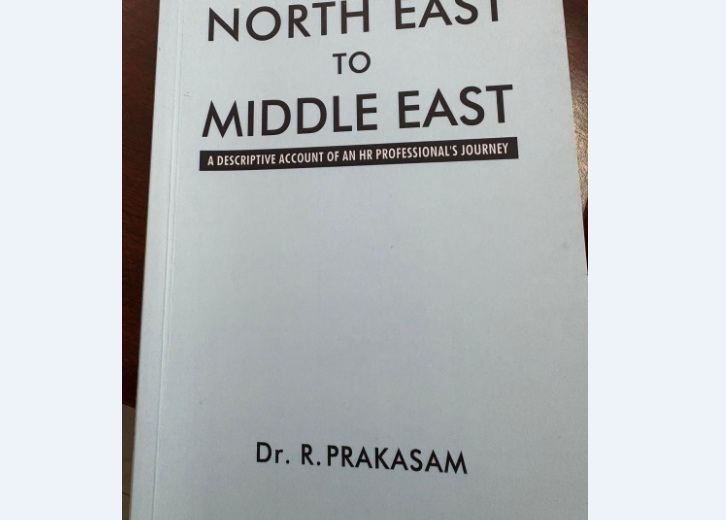
A book launch event for the book “North East to Middle East: A Descriptive Account of an HR Professional’s Journey” took place on February 20, 2026, at the Omeo Kumar Das Institute of Social Change and Development.
Attendees included the institute’s faculty, prominent bankers, and key resource persons from NEIBM. The author, Dr. Rajappa Prakasam, had served as Director of NEIBM back in 1989 amid the turbulent insurgency era.
His inspiring leadership significantly enhanced bank operations and motivated his team. Speeches from those who worked with him at the event eloquently praised his contributions, serving as powerful testimony to his lasting impact.
Dr. Rajappa Prakasam is a distinguished scholar with a PhD in Industrial and Organizational Psychology from the early 1970s in Coimbatore, where he quickly transitioned from academia to practical HR roles, influenced by pioneers like McClelland’s achievement motivation and Lefcourt’s locus of control theories.
Mentored by figures such as Dr. S.P. Adhinarayanan of Annamalai University, he dedicated three decades to bridging behavioural science with banking, serving at the National Institute of Bank Management in Bombay, directing the North Eastern Institute of Bank Management (NEIBM) in Guwahati for nine fulfilling years amid Northeast India’s challenges, and later consulting for 15 years at Saudi Arabia’s Monetary Agency’s Institute of Banking (SAMA-IOB) before retiring in 2013.
His career exemplifies fearless leadership, turning underperforming institutions into powerhouses through trust, transparency, and innovative training—qualities that shine through in his memoir, “From North East to Middle East: A Descriptive Account of An HR Professional’s Journey”.

This captivating narrative unfolds like a professional thriller, chronicling Prakasam’s odyssey from the humid bustle of Mumbai’s banking reforms in the post-1969 nationalization era to the sun-baked boardrooms of Riyadh, where he ignited performance revolutions in oil-rich economies.
Starting with his breakthrough at NIBM, where he dissected why some banks thrived while others floundered, Prakasham pioneered behavioural screening for SME loans—blending psychometric tools, structured exercises, and four-week entrepreneurship bootcamps that skyrocketed recovery rates to 90%, proving that inner drive trumps mere capital every time.
It’s riveting how he spotlights the “self-dimension”—attitudes and motivation—as the unsung hero of economic progress, a lesson drawn from real-world experiments where first-generation entrepreneurs defied odds in India’s priority sector push.
The heart of the book pulses with his transformative stint at NEIBM in Guwahati, Assam, a region plagued by militancy, poor infrastructure, and sceptical sponsor banks viewing it as a backwater posting.
Prakasham arrives to find low morale and a vicious cycle of shoddy training breeding branch failures, which he shatters with audacious moves: experiential recruitment camps over rote interviews, faculty hunts prioritizing grit over credentials, and bold confrontations with RBI governors armed with gritty surveys on Northeast lags.
His “clarity of purpose and fearlessness” mantra yields magic—slashing NPAs by crores through three-day motivation workshops for branch managers (one branch alone recovered 150 lakhs post-training), securing a 33-million-rupee campus via transparent employee involvement, and even reviving Tripura Gramin Bank’s fortunes against union resistance and losses.
These tales, laced with personal anecdotes like midnight Guwahati walks to debunk safety myths, humanize the grind, showing how a demanding yet supportive climate unleashes loyalty and creativity in the unlikeliest terrains.
Venturing eastward, the memoir’s latter chapters transport readers to the Middle East, where Prakasham navigates cultural whirlwinds—from prayer-time disruptions to gender-segregated hierarchies—yet uncovers universal HR truths amid Saudi banking’s evolution.
At SAMA-IOB, his “Target Shooters” program deploys goal-setting and achievement tracking to surge branch volumes by 150-400 points monthly; at Tawuniya Insurance, he architects SMART objectives, competency ladders, and motive-arousal workshops from scratch, echoing successes back home.
Forewords by luminaries like Dr. C. Rangarajan (ex-RBI Governor) and Abdullatif M. Ghaith laud these feats, affirming Prakasham’s alchemy in NPA reductions, rural bank turnarounds, and talent unlocking across borders—timely wisdom for today’s labour-intensive banking amid automation.
What elevates this beyond a career recap is Prakasham’s storyteller’s flair: crisp case studies, data-backed triumphs (like 21% NPA drops outpacing regional averages), and philosophical nuggets on self-fulfilling prophecies, where expectations sculpt realities.
ALSO READ: Ink, Bark and Identity: Assam’s battle against cultural amnesia
In an era of AI-driven HR, his insistence on experiential learning and human potential resonates profoundly, especially for Northeast watchers grappling with persistent development hurdles.
Retiring to reflect, Prakasham doesn’t preach; he inspires with proof that one visionary, wielding psychology like a scalpel, can redraw institutional maps from Guwahati to the Gulf—making this essential reading for HR pros, bankers, and anyone chasing meaningful impact.