









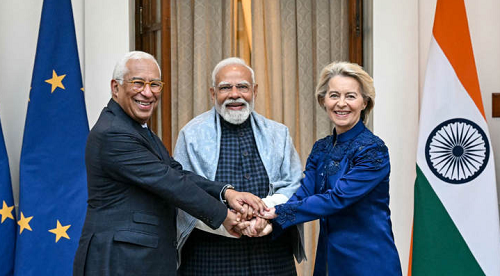
The winter sun at New Delhi’s Kartavya Path on January 26, 2026, illuminated more than just the vibrant tableaux and military precision of India’s 77th Republic Day. It cast a spotlight on a profound geopolitical shift as European Commission President Ursula von der Leyen and European Council President António Costa took their places as Chief Guests. This ceremonial prelude, featuring an integrated European Union contingent marching for the first time in the parade, was no mere diplomatic nicety. It was the symbolic launchpad for the formal operationalization of the India-European Union Free Trade Agreement (FTA) the following day. Concluded after nearly two decades of arduous negotiations, this watershed deal creates an economic titan encompassing approximately 25% of global GDP and one-third of international trade, effectively uniting an economic zone of two billion people.
The significance of this accord extends far beyond the dry arithmetic of tariff reductions. It represents a fundamental realignment of the post-multilateral trading system. In an era increasingly defined by the bipolar tension of US-China strategic competition and the escalating protectionism of “weaponized tariffs,” the India-EU pact emerges as a vital alternative. For both partners, the agreement serves as strategic insurance—a hedge against unilateral tariffs and the vulnerabilities of concentrated supply chains. By anchoring their bilateral trade through firm tariff commitments and deep investment partnerships, India and Europe are diversifying their economic geography and resisting the drift toward a fractured global order.
The economic specifics of the deal are transformative. The agreement is expected to eliminate or substantially reduce duties on 96.6% of EU goods exports, saving European businesses approximately €4 billion annually. For India, the framework is even more generous, with 90% of Indian goods entering the EU tariff-free on day one. This asymmetry reflects a strategic calculation by the EU to induce Indian political commitment while gaining access to a vast domestic market. High-profile sectors such as automobiles will see Indian tariffs slashed from 35% to 10% over five years, while duties on European wines will drop from 150% to as low as 20%.
Also Read: The February Bargain: India’s calculated gamble on America
Indian exporters, particularly in labour-intensive sectors, stand to gain immensely. In the textile and apparel sector, where India faces a USD 263.5 billion market opportunity in the EU, the elimination of tariffs creates a multiplicative expansion opportunity. Manufacturing hubs like Tiruppur, Surat, and Ludhiana are positioned to capture orders that could exceed USD 100 billion over the medium term. Similarly, the removal of 17% tariffs on leather products and 12% on marine products places Indian manufacturers at competitive parity with global rivals. This trade surge is backed by a massive wave of corporate confidence; 95% of EU companies surveyed plan to expand operations in India, with many intending to add over 1,000 jobs each.
Beyond goods, the FTA leans heavily into the “natural complementarity” of the two economies. It brings together Indian skills and scale with European technology and capital. A major pillar of the agreement is the framework for professional mobility and the Trade and Technology Council, which provides an institutional platform for cooperation in semiconductors, critical minerals, and green energy without the restrictive conditions often accompanying other defence partnerships. This is matched by a robust Security and Defence Partnership—the first of its kind between India and the EU—focused on maritime security, cybersecurity, and space technologies.

At its core, the FTA is a strategic architecture for democratic multipolarity. For India, it is a masterstroke in its pursuit of strategic autonomy. Historically, India has faced a “Strategic Autonomy Paradox,” dealing with defence dependency on Russia, a massive trade deficit with China, and inconsistent technology access from the US. The EU partnership addresses these contradictions by diversifying trade access and providing a technology partnership grounded in shared democratic values rather than formal alliance subordination. For the European Union, it offers a first-mover advantage in one of the world’s fastest-growing economies while explicitly positioning India as a primary strategic anchor in the Indo-Pacific to ensure freedom of navigation.
The timing of this deal is a direct response to the “Protectionist Crucible” of the mid-2020s. Following aggressive US tariff escalations in 2025—which saw duties on Indian goods like textiles and jewellery reach a staggering 50%—both New Delhi and Brussels recognized that allowing US-led trade barriers to harden without securing alternative access would be catastrophic. The FTA therefore functions as a necessary “de-risking” architecture, incentivizing EU companies to source from India rather than remaining overly dependent on Chinese manufacturing.
However, the path forward is not without friction. Navigating agricultural politics remains a challenge, as the EU’s demands for lower Indian duties clash with the need to protect India’s 86% small-holder farming population from highly subsidized European producers. Additionally, India views the EU’s Carbon Border Adjustment Mechanism (CBAM) as a form of “green protectionism” that imposes heavy compliance burdens on developing industries. Despite these tensions, the institutional innovations of the agreement provide a flexible framework to resolve disputes through cooperation rather than confrontation.
As the implementation sequence begins—with ratification expected by late 2026—the India-EU FTA stands as a blueprint for shared prosperity in an insecure world. It codifies an emerging “third pole” in global governance, anchored in democratic institutions and rules-based multilateralism. It is a bold statement that collaboration remains the most effective answer to the dual threats of authoritarian state capitalism and protectionist nationalism. Whether this architecture can fully scale to constitute a stable alternative to the current global system remains the defining question of the century. However, as the flags of India and the European Union flew together over New Delhi, the answer seemed clearer than ever: the two giants have chosen each other to shape the 21st-century order.