










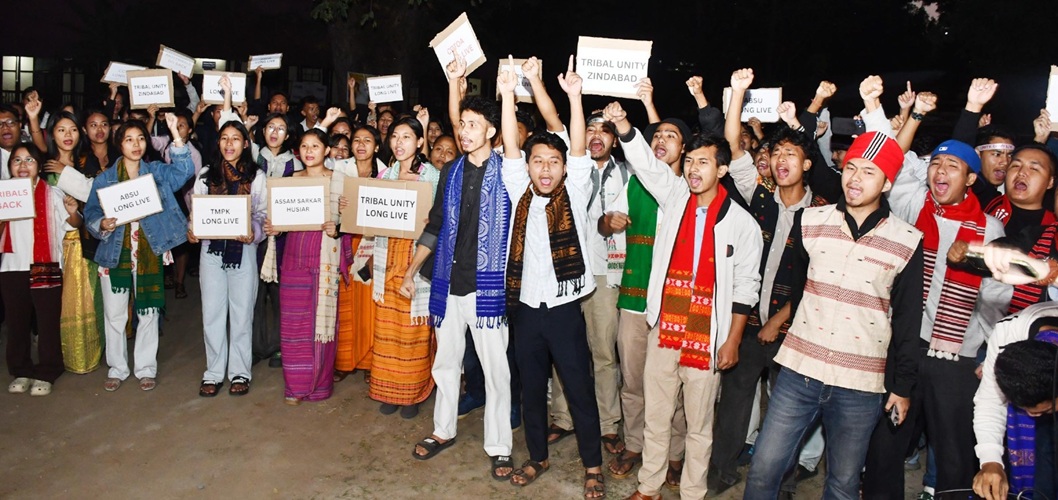
Guwahati: One single report has turned Assam into an emotional volcano. In the tea gardens of Dibrugarh, Adivasi women in colourful sarees danced with tears streaming down their cheeks. Two hundred kilometres away in Guwahati’s Cotton College, tribal students from the hills set fire to the very same document while shouting themselves hoarse. And in Chirang, Koch Rajbongshi leaders tore up their ruling-party flags in fury.
All because of 38 pages tabled in the Assembly on November 29 — the Group of Ministers (GoM)’s proposal to create a new “ST (Valley)” category for six communities, while promising that existing hill and plains tribes will lose nothing.
“Seventy years ago, we broke our backs in the tea gardens. Congress never cared. Today Himanta da has given us justice,” said Dulen Nayak, BJP’s tea-tribe face, his voice breaking as hundreds cheered in a labour line near Doomdooma.
“The British called us ST in 1935. Independent India forgot us in 1950. This report wipes away seven decades of tears,” he said.
Nayak warned three opposition leaders — Akhil Gogoi, Lurinjyoti Gogoi and Gaurav Gogoi — never to step into tea areas again, accusing them of trying to snatch the community’s dream.
But in the hills and flood plains, the mood is betrayal.

At Cotton State University on November 30, hundreds of students from the Karbi, Bodo, Mising, Dimasa, Rabha, and Tiwa unions burned copies of the report.
“This is vote-bank politics dressed as justice,” shouted Sengkan Hanse, president of Greater Guwahati Karbi Students’ Union, eyes red with anger. “If this report is forced on us, we will revive our demand for a separate state under Article 244(A).”
In another corner of the city, the Coordination Committee of Tribal Organisations of Assam (CCTOA) turned a solemn tribute to tribal icon Bhimbar Deori into a war cry.
“On December 25, we will burn this report in every district. Then we block railways and national highways,” declared CCTOA coordinator Aditya Khakhlary. “This is our last warning.”
The Rabha community is especially wounded. The report categorises the Koch-Rajbongshis of undivided Goalpara as ST (Plains) — a direct blow to the Rabha Hasong Autonomous Council.
“We begged the Chief Minister and Minister Ranoj Pegu: give ST to anyone, but don’t touch our rights,” said ARSU president Motilal Rabha, voice shaking.
“In 1996, Koch-Rajbongshis got ST for six months by ordinance and took everything meant for us. We still carry that scar. History is repeating.”
In the Bodoland Territorial Region (BTR), the crisis turned political. On the day of tabling the GoM report, supporters of ABSU vandalised the Assembly Hall of the Bodoland Territorial Council (BTC).
Dozens of Koch Rajbongshi leaders of the ruling UPPL resigned en masse at a tense meeting in Sidli, Chirang.
“We waited for our own party to speak for us. It stayed silent,” said central committee member Kusumbar Choudhury, fighting tears as he handed over his resignation.
Hardline groups like Kamatapur Liberation Organisation-KN branded UPPL “anti-Koch Rajbongshi” and accused its Bodo partners of violence.
Congress MP Gaurav Gogoi fired the sharpest salvo yet: “Himanta Biswa Sarma is neither with the tribes nor with the six communities — he is only adding fuel to a new conflict. This is classic British ‘Divide and Rule’. Assam is fed up. The people want a new politics, a new Assam of new dreams.”
ALSO READ: When the Indian Ocean Calls: A New Security Architecture for a Turbulent World
The BJP, meanwhile, celebrated the report as a “landmark” and said it will be sent to Delhi immediately.
Tai Ahom students’ leader Bhaaskar Jyoti Borgohain thanked the chief minister and urged Parliament to pass the bill in the winter session itself.
“We are ready even for ST-Valley. Just give us political safeguards and protect our land,” he said.
As night fell over Assam on Sunday, the state stood dangerously divided: tea workers dreaming of a better tomorrow, hill tribes fearing they are losing theirs, and politicians on all sides sharpening knives for the battles ahead.
One report. Six communities are hopeful. A dozen others were terrified. And an entire state holding its breath.