










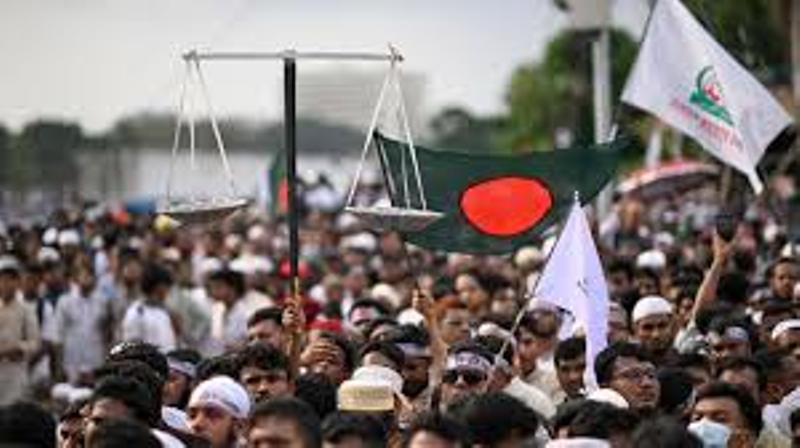
In recent months, a series of claims have circulated that Western powers, and particularly the United States, are “funding” or otherwise backing Jamaat-e-Islami in Bangladesh to help the party win the February 12 national elections.
The claim gained authenticity after the Washington Post exposed the audio tape of a conversation between an unidentified US diplomat and a few journalists, talking about the support to the Jamaat-e-Islami to win the election in Bangladesh.
However, the U.S. Embassy in Dhaka reiterated that the United States does not favour any particular political party and intends to work with whoever the Bangladeshi electorate chooses.
It is true that apart from the audio tape, there is no credible or leaked proof showing that the United States or Western governments are directly providing money, election campaign funding, or covert financial support to the Jamaat-e-Islami.
However, in the narrow and congested lane in Moghbazar area of Dhaka, the state of affairs at the three-storeyed building, which is the headquarters of the Jamaat-e-Islami, is totally turning majestic.
The new look definitely has a different story to tell. The building has been freshly painted yellow; the Jamaat-e-Islami headquarters now has a new set of extravagant furniture, woodwork, and even a high-class elevator.

According to the locals, the setting at the Jamaat-e-Islami headquarters at Moghbazar is turning urbane at a very fast pace.
The present scenario is a sharp contrast from the dilapidated condition of the headquarters just about a year-and-a-half ago, when the ban on the party had just been lifted.
Now, the Jamaat-e-Islami headquarters is the address frequently visited by diplomats, foreign journalists, and it is buzzing with visitors and party workers.
After the unceremonious exit of Sheikh Hasina from Dhaka on August 5, 2024, people now want to be associated with the Jamaat-e-Islami. It has emerged as the biggest rival to the Bangladesh Nationalist Party (BNP) led by Tarique Rahman.
It is apparent that the Jamaat-e-Islami is tipped to become a major political force in Bangladesh’s political landscape after the February 12 elections.
It now leads an 11-party coalition contesting the polls following the interim government lifting its ban and restoring its registration.
While the Jamaat’s top score was 18 seats in 1991, it was part of the ruling coalition with the BNP in 2001-2006, under then Prime Minister Khaleda Zia, with just 17 seats in Parliament.
The Jamaat is optimistic to increase its tally to 80-90 seats of the total 300 seats in Bangladesh Parliament. Some Jamaat leaders have even started claiming that they may win the elections by a narrow margin.
While a section of political analysts are still of the opinion that the BNP will ultimately emerge as the winner in the February 12 election, the Jamaat’s worst-case scenario is to play the key role of the main opposition party in Bangladesh’s Parliament.
Definitely this is a big comeback for a party which was banned in Bangladesh during the 17 years of Awami League rule. Even some of its top leaders were sentenced to death for their role in the 1971 war crimes.
The resurgence has sparked intense debate and concern — both inside Bangladesh and in the global arena — about where its support, alliances, and backing come from.
It is apparent from the Jamaat’s transformation from a scrawny Islamist party to a patrician political force that some organised forces are supporting it with money to put up a tough fight against the BNP.
There are reports that Gulf-linked charities like the Revival of Islamic Heritage Society (RIHS), which is based in Kuwait, provided significant funding to build mosques and madrassa in Bangladesh.
And some of the RIHS funds later helped to sustain terrorist networks in Bangladesh, and a portion of which, was used to push Jamaat-e-Islami’s electoral battle.
There are also reports that Turkish state or quasi-government networks provided financial support to Jamaat-e-Islami for activities such as office renovations and organizational strengthening.
ALSO READ: Bangladesh polls: Jamaat-e-Islami releases manifesto, promises women’s inclusion in cabinet
In democratic politics, funding sources are often a mix of public transparency, opaque domestic networks, and informal or grassroots contributions.
Whosoever is funding Islamists forces, and especially the Jamaat-e-Islami to win elections in Bangladesh, will come to light later.
It definitely suggests a “hidden hand operating behind the scenes” in Bangladesh.