









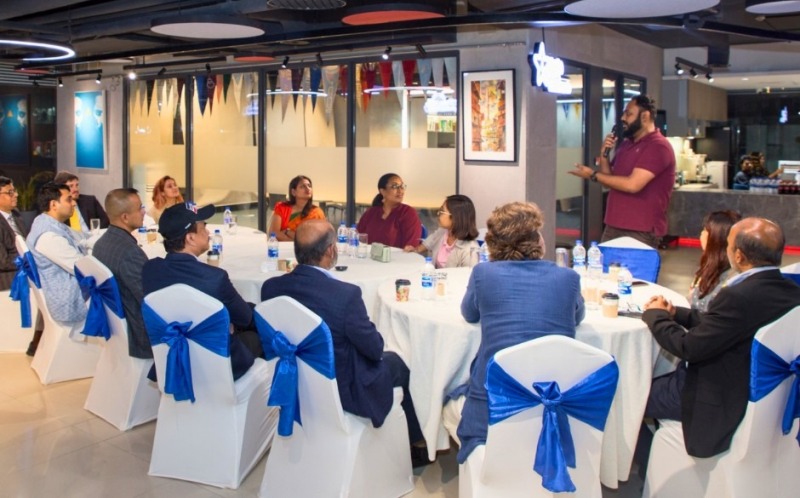
In the forenoon of December 22, a tea party was organised at the American Club in Dhaka’s Baridhara on the occasion of a long-overdue Thanksgiving potluck. The gathering of some US diplomats and a few select Bangladeshis, under the forum of the American Exchange Alumni, primarily discussed the December 19 mob fury that set the offices of two mainstream newspapers – Prothom Alo and The Daily Star – and a cultural organisation (Chhayannot) on fire.
A few Bangladeshi journalists raised the issue of the devastating fire that they felt was engineered by fundamentalist Islamist organisations, including the Jamaat-e-Islami, which the US embassy has traditionally viewed as far less militant than other outfits.
While the US embassy put out a Facebook post that said the US exchange alumni and partners reconnected “over a meal that celebrated American values of sharing and community” and the “menu that highlighted the bounty of American agriculture”, the discussion was intense.
Informed sources said that the US diplomats “went out of their way to explain” that they had progressively disengaged with the ongoing political developments in Bangladesh.
While the US embassy diplomats were in the thick of things before and after the violent July-August 2024 students’ movement that led to the fall of the Sheikh Hasina government, their seeming disengagement from the political process appears to be taking place at a time when a new ambassador – Brent Christensen – is scheduled to assume charge in January 2026.
This is evident from a December 23 tweet on X by the State Department’s Bureau of Central and South Asian Affairs, which said that “Today, Special Envoy for SCA Ambassador Sergio Gor held a productive call with Chief Advisor Yunus @ChiefAdviserGoB to discuss recent events in Bangladesh and shared US interests to advance prosperity through trade.”

On December 21, moments after Bangladesh interim regime Chief Adviser Mohammad Yunus held a closed-door meeting with Foreign Adviser Touhid Hussein and National Security Adviser Khalilur Rahman, Hussein briefed journalists, using unusually strong language to blame New Delhi for the disturbances near Bangladeshi missions in India.
Dhaka-based analysts said that the Bangladesh Foreign Ministry appears to have adopted a course that could lead to a collision with the Ministry of External Affairs, and there is a fear that the Yunus-led regime may even take the first step to downgrade diplomatic relations.
This came into sharp relief as Indian High Commissioner Pranay Verma was summoned a second time in ten days to the Bangladesh Foreign Ministry on December 23. The meeting between Verma and Bangladesh Foreign Secretary Asad Alam Siam was scheduled for 9 am today, but the Indian envoy was made to wait for at least 30 minutes before he was called in.
The Russian envoy to Dhaka, Alexander Grigoryevich Khozin, appealed for de-escalation of tensions between India and Bangladesh, saying that “the sooner you reduce the tension…the better. Because…historically, since 1971, when Bangladesh gained independence, [it was] mostly because of Indian help. And Russia also supported this in this regard. And shoulder to shoulder, India, Bangladesh, and Russia, we work together”.
However, even today, demonstrations were staged in front of the Bangladesh High Commission in Delhi, which can potentially inflame sentiments in Dhaka, especially at a time when anti-India sentiments have reached unprecedented heights among Islamist parties and students’ bodies which have openly called for a confrontationist approach.
Dhaka-New Delhi ties hit a new low on December 19 when mobs attacked Indian missions in Chittagong and Khulna following a radical political activist’s death after he was shot in his head by assailants on December 12. This was followed by New Delhi suspending visa issuance at the Chittagong mission. Bangladesh reacted by shutting down visa operations at its missions in Delhi, Kolkata, Agartala and Siliguri.
That Bangladesh was spoiling for turning the situation murkier than it already is was evident in the Foreign Ministry’s December 21 press release in which it dismissed the lynching of a Hindu man in Myemensing district’s Bhaluka town as an “isolated case”.
ALSO READ: Russian envoy to Bangladesh urges Dhaka to ease tensions with New Delhi
The Foreign Ministry said that it rejected the attempt of the Indian authorities to depict an isolated attack on a Bangladeshi citizen, who happens to belong to the Hindu community, as attacks on minorities.”