










By Enayet Kabir
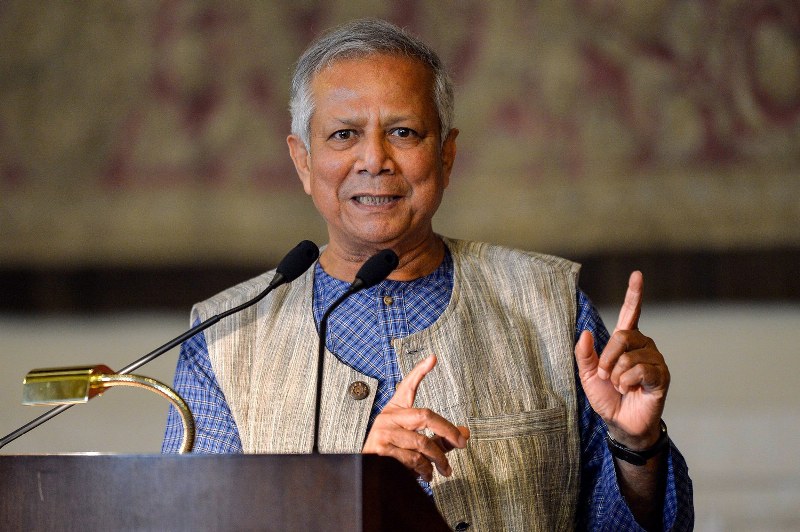
If you were to write a saga titled ‘The 101 Achievements of Muhammad Yunus’, which feat would you credit first? Known primarily as an economist, Bangladesh’s “all-powerful” Yunus and his Advisory Council have added another feather to their list of failures.
It was already proven that their bargaining and negotiation capacities are very weak; it is now clear that they are merely completing the full “cycle of failure.” Their latest “achievement” was signing a deal to buy 25 Boeing aircraft, trapping the country in a debt of BDT 48,000 crore, all to reduce reciprocal tariffs by a mere 1 percent. Now, the interim regime advisers will beat their chests in triumph, claiming the rate is “only 1 percent higher” than India’s.
The United States reduced the reciprocal tax on Bangladesh by only 1 percent—from 20 percent to 19 percent. When added to the existing 15 percent, the total tax stands at 34 percent. To achieve the 1 percent reduction, the “razakar-military-NGO” government signed a Non-Disclosure Agreement (NDA), effectively trading away the power to make decisions regarding the country’s “economic interests.” They signed a deal to purchase 25 Boeing aircraft—14 in the first phase for BDT 35,000 crore and 11 more in the next phase for BDT 28,000 crore—totalling BDT 53,000 crore.
Additionally, a deal was signed to buy 3.5 million tonnes of wheat from the US over the next five years at one-and-a-half times the market price. A decision was also taken to purchase LNG worth nearly BDT 1 lakh crore over the next 15 years from Excelerate Energy at prices higher than the market rate. Furthermore, labour laws were amended to make it easier to form trade unions in factories, even allowing union activities within EPZs (export processing zones).
Why did the interim government, led by Muhammad Yunus, feel the need to sign a trade deal with the US toward the end of their “term”? The agreement was signed in Washington, D.C., on February 9 night. Previously, the Yunus government signed several agreements with a range of countries on issues, including defence. In many cases, the terms were neither made public nor did the government consult other stakeholders. Consequently, suspicion brewed in various circles.

“This is an interim government whose primary responsibility was justice, reform, and elections. But moving beyond that, they are signing one agreement after another with foreign states. No government other than an elected one has the authority to take decisions on such matters of national importance,” economist Anu Muhammad, who backed the July-August regime change, told BBC Bangla.
There are fears that while these significant state agreements are being signed by the interim government, future political governments will have to bear the burden. Mustafizur Rahman, Distinguished Fellow at the Centre for Policy Dialogue (CPD), also a supporter of the regime change, told BBC Bangla that decisions should have been made through discussions with political and business stakeholders, and the public should have been informed of the primary conditions.
On February 9, visiting Indian and Bangladeshi officials were seen in a convivial mood, having lunch with US bureaucrats in Washington, D.C. US oil and gas companies have been active in extracting resources in Bangladesh on a PSC (production sharing contract) basis since 1996.
In 2000, the Sheikh Hasina-led Awami League government rejected a US proposal to export gas from Bhola’s Shahbazpur to India via pipeline, citing “50 years of energy security.” Even US President Bill Clinton failed in his lobbying efforts for the US IOC, Unocal. It is alleged that for this reason, India and the US played a role in the 2001 general election to ensure the Awami League’s defeat.
The US wants to extract gas from Bangladesh and export it to the Indian market so that India can move away from its Iran-dependency for gas or LNG. US IOCs Chevron and Excelerate Energy have long been active in Bangladesh, seeking contracts for offshore oil and gas exploration.
Abdul Awal Mintoo—once a businessman close to the Awami League and now an influential BNP leader—is a partner for these two companies in Bangladesh. In 1996-97, he became a partner in the Bibiyana gas field with the US company Occidental (now acquired by Chevron) upon the recommendation of Prime Minister Sheikh Hasina.
In the last decade, China’s Himalaya Energy (a subsidiary of the state-owned defence equipment manufacturer Norinco) signed a deal to buy the Bibiyana field from Chevron. However, after Indian objections, the field—located near the Bangladesh-India border in Sylhet—could not be transferred to the Chinese company.
Bangladesh received duty-free benefits in the textile sector on the condition of importing cotton from the US at high prices. But in reality, over 200 garments and textile factories have shut down in the last 18 months, and 200,000 workers have lost their jobs. As a consequence of “mob rule,” buyers started moving their establishments to India. Many orders, especially for value-added garments, moved to India and Cambodia. By ratcheting up anti-India propaganda, the US-backed interim regime has actually benefited India.
The US signed an NDA with the Yunus government to take control of Bangladesh’s marine resources, agricultural products and its massive consumer market for medicines. In 1974, US Secretary of State Henry Kissinger called Bangladesh a “bottomless basket.” Until the mid-1990s, Bangladeshi finance ministers had to rush to the Paris Consortium to beg for “loans” from “donors” before the national budget.
Today, Bangladesh is an $800 billion economy. Until two years ago, Bangladesh negotiated its own loan terms. By earning a reputation for debt repayment, it attracted infrastructure investment from Japan and China. Utilising the demographic dividend, it remained self-reliant with a GDP growth of over 6 percent for a decade-and-a-half. It even lent money to Sri Lanka during its economic crisis.
With 74 percent of its population being of working age, Bangladesh was on track to achieve the status of a developed middle-income country this year. Bangladesh’s “social economy” is much stronger than the state economy due to its vast internal consumer market.
ALSO READ: Bangladesh’s exclusionary election and its tryst with democratic renewal
A former Malaysian prime minister lamented, “Bangladesh was rising under Sheikh Hasina, but it was stopped.” This is because, in the last two fiscal years, the Yunus government’s “achievement” has been to bring GDP growth down to 3 percent. Bangladesh’s “so-called” intellectuals are silent about Yunus’ feat — as they are prepared to do America’s bidding.
(The writer is a political and economic analyst)