









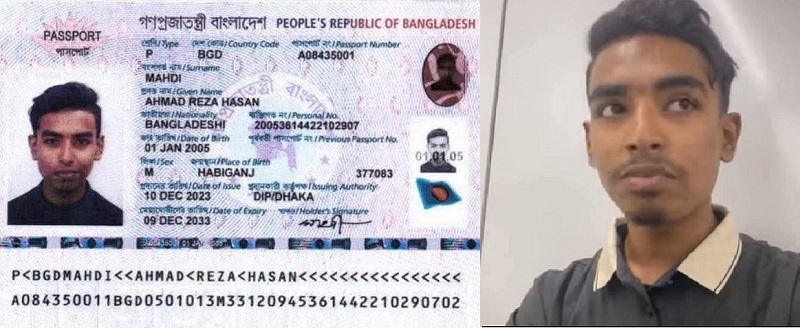
A self-confessed police killer in Bangladesh was recently granted a double-entry visa by the Indian High Commission in Dhaka, bringing into serious question the conditions under which the visa was issued and by which officer at the Gulshan-located mission.
Twenty-one-year-old Ahmed Reza Hasan Mahdi of Habiganj district in Bangladesh shot into infamy when he was seen in a video clip taken inside a police station in his home district, admitting that he and other Anti-Discrimination Students’ Movement activists had lynched and burnt to death Sub-Inspector Santosh Chowdhury Shubho on August 5, 2024.
Mahdi was detained by the Bangladesh Police but later released following pressure from the National Citizens Party, which was formed by student movement leaders, of whom many contested the February 12 elections in which six emerged victorious in alliance with the Jamaat-e-Islami.
On February 17, social media exploded with Mahdi’s video that featured him at the offices of VFS Global, the organisation that issues visas to applicants for multiple destinations, including European Union countries. The video showed a young woman sitting next to Mahdi. This woman, whose identity was not immediately known, is said to have entered into a “contract marriage” with Mahdi, a ploy that would have facilitated easy exit from India and entry into his preferred destination – Portugal.
Multiple social media posts showed that Mahdi, whose date of arrival in Delhi is not known, checked into a hotel in Paharganj, near the New Delhi Railway Station and Connaught Place. He had made an initial appearance at the VFS Global offices and was scheduled for a second visit today (February 18), presumably to pick up his passport (No. A08435001).
Mahdi’s passport details accessed by Northeast News show that he was born at Habiganj on January 1, 2005. It was issued on December 10, 2023, and is valid till December 9, 2033.

It is said that he applied for an Indian double-entry visa, which is a category issued only from the Dhaka-based Indian High Commission and not from the other four Assistant High Commissions – Chittagong, Rajshahi, Khulna and Sylhet.
It is not yet known which particular officer at the Indian mission in Dhaka issued the visa to Mahdi. What is also not clear is whether visa brokers in Dhaka facilitated the issuance of the visa for financial considerations.
What is more alarming is that his name as a “police officer killer” is common knowledge in Bangladesh and should have been known to Indian High Commission officers and staff, indicating that Mahdi’s visa application was either not scrutinised as deeply as it should have been or there was willful dereliction.
Mahdi’s name should have been blacklisted by the Indian High Commission and the other Assistant High Commissions in the four Bangladesh cities.
Inquiries in Bangladesh revealed that Mahdi crossed into India at a point in Feni district. He then travelled to New Delhi, where he checked into a hotel in Paharganj. His aim was to get the visa for Portugal, return to Bangladesh and then fly out at a later date to Lisbon.
After the video and the visa photograph went viral on social media on February 17, Mahdi tried to evade Delhi Police sleuths and sought to hide in the congested lanes and bylanes around Jama Masjid.
He is said to have reached Delhi airport to board a flight back to Bangladesh on February 18. He successfully checked in but was detected by a Bureau of Immigration officer. This followed some intense interrogation before he was allowed to board the flight back to Bangladesh. Mahdi took a 1:40 pm flight from Delhi to Dhaka, where he landed two hours later.
ALSO READ: Will feud between Bangladesh Army chief Gen Zaman and new ‘Foreign Minister’ Khalilur intensify?
A separate video of the woman with whom Mahdi had supposedly entered into a “contract marriage” showed her admitting – in the backdrop could heard voices in Hindi – to this liaison which took place some “five to fix months ago”.