










The pupils of a Bangladesh political party activist and a so-called July warrior who was shot in the rear of his head by one of two bike-borne assailants on December 12 remained “non-reactive” to light 48 hours after he was admitted at Evercare Hospital in Dhaka the same day, Northeast News has reliably learnt.
Bangladesh Health Ministry officials, who kept a close watch on Inquilab Mancha Convenor Sharif Osman Hadi’s health conditions and other vital parameters after suffering serious brain damage as a consequence of the bullet’s entry at the rear of skull near the right ear, said that the non-reactive pupils means that his chances of survival were slim.
The bullet, fired from close range, penetrated Hadi’s skull after “burning” his right earlobe. It then exited from a region close to the left ear, causing blood loss.
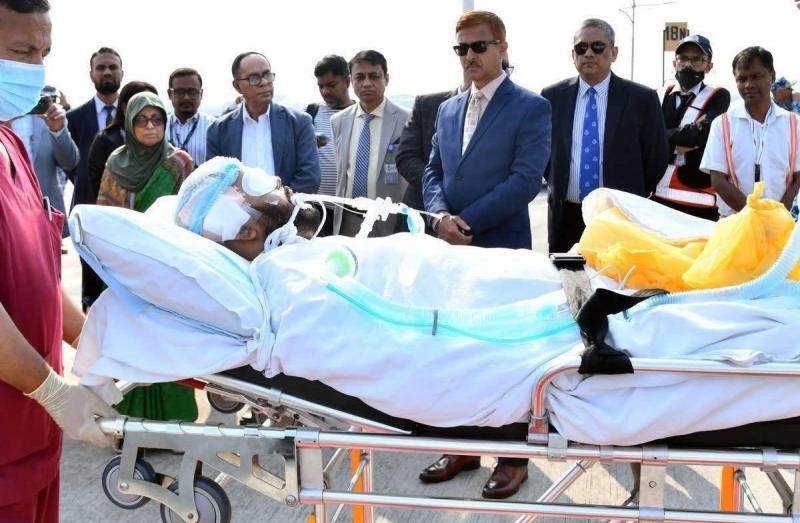
Hadi was moved to an air ambulance which left Dhaka’s Hazrat Shah Jalal International Airport on December 15 afternoon for Singapore. Senior Civil Aviation Authority of Bangladesh (CAAB) officials and Health Ministry officials were seen alongside the stretcher carrying Hadi, whose entire head was wrapped in bandages.
Non-reactive pupils (pupils not constricting to light) signal serious issues such as neurological emergencies (stroke, aneurysm, brain injury, tumour), nerve damage (third cranial nerve palsy), or severe eye trauma/inflammation, but can also stem from anticholinergic/cycloplegic drugs (like atropine) or opioids/neuromuscular blockers, requiring urgent medical evaluation for conditions from head trauma to drug effects.
A team of doctors and surgeons at Evercare Hospital performed a surgery on Hadi’s skull on December 12. The flat occipital bone, which covers the back and base of the skull, protecting the brain’s occipital lobe and providing muscle attachment points, was cut to see the extent of the damage caused by the bullet.

Earlier, surgeons who performed the surgery had said that Hadi’s condition was grim as a small portion of his brain had spilled out when the bullet first hit the occipital bone close to the right ear. It then hit the brainstem, causing extensive damage, before exiting from the left portion of the occipital bone near the left ear.
The following are some of the effects of bullet injuries to the brainstem:
- Brain injury/trauma: Diffuse brain injury or specific damage from trauma.
- Intracranial haemorrhage/mass: Bleeding or tumours affecting the brainstem or optic pathways.
- Third cranial nerve palsy: Damage to the nerve controlling eye movement and pupil constriction, often from aneurysms.
- Midbrain lesions: Damage to the area controlling pupillary reflexes.
- Stroke: Particularly affecting the brainstem.
While Health Ministry sources were unwilling to identify themselves, they said that a bullet injury to the head can cause pupils to become non-reactive primarily through increased intracranial pressure (ICP), leading to brainstem ischemia or direct damage to the oculomotor nerve (cranial nerve III).
A gunshot wound often causes extensive damage, including bleeding, brain swelling (oedema), and bone or bullet fragments entering the brain tissue. The skull is a fixed space, so this accumulation of blood and swelling significantly increases the pressure inside the cranium. As pressure rises, it can push brain tissue downwards, a process called herniation
ALSO READ: Bangladesh: BGB, DMP intensify search; no trace of Dec 12 Dhaka shootout suspects
The oculomotor nerve or the third cranial nerve, which controls the muscles responsible for pupillary constriction, runs along the edge of the brainstem. As the brain shifts due to increased ICP, this nerve can be mechanically compressed. This compression disrupts the nerve’s ability to transmit signals, resulting in a dilated (enlarged) pupil that cannot constrict when exposed to light (non-reactive).