








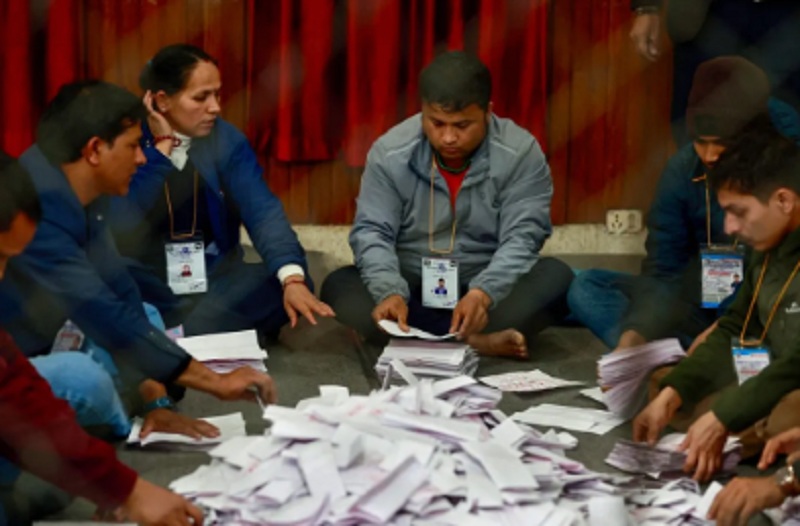
The Rastriya Swatantra Party (RSP) has emerged as the dominant force in Nepal’s parliamentary elections, winning 125 out of 165 seats contested under the direct voting system, according to results announced after the completion of vote counting on Tuesday.
The counting of ballots under the First-Past-the-Post (FPTP) system has concluded, placing the RSP in a strong position to form the next government.
However, the Election Commission of Nepal said that the counting of votes under the Proportional Representation (PR) system is still ongoing and is expected to be completed later on Tuesday.
As per the final FPTP results, the Nepali Congress secured 18 seats, while the Communist Party of Nepal (Unified Marxist–Leninist) won nine seats. The Nepal Communist Party obtained eight seats, followed by the Shram Sanskriti Party with three seats and the Rastriya Prajatantra Party with one seat. One independent candidate also won a constituency.
According to the Election Commission, preliminary figures from the proportional representation vote count show the RSP leading with 49,74,957 votes.
The Nepali Congress has so far received 16,85,722 votes, followed by the CPN-UML with 14,02,157 votes, the Nepal Communist Party with 7,63,633 votes, the Shram Sanskriti Party with 3,50,809 votes, and the Rastriya Prajatantra Party with 3,23,744 votes.

If the current trend continues, the RSP is projected to secure at least 50 seats through the proportional representation system.
ALSO READ: 14 women win Nepal parliamentary seats; Rastriya Swatantra Party bags 13
This would increase the party’s overall strength to around 175 seats in the 275-member House of Representatives, comfortably crossing the majority mark. This would allow the party to form a majority government under Article 76(1) of the Constitution of Nepal.