








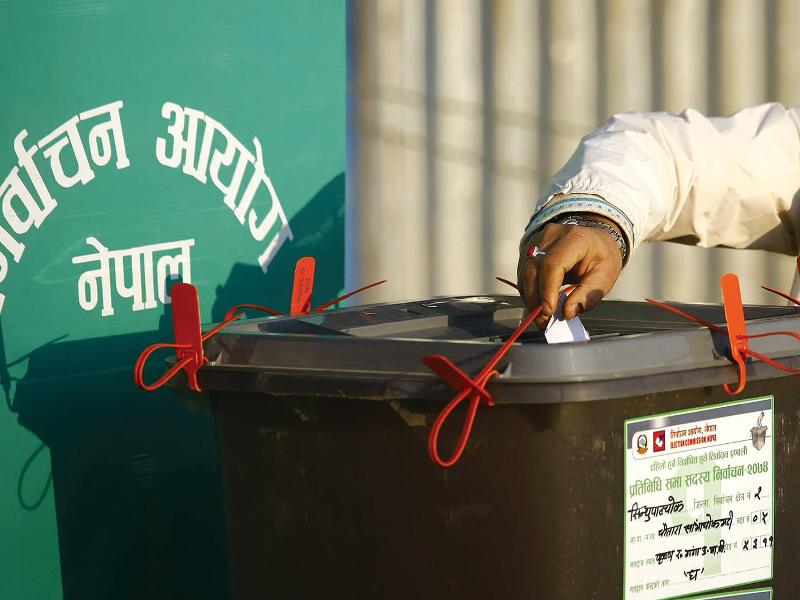
Nepal is set to go to the polls on Thursday (March 5, 2026) in a significant general election that many view as a push for political change.
More than 1.89 crore registered voters are expected to cast their ballots to elect a new 275-member House of Representatives.
Polling will be held from 7 am to 5 pm across the country. The contest features 3,424 candidates under the first-past-the-post (FPTP) system and 3,213 candidates under the proportional representation (PR) system.
Of the 275 seats in the House of Representatives, 165 lawmakers will be elected directly through the FPTP system, while the remaining 110 seats will be allocated under proportional representation, in accordance with constitutional provisions.
The elections were originally scheduled for November–December 2027 but were advanced by nearly two years following the Gen Z-led uprising of September 8–9.
The youth-led protests resulted in the fall of the coalition government headed by KP Sharma Oli, which had been supported by the Nepali Congress and the Communist Party of Nepal (Unified Marxist–Leninist) (CPN-UML).

After a new citizens’ government was formed on September 12 under former Chief Justice Sushila Karki, it was decided that elections for the House of Representatives would be held on March 5.
This time, the election is being shaped less by traditional party rivalries and more by the aftereffects of the youth movement that challenged Nepal’s established political order. Political observers note a visible surge in enthusiasm among young voters.
Political scientist Krishna Pokharel told The Kathmandu Post that a significant number of young Nepalis have returned from abroad specifically to participate in the polls.
According to data from Nepal’s Department of Immigration, the number of returnees rose by 28.58 percent in the lead-up to the election. In February alone, 148,623 Nepalis flew back home, compared to 115,584 during the same period last year.
As part of election preparations, the Election Commission of Nepal enforced the mandatory silence period from midnight on March 2.
During this period, political parties, candidates and their supporters are barred from canvassing votes, organising public gatherings, or engaging in any form of election-related publicity until voting concludes.
To ensure a peaceful process, the commission has also imposed a nationwide ban on the sale and consumption of alcohol, which will remain in force until the final results are declared.
Security has been significantly tightened ahead of polling day. The India–Nepal international border has been sealed until March 5, with only ambulances and emergency services permitted to cross.
Joint patrols by Indian and Nepali security personnel, along with CCTV surveillance, are being conducted along the border areas.
The Nepal Army has implemented a three-phase security plan covering the period before, during and after the election. Army spokesperson Rajaram Basnet said the force will secure polling stations and counting centres, conduct aerial patrols, and dispose of any suspicious objects.
On polling day, a three-tier security arrangement will be deployed at all voting centres. After voting concludes, integrated security teams will escort and safeguard ballot boxes during transportation to counting sites.
ALSO READ: Youth push for good governance drives Rastriya Swatantra Party’s surge ahead of Nepal elections
In total, around 3,30,000 security personnel, including 80,000 Nepal Army soldiers, along with members of Nepal Police and the Armed Police Force, will be mobilised to ensure that the elections are conducted in a free, fair and secure manner.