










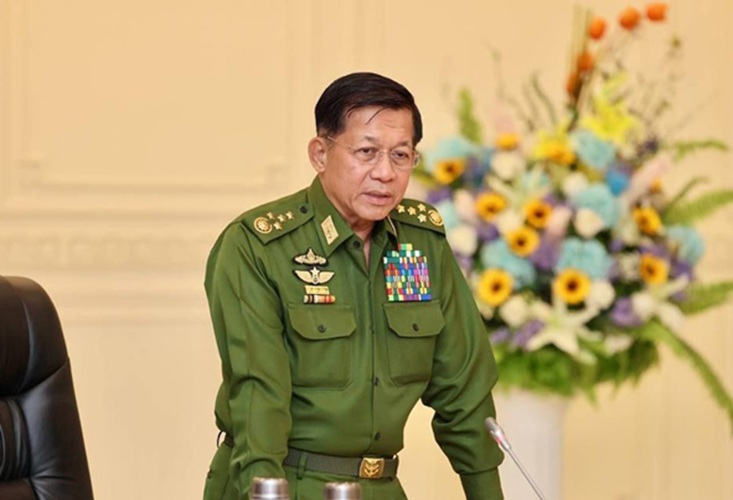
Myanmar’s ruling military establishment is preparing for a major political transition, with strong indications that Senior General Min Aung Hlaing is positioning himself to step down as commander-in-chief and move into the presidency, according to senior military-linked sources.
Reports suggest that the military chief is expected to oversee the selection of his successor within the armed forces, a move seen as crucial to securing firm control over both the military and civilian administration during his potential presidential tenure.
BBC Burmese reported that Myanmar’s Foreign Minister Than Swe recently informed Thai diplomat Sihasak Phuangketkeow that a new commander-in-chief would soon replace Min Aung Hlaing, who has led the military since 2011.
Political developments following the controversial national elections have further fuelled speculation.
The military-backed Union Solidarity and Development Party (USDP) secured a sweeping majority, winning 232 of 263 seats in the lower house and 109 of 157 declared seats in the upper chamber — results widely dismissed by critics as lacking credibility.
Junta spokesperson Zaw Min Tun has indicated that parliament is likely to convene in March to elect a new president, with a fresh government expected to assume office in April, according to pro-military Eleven Media Group.

Under Myanmar’s military-drafted 2008 Constitution, the commander-in-chief must be appointed by the president on the recommendation of the National Defence and Security Council, and the president cannot hold another post simultaneously — a provision that would require Min Aung Hlaing to formally retire from the army before taking office.
In early February, the junta established a new body, the Union Consultative Council, to oversee the transition to the next government.
This has raised the possibility that Min Aung Hlaing could chair the council as president, further consolidating authority across both civilian and military structures. Military insiders say his presidential ambitions date back to at least 2015.
Sources within the armed forces also claim that Min Aung Hlaing had repeatedly signalled his desire to become president to Nobel laureate and NLD leader Aung San Suu Kyi, and grew increasingly frustrated by her refusal to support those ambitions.
The same sources allege that this rejection was a key factor behind the February 2021 coup, which followed the landslide victory of the National League for Democracy (NLD) in the 2020 elections.
ALSO READ: 88 countries endorse New Delhi Declaration on AI at Global AI Impact Summit 2026
The coup, carried out just a day before the NLD government was due to begin its second term, led to the arrest and imprisonment of Suu Kyi and senior party leaders on multiple charges that international observers have described as politically motivated.
If Min Aung Hlaing assumes the presidency, analysts believe he could further entrench his authority by installing a trusted loyalist as the new army chief and filling the cabinet with USDP figures who won parliamentary seats, creating a tightly controlled power structure.
However, such consolidation is expected to deepen Myanmar’s instability.
Ethnic armed organisations opposing military rule have already vowed to intensify their resistance against the Tatmadaw, while the opposition National Unity Government has rejected the elections and reiterated its commitment to dismantling the military junta.
Observers warn that a Min Aung Hlaing presidency would not signal political normalisation, but rather a new phase of centralised military dominance with prolonged conflict and resistance across the country.