










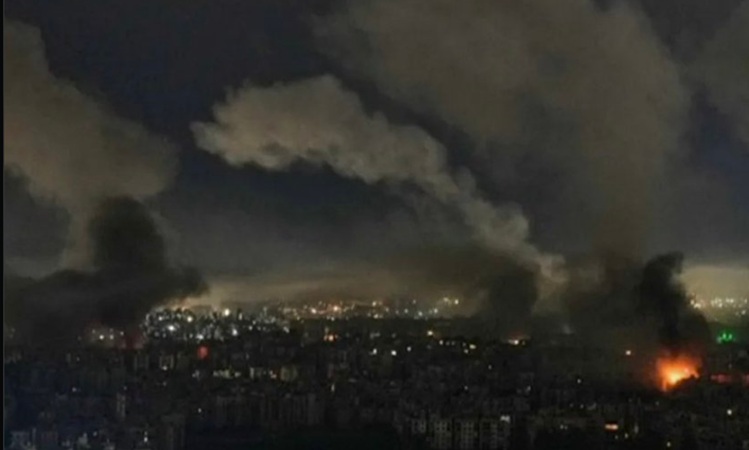
Missile and drone attacks were reported across several Gulf countries on Sunday as tensions in the Middle East conflict escalated further, with Iran warning it could widen its military campaign and urging the evacuation of three major ports in the United Arab Emirates.
Authorities in Bahrain, Saudi Arabia and the UAE said their air defence systems were working to intercept incoming projectiles, a day after Tehran issued threats targeting key Emirati ports.
The development marks one of the first instances during the conflict in which Iran has directly threatened non-US assets in neighbouring Gulf states.
The ongoing war, which entered its third week, began after strikes by Israel and the United States on February 28 targeting Iranian nuclear and military facilities. Both countries said the attacks were intended to weaken Iran’s military capabilities and pressure its leadership.
Tehran has since retaliated with missile and drone strikes aimed at Israel and countries in the Persian Gulf hosting American military bases.
The conflict has severely disrupted international air travel, affected oil shipments from the Gulf region and pushed global fuel prices higher.

Concerns have also mounted over the security of the Strait of Hormuz, a vital shipping route for global energy supplies.
Donald Trump, the president of the United States, urged major economies dependent on Gulf oil and gas to deploy naval vessels to ensure the strait remains open and secure.
However, by Sunday, no country had made firm commitments, although some governments indicated they were reviewing the proposal.
The United Kingdom said it was consulting with allies on possible steps to safeguard the shipping route. Meanwhile, South Korea said it would coordinate closely with Washington while assessing the situation.
Iran’s Foreign Minister Abbas Araghchi accused the United States of launching recent strikes on Iran’s Kharg Island from locations in the UAE, an allegation the Emirati government strongly denied.
Emirati officials reiterated that neither their territory nor airspace had been used to conduct military operations against Iran.
The United States Central Command said it had no immediate response to the claims.
Despite escalating hostilities, Araghchi said Tehran remained open to diplomatic proposals that would bring about a “complete end” to the conflict, noting that mediation efforts involving regional actors were continuing.
The conflict has resulted in heavy casualties across the region.
According to the International Committee of the Red Cross, more than 1,300 people have been killed in Iran since the fighting began.
Iranian authorities say the death toll includes hundreds of women and children.
In Israel, at least 12 people have died from Iranian missile strikes, while several others were injured during attacks reported on Sunday.
At least 13 members of the US military have also been killed since the conflict began, including six who died in a plane crash in Iraq last week.
The violence has also intensified along Israel’s northern border with Lebanon, where exchanges of fire between Israel and the Iran-backed Hezbollah have killed more than 800 people and displaced around 850,000 residents.
ALSO READ: Meghalaya athlete Retina Hanse dies in road accident in Ri-Bhoi
Iran launched additional missile barrages toward Israel on Sunday, triggering sirens and sending residents rushing to shelters in several cities, including the Tel Aviv area.
Israel’s emergency service Magen David Adom reported damage at multiple sites, including a large crater in a street and shrapnel impacts on residential buildings.
Authorities said strikes caused damage at more than 20 locations in the Tel Aviv region and sparked a small fire.
Israeli officials said some of the attacks involved cluster munitions, which release multiple submunitions and can strike several locations simultaneously, complicating air defence efforts.
As the war intensifies, residents across the region continue to face uncertainty, with governments scrambling to manage security threats, economic disruptions and the growing humanitarian crisis.