









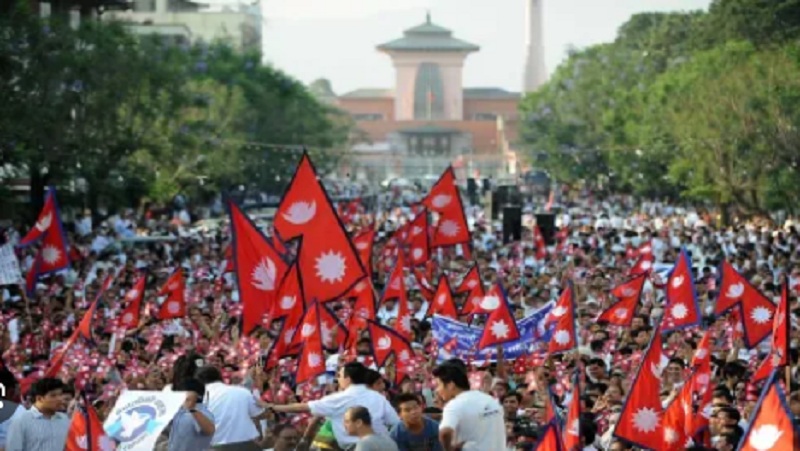
As Nepal gears up for the March 5 general elections, leading political parties have intensified their campaigns, releasing comprehensive manifestos outlining their plans and priorities to win over voters nationwide.
The Communist Party of Nepal (Unified Marxist–Leninist) (CPN-UML), led by former prime minister KP Sharma Oli, released its manifesto in Kathmandu, outlining what it described as a development-oriented and stability-focused agenda. Oli said the party’s objective was to rebuild and strengthen the nation, emphasising governance reforms and long-term progress rather than political confrontation.
In its document, the CPN-UML placed strong emphasis on good governance, infrastructure expansion, job creation and social equity. The party stated that several development initiatives launched during its earlier tenure in government had been left incomplete due to recurring political instability. It pledged to generate employment for one million young people over the next five years and laid out a roadmap comprising immediate priorities, core structural reforms and a broader set of long-term commitments.
The manifesto also highlighted plans to promote disciplined labour practices, affordable housing, industrial zone expansion, modernised agriculture, improved education standards and accelerated digital infrastructure growth. The party expressed its intention to build a competitive industrial ecosystem and use state institutions more effectively to drive national transformation.
Meanwhile, the Rastriya Swatantra Party (RSP), headed by Ravi Lamichhane, presented its 100-point commitment plan at a public gathering in Surkhet, Karnali province. The event was also attended by the party’s prime ministerial candidate, Balendra Shah.
The RSP’s platform centres on structural political reform, including initiating a constitutional amendment process through national consensus. The party advocates a directly elected executive leadership model, a fully proportional parliamentary system and non-partisan local governments.

On economic and regional cooperation, the RSP proposed expanding energy diplomacy through short-, medium- and long-term electricity trade agreements with neighbouring countries such as India and Bangladesh. It also called for balanced and adaptive foreign policy measures to convert shifting geopolitical dynamics into development opportunities.
Infrastructure proposals in the RSP manifesto include construction of an east–west electric railway to facilitate passenger and cargo movement, as well as rail connectivity linking Kathmandu and major southern cities with Indian and Chinese networks. The party further pledged to digitalise public service delivery and reform the bureaucracy to ensure professionalism, neutrality and accountability, alongside promoting a digital economy to spur growth and employment.
ALSO READ: Campaigning begins in Nepal for March 5 Parliamentary polls
Earlier, the Nepali Congress, Nepal’s largest democratic party, also released its election manifesto under the slogan “Sustainable Infrastructure, Strong Economy, Secure Future, Developed Nepal.” Party president and prime ministerial candidate Gagan Thapa outlined commitments focused on economic expansion, improved living standards, urban development, energy generation and enhanced national connectivity.