










By Enayet Kabir
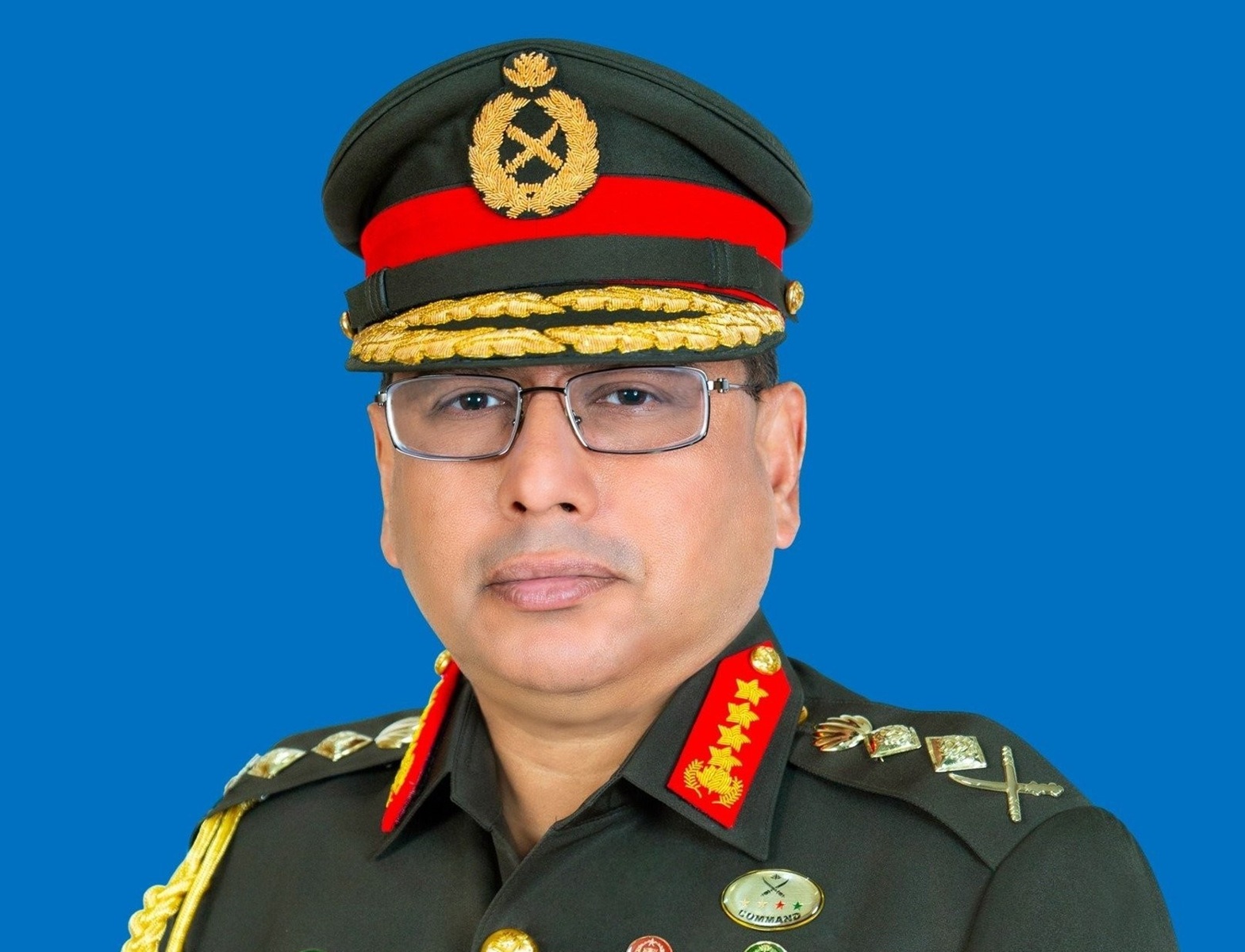
Is “indirect military rule” in Bangladesh becoming permanent? Is Army chief General Waker-uz-Zaman going to become the formal Supreme Commander of the Armed Forces? Currently, as the constitutional head of Bangladesh, President Shahabuddin is the “controller” of the armed forces.
The Armed Forces Division is directly under the Prime Minister. But in reality, the army still controls politics.
Even after the general election, the army has not returned fully to the barracks.
They have a clear role in running the civilian administration.
Needless to say, a major reason why Muhammad Yunus’s extra-constitutional government was able to remain in power for 17 months was the Army’s conditional support.

It is worth recalling that in September 2024 Army chief Gen Waker-uz-Zaman made it clear through international media that a general election must be held within 18 months. In other words, he effectively set the “term limit” for Muhammad Yunus’s administration.
The same extra-constitutional interim government reportedly failed to remove President Mohammad Shahabuddin because of the Army chief’s stance—this claim was openly made in the media.
Soon afterward, the BNP’s Secretary General and the LGRD Minister stated that the president’s term had not yet ended, so there was no opportunity to change the president at this moment.
Since the election, the president has appeared relaxed and active.
By July-August 2024 it had already become clear that Bangladesh was moving toward a “Pakistani model” of indirect military rule through depoliticisation.
The young leadership of the anti-Sheikh Hasina movement was politically inexperienced and confused.
Two figures known as mentors to them—Dhaka University teacher Asif Nazrul and politician Jonayed Saki—visited the army chief, described as the “controller of the moment”, on the afternoon of August 5, 2024, and accepted his authority.
Asif Nazrul has long been known as an intellectual aligned with the BNP, and Jonayed Saki, an ally of the BNP, is now the State Minister for Planning in the BNP government.
After Sheikh Hasina left the country, leaders of various political parties—including the BNP—went to the cantonment and effectively submitted themselves to the Army chief, agreeing to form an interim government.
From the cantonment, the Army chief announced the extra-constitutional interim government, in a national address. In effect, from that day he became the state’s indirect driving force.
In Pakistan, before a managed election, the military brought back the exiled leader of the Pakistan Muslim League, Nawaz Sharif.
A similar model is allegedly being followed in Bangladesh. Before the election, exiled BNP leader Tarique Rahman was brought back to the country with the Prime Minister’s security protocol.
As expected, the Army allegedly helped the BNP win a “managed election,” paving the way for Tarique Rahman to become prime minister. With a “political government” now in place, the public is also satisfied with Gen Waker-uz-Zaman.
Soon after the election, senior positions in the military were reorganised. It can be said that the entire military establishment is now under the authority of “Team Waker.”
In fact, since the assassination of Bangabandhu on August 15, 1975, the military has sought the right to rule the country.
Over the past fifty years, they have been the real controllers of Bangladesh’s power politics. In every election, they pull the strings behind the scenes. “`
Both the BNP and the Awami League have formed governments through negotiations with the army.
The military has also become the country’s largest corporate business group. The chief of the army leads the most privileged group within the state.
After the military coup of August 5, 2024, the non-political, extra-constitutional Yunus government carried out various experiments in state reform, but the reins remained in Gen Zaman’s hands.
He kept President Shahabuddin safe, brought Tarique Rahman back to the country, and ensured that elections took place.
Now it will not be difficult for him to run the weak government that emerged from the “managed election” from behind the scenes.
However, to make his power absolute, he would need to formally obtain the position of Supreme Commander of the Armed Forces.
Therefore, following the “Pakistan model,” efforts are reportedly underway—by consensus among political parties—to formally install Gen Zaman in that position after the election.
In the first session of parliament beginning on March 12, Gen Waker-uz-Zaman may become Bangladesh’s Asim Munir.
(The writer is a political and economic analyst)