










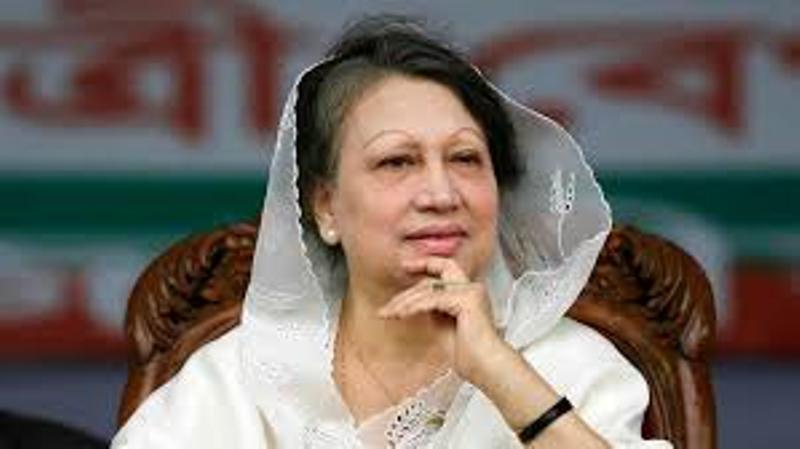
Bangladesh’s first woman Prime Minister, Khaleda Zia, who played a key role in restoring democracy after years of military rule, passed away on Tuesday following a prolonged illness at the age of 80, the Bangladesh Nationalist Party (BNP) said on Tuesday (December 30, 2025).
“The BNP Chairperson and former prime minister, the national leader Begum Khaleda Zia, passed away today at 6.00 a.m., just after the Fajr (dawn) prayer,” the party said in a statement.
“We pray for the forgiveness of her soul and request everyone to offer prayers for her departed soul,” it added.
Her personal physician, Dr AZM Zahid Hossain said she breathed her last early on Tuesday while receiving treatment at Evercare Hospital in Dhaka.
Zia was a three-time prime minister and held the position of chairperson of BNP.
BNP officials said Zia’s funeral prayer was expected to be held on Wednesday at Dhaka Manik Mia Avenue in front of the parliament complex.

Zia was admitted to Evercare Hospital on November 23 for routine tests, during which doctors detected a chest infection and decided to keep her under observation. Her condition worsened on November 27, prompting her transfer to the hospital’s Coronary Care Unit (CCU).
She had been suffering from multiple complex and chronic health conditions, including liver and kidney complications, heart disease, high blood pressure, diabetes, arthritis and infection-related problems.
The former Bangladeshi Prime Minister’s long-running rivalry with Sheikh Hasina shaped the nation’s politics for an entire generation.
She had faced corruption cases, which she said were politically motivated, but in January 2025, the Supreme Court acquitted Zia in the last corruption case against her, which would have let her run in February’s election.
Zia had returned to the country in May after undergoing medical treatment in the U.K. In early January, Bangladesh’s interim government had allowed her to travel abroad after Sheikh Hasina’s government rejected previous requests at least 18 times.
Her rise as a public figure is widely viewed as accidental. A decade after becoming a widow at the age of 35, she assumed the role of prime minister, but her entry into politics was not planned. She was largely unfamiliar with the political world until she was seemingly dragged into it following the assassination of her husband, President Ziaur Rahman, a military strongman turned politician, in an abortive army coup on May 30, 1981.
She won her first term in 1991 and served again from 2001.
In 1999, Zia formed a four-party coalition and launched agitations protesting the then-ruling Awami League government. She was re-elected in 2001. In 2006, she stepped down from office, passing power to a caretaker administration. In September 2007, she was arrested on what her party claimed were “baseless charges of corruption
Although Zia had been out of power since 2006 and spent several years in jail or under house arrest, she and her centre-right BNP continued to command significant support.
ALSO READ: BNP’s Tarique Rahman offers prayers at graves of Osman Hadi, Kazi Nazrul at Dhaka University
The BNP is seen as the frontrunner to win the parliamentary election slated to take place in February. Her son and acting chairman of the party, Tarique Rahman, 60, returned to the country last week from nearly 17 years in self-exile and is widely seen as a strong candidate to become prime minister.