










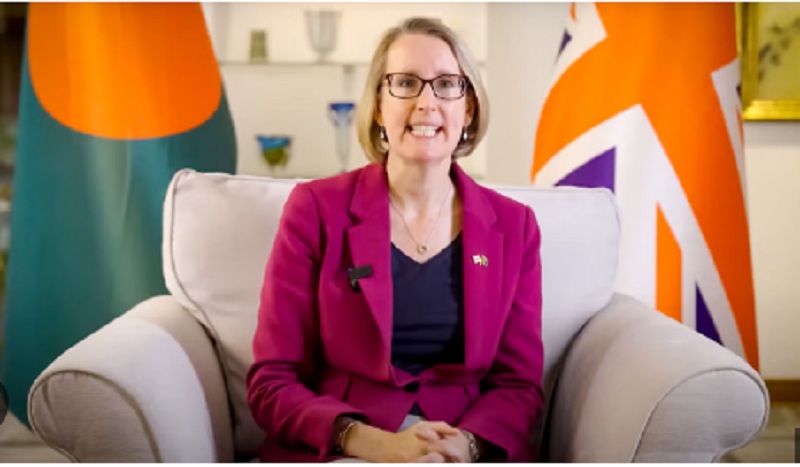
In an unprecedented move, the Indian Ministry of External Affairs turned down a request for a meeting from British High Commissioner to Bangladesh Sarah Cooke with senior ministry officials on January 21, two days after she took a flight from Dhaka to New Delhi.
Northeast News has learnt that Cooke, who is on a mission in the Indian capital to meet various “distinguished persons” to get a sense of the official stand on the February 12 elections in Bangladesh, was rebuffed as she had jumped diplomatic protocol to seek in-person meetings. She arrived in New Delhi on January 19 evening and is scheduled to return to Dhaka on Thursday (January 22)
However, Cooke, who had teamed up with previous US Ambassador Peter Haas in 2023-24 to regularly call for “free, fair, participatory and violence-free” elections (which took place under controversial circumstances on January 7, 2024) when the Sheikh Hasina-led Awami League government was still in power, could meet two former Indian diplomats, an academic and a journalist. Another former Indian diplomat, who was “contacted” to join the meeting at the UK high commission in New Delhi, did not take part.
During this meeting, Cooke is said to have expressed satisfaction with the “very good law and order situation” in Bangladesh and commented that the forthcoming election should be “democratic”, even as it will not be inclusive, as the Mohammad Yunus-led interim regime continues to be vehemently against the participation of Sheikh Hasina’s party in the polls.
It is learnt that both the former Indian diplomats sought to disagree with and gently challenged Cooke’s contention that Bangladesh’s law-and-order situation is “very good” even as there is “incontrovertible” evidence of anti-minority atrocities in the country.
Informed Bangladesh Foreign Ministry sources said that Cooke, who was previously posted as the Country Director, Department for International Development (DFID) Bangladesh, from 2012 to 2016, visited New Delhi along with two other British diplomats at a time when US Ambassador Brent Christensen, who too had earlier served in Dhaka, had just taken charge of his new assignment on January 12.

Cooke and her two colleagues took an Air India flight to New Delhi on January 19 evening after a meeting with the Jamaat-e-Islami amir Shafiqur Rahman in Dhaka, setting off intense speculations on the purpose of her visit to the Indian capital.
Informed Bangladesh Foreign Ministry sources recalled that just like Cooke’s ongoing New Delhi mission, in 2014 a similar visit was made to the Indian capital by the then US Ambassador to Bangladesh Dan Mozena who had sought a meeting with the then Indian Foreign Secretary Sujata Singh.
At that time, the sources said, the Indian political leadership, as well as senior MEA officials, were instructed by “higher political authorities” that Mozena could only meet the Joint Secretary in charge of Bangladesh and Myanmar (at that time Harsh Vardhan Shringla) and no other senior official.
Cooke’s position on violence and the law-and-order situation is at variance with ground realities. Besides, the stand on a “unity government”, Bangladeshi geopolitical analysts suggested, reflected a continuing “soft corner” for the Jamaat-e-Islami, which successive US diplomats in Dhaka, including former Ambassador Peter Haas, have sought to hardsell as a mainstream political outfit.
The West, chiefly the US, played a key clandestine role in the political developments and the students’ movement that dislodged the Sheikh Hasina-led Awami League regime in August 2024. The British foreign and security establishment also played a less well-known part in the events leading to the US-inspired regime change in Dhaka 17 months ago.
Before the controversial election of January 7, 2024, the US insisted on a “free, fair, participatory and violence-free election”. However, since August 2024, neither the US State Department nor the British High Commission in Dhaka has clearly spelt out the necessity for a free, fair and inclusive election, which the Indian Ministry of External Affairs has made a fundamental basis for the restoration of democracy in Bangladesh.
ALSO READ: Seizure of drone components from ARSA member in Teknaf has Bangladesh security officials in tizzy
The Yunus-led interim regime, which continues to enjoy the support of the US authorities, despite ceaseless political violence and atrocities on the minority Hindus, seeks to prolong its tenure in authority. This is being sought to be achieved by a combination of keeping the BNP at bay and giving a lot of leeway to the Jamaat-e-Islami and the National Citizens Party (NCP).