









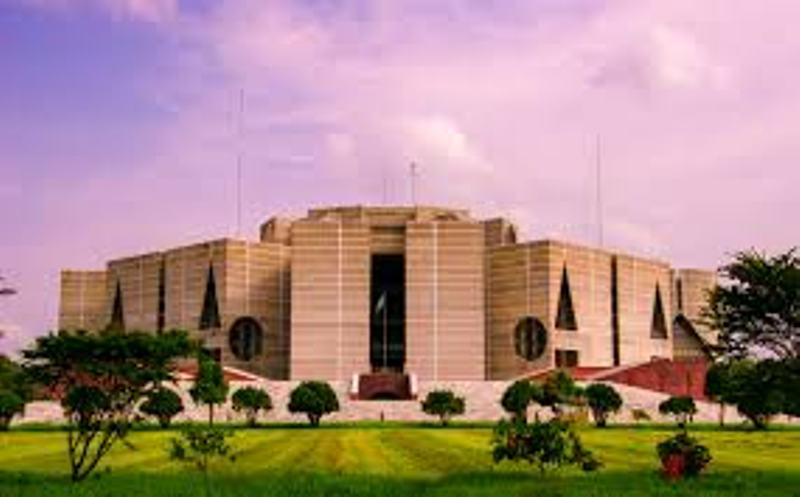
By Enayet Kabir
Bangladesh’s “extra-constitutional” and military-backed “state-seizing” Yunus government’s “non-state acts” are about to receive indemnity in the “National Parliament” dominated by the BNP.
At the same time, the BNP-controlled parliament is also going to grant indemnity to the state-recognized “non-state actors” known as the “July fighters.”
In other words, the government led by Tarique Rahman under the “anti-Awami consensus” is being forced to take the unpopular decision of assuming responsibility for the Yunus government.
In parliament, the role of the war-crimes-accused Jamaat-e-Islami or the NCP will be that of a “domesticated” opposition party. In effect, from today, an “anti-Awami one-party rule” is beginning.
On the very first day, 133 ordinances of Muhammad Yunus’s government, influenced by war-crimes-accused Jamaat-e-Islami, will be presented in the National Parliament as bills. However, many of these ordinances have caused discomfort within the ruling BNP government in Bangladesh.

BNP-aligned legal experts believe that many of these ordinances—including the “July Charter” and amendments to the law governing the International Crimes Tribunal (ICT)—are not implementable.
The BNP leadership also believes that almost all the ordinances of the Yunus government were influenced by Jamaat-e-Islami, which has been accused of war crimes. If the “state acts” of the Sheikh Hasina government are investigated and tried while the “non-state acts” of the July riots are exempted from investigation and trial, it could create problems for the current government in the future as well.
Whatever happened in July–August was all human rights violations. If the constitution remained in force and no war was declared, then all criminal activities committed during that time would be unquestionably crimes.
There is also an argument within the government that these ordinances could be used in the future as legal references against the current government’s own “state acts.”
It should be noted that the instructions given by the deposed and India-exiled Prime Minister Sheikh Hasina up to August 4, 2024, and the actions carried out by other employees of the republic in accordance with those instructions, fall within the constitutional framework as “state acts.”
However, it is still legally unresolved whether those “state acts” can be tried in the International Crimes Tribunal, which was originally established to prosecute the war crimes of 1971, after amendments to its law.
The president’s ordinance amending the law is still awaiting parliamentary approval in the form of a bill. On March 9, 2026, after a report by UK journalist David Bergman exposed an incident of “demanding money to secure bail for an accused,” a crisis of confidence has emerged regarding judicial proceedings under the International Crimes Tribunal.
Earlier, on March 8, 2026, Northeast News reported that allegations of bribery and financial irregularities had been raised against Tajul Islam, a Jamaat-e-Islami leader and former chief prosecutor of the tribunal, along with several other prosecutors. These allegations are currently being examined by a new prosecution team led by Aminul Islam.
There are also accusations that a large financial transaction took place to turn former Inspector General of Police Abdullah Al Mamun into a state witness against Sheikh Hasina.
The following day, Tuesday 9 March, several media outlets reported under the headline:
“Prosecutor demanded one crore taka to arrange bail for an accused in the July riot crimes case.”
Saimum Reza Talukdar was appointed as a prosecutor on October 7, 2024, in the tribunal that was reorganised after the July riots under the influence of Jamaat-e-Islami. He was previously a teacher and served as a senior lecturer at a private university.
Although an expert in internet governance and security, he had no prior experience conducting legal cases before being appointed to the tribunal.
It is worth mentioning that on August 8, 2024, Muhammad Yunus’s “extra-constitutional” government seized state power with the direct support of the military within the constitutional framework.
That government granted indemnity to the “non-state acts” committed during the political riots of July–August, meaning that all such acts—including the killing of police officers—were exempted from investigation and trial.
There are allegations that during the past 18 months the Yunus government encouraged mob actions by the tawhidi nation and extrajudicial killings carried out by those mobs.
Indemnity was granted for police killings and political murders between 5 August and August 15, 2024. The government did not investigate deaths in prisons or unidentified bodies found floating in rivers.
The Yunus government has also been accused of amending the law of the International Crimes Tribunal, originally established to try the war crimes of 1971, under the influence of Jamaat-e-Islami in order to use the state as a tool of revenge against the Awami League. This has undermined judicial neutrality.
The July–August political riots were not a war, nor were they a revolution. Many people are not even willing to call it a “mass uprising.” It was a planned military coup aimed at toppling the government.
Such events are not unprecedented in Bangladesh.
During the July–August movement and the period afterward, was the constitution suspended? No. The constitution remained fully in force and even a state of emergency was never declared. Therefore, human rights were not suspended.
Trying to forcefully label a movement to overthrow a government as a “war” or “civil war” will not stand scrutiny.
Since the constitution remained in force, citizens’ fundamental rights remained in force, the subsequent government was formed according to the constitution, that government operated under the constitution (although Yunus and the advisory council violated it), elections were later held according to the constitution, and the current elected government is also operating under the constitution—therefore there is no opportunity to grant immunity for “non-state acts.”
To investigate the financial scandal, a five-member “facts-finding committee” has been formed under the leadership of ICT Chief Prosecutor Mohammad Aminul Islam. All members of the committee are prosecutors.
Several legal experts have stated that to ensure justice for those who were killed in the July political riots, all allegations must be investigated impartially and properly.
One arrested accused in a crimes-against-humanity case related to the July political riots in Chattogram city is former Awami League Member of Parliament for Chattogram-6 (Raozan), ABM Fazle Karim Chowdhury. Prosecutor Mohammad Saimum Reza Talukdar—who resigned on Monday—had demanded one crore taka from his family to secure his release on bail.
On March 9, several influential Bangladeshi media outlets released multiple audio recordings of WhatsApp conversations related to the matter.
The past month was a grace period. From today, effectively, the BNP’s “state acts” are beginning.
For the current BNP government, presenting the July Charter and the ICT ordinance in the National Parliament is the biggest challenge.
From today, the newly formed National Parliament—elected on 12 February—will begin its session. However, questions have already been raised about the credibility of that allegedly manipulated election.
Although the BNP won the majority of seats, control of the government lies in the hands of the military.
ALSO READ: US State Dept official Paul Kapur’s India-Bangladesh visit: Arrived with fanfare, left Dhaka quietly
President Mohammad Shahabuddin has already stated that the Yunus government issued the ordinances without informing him. The president—who was elected during the Awami League era—has denied responsibility for those ordinances.
Now the question is what he will say in his speech to the BNP-controlled National Parliament, since the speech will be written by the BNP parliamentary party.
(The writer is a political and economic analyst)