










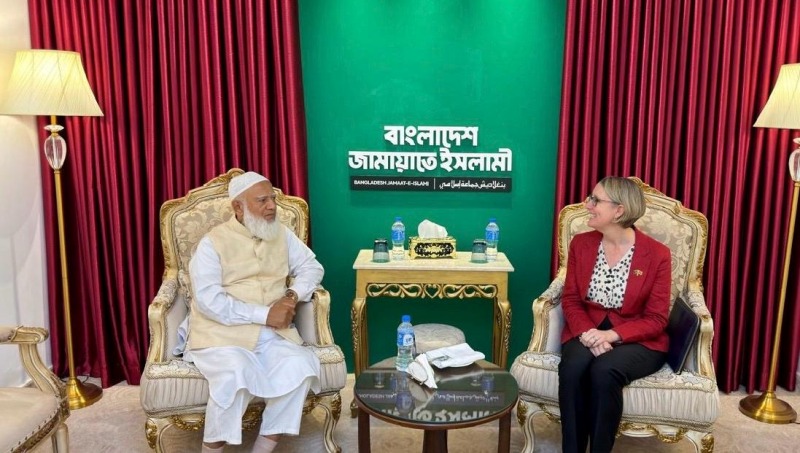
The Jamaat-e-Islami (JeI) expects to win outright 76 parliamentary seats in the event elections take place across Bangladesh on February 12 even as it believes the contest to be evenly poised across 85 constituencies, an internal assessment by the Islamist party reveals.
The JeI, whose political-electoral fortunes have risen since the US-backed regime change operation that unseated the Sheikh Hasina regime and brought in the Mohammad Yunus-led interim regime in August 2024, is confident that it could give the Bangladesh Nationalist Party (BNP) a run for its money.
The BNP, whose tail was up following the return of then Acting Chairperson Tarique Rahman to Bangladesh on December 25, 2025, after an 18-year-long exile in the UK, is now worried about a likely JeI electoral surge even as the party leader will hit the campaign trail from Thursday (January 22).
Beginning today, Rahman is scheduled to visit seven to eight districts in North Bangladesh, a move that was earlier stopped by the Election Commission as the process involving nomination paper scrutiny had not been completed at that time.
It is learnt that the JeI, meanwhile, has been able to devise an electoral strategy aimed at aggressive campaigning across at least 172 of 300 constituencies where it will take the BNP head-on, even though the Bangladesh Islamic Andolan outfit recently withdrew from a broad-based alliance of avowedly Islamist political parties.
For the Jamaat, the February 12 election – if it is held in a relatively free and fair environment – would be crucial from the perspective of taking power. At the same time, it also expects to reap some advantage from the referendum to be held on the same day.

Based on seat-wise vote performance in the 1991 and 1996 national elections, and combined with current internal surveys, the Jamaat assessed its vote share across all 300 constituencies. From October 2024, the party reportedly concentrated efforts to ensure outright victory across 162 seats, transferring a significant portion of votes from the remaining 138 seats to the targeted constituencies. A major portion of this vote transfer was focused on 20 Dhaka constituencies where, over a six-year period, it pushed its supporters and cadres to take up residence.
The Jamaat has reportedly prepared 1.5 million expatriate supporters for postal voting. Similarly, a large number of domestic supporters will also cast postal ballots in its favour.
In 20 constituencies in Dhaka, the JeI has reportedly prepared its Women’s Wing and Islami Chhatri Sangstha to adopt “other special tactics” for which it has been conducting door-to-door surveys.
The Jamaat’s male and female activists are reportedly collecting NID numbers and mobile phone numbers of poor and general voters nationwide, including information on whether voters have active bKash, Nagad, or Rocket accounts, where cash could be transferred before polling day to secure votes for the “scale” symbol.
Ansar–VDP personnel will reportedly constitute the largest security presence at polling centers. The Jamaat’s plan is to ensure that at least 15 JeI-Shibir activists are assigned security duties at each polling centre. Additionally, there is a reported ideological alignment of Jamaat sympathisers among a host of district-level administrative and police officials.
The Jamaat is also said to have allocated substantial campaign funds, ranging between BDT 50-100 crore, for 162–188 priority seats. The party is also reportedly covering significant campaign expenses for NCP and other allies.
On election day, immediately after Fajr prayer, large groups of Jamaat-Shibir activists are expected to line up early at polling booths to assert control and ensure dominance when people line up to cast their ballots.
For strategic reasons, Jamaat’s student wing achieved major victories in recent student union elections at Dhaka University and five public universities. Similar micro-level strategies might be applied for the February 12 polls.
While Jamaat’s vote share may have increased considerably over the past few years, with the party sufficiently well-organised at the district, union and village levels, the BNP is having to contend with over 90 rebel candidates who could cut into the votes of official nominees.
ALSO READ: British envoy to Bangladesh Sarah Cooke’s unusual Delhi visit ahead of Feb 12 election
As far as the referendum is concerned, the Yunus-led interim government has been playing a major operational role as the principal stakeholder to ensure a “Yes” outcome. Through the referendum mandate, the government may pursue constitutional amendments, enhancement of presidential powers and pave the way for pitchforking Yunus as the next President.