










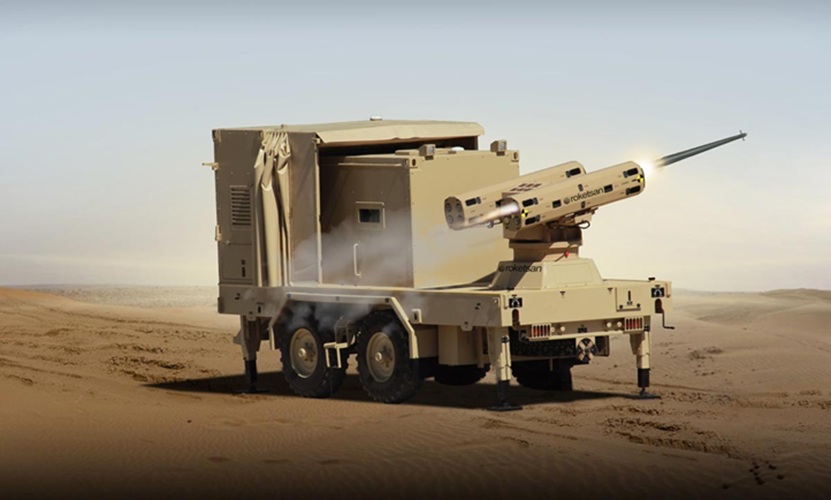
The Bangladesh military establishment, which has taken a renewed course to widen its weaponry arsenal and deepen its strategic capabilities, is now aiming to increase its stockpile of ‘smart’ laser-guided missiles.
In line with this long-term objective, the Bangladesh Air Force (BAF) has taken a firm decision to procure at least Turkish Cirit semi-active laser guided weapon system, including multi-purpose warheads as well as logistics package, Defence Ministry documents accessed by Northeast News reveal.
Today, the Directorate General Defence Purchase (DGDP) under the ministry opened a tender that sought bids from foreign manufacturers even though there were clear indications that the BAF prefers the Cirit weapons system that are manufactured by Rokestan, a Turkish company based in Ankara.
Cirit laser-guided missiles are said to be highly accurate and a cost-effective solution for armed helicopters.
They are optimised for use against static or moving lightly armoured/unarmoured targets.
The next generation Cirit has been designed to fill the tactical gap between 70 mm unguided rockets and guided anti-tank missiles.

While Rokestan claims Cirit rockets’ “versatile design” permits “easy integration and use with different platforms”, Bangladesh defence sources said they were confident that the laser-guided missiles would be appropriate for the country’s military scenarios.
The Cirit rockets have been tested for both air-to-surface and surface-to-surface engagement scenarios.
The BAF uses Cirit laser-guided missiles on its Selex Falco Astore UAVs (drones) and has previously procured these for its new T129 ATAK attack helicopters, which indicate growing integration for precision strikes in challenging terrain.
Cirit rockets on Falco Astore drones are aimed at counter-insurgency/anti-armour roles. Along with UMTAS anti-tank missiles, Cirit laser-guided missiles enhance precision in challenging areas such as the Chittagong Hill Tracts.
The BAF has reached final stages of a decision to acquire at least six Turkish-built T-129 ATAK attack helicopters.
ALSO READ: PIL moved in Supreme Court over killing of Tripura student in Dehradun
While this signals the Bangladesh defence establishment’s attempt to redefine its strategic autonomy, procurement philosophy and long-term air combat doctrine, the latest series of potential acquisitions, including the fourth generation Eurofighter Typhoon multi-role combat aircraft, points to a more aggressive approach to its defence capabilities and “autonomy posturings” in South Asia.
Pairing the Eurofighter Typoon and T129 ATAK helicopters will help the BAF achieve full spectrum of modern air operations, ranging from maritime strikes over extended ranges, low-altitude air support along Bangladesh’s coast, hills and forests and long border conditions.
In August this year, Rokestan undertook tests integrating the Cirit missile systems with various firing platforms, including unmanned surface vessels, self-propelled anti-tank, amphibious and tracked armoured vehicles as well as T129 ATAK helicopters.