










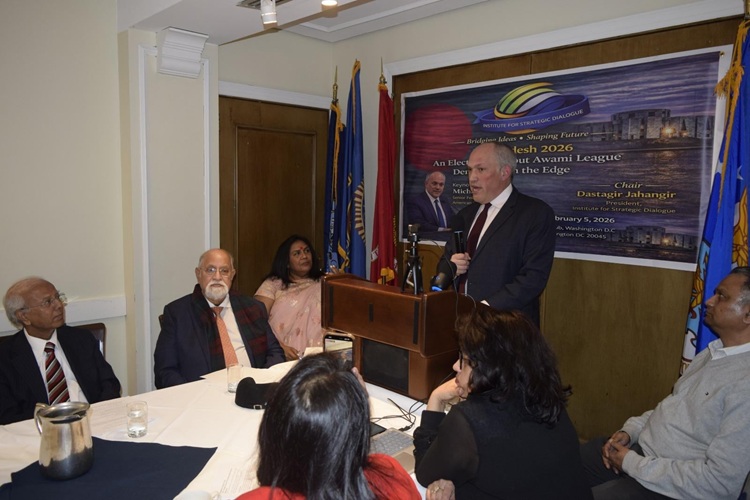
The interim government, together with Jamaat‑e‑Islami, has moved to prohibit the Awami League from engaging in political activities because they fear the party would be unbeatable in a genuinely free and competitive election, according to Michael Rubin, Senior Fellow at the American Enterprise Institute and a US-based political analyst.
He made these remarks on Thursday, February 5, during a Bangladesh-focused dialogue hosted by the Washington, DC–based Institute for Strategic Dialogue (ISD) at the National Press Club.
The event also featured remarks from former Foreign Minister of Bangladesh A. K. Abdul Momen and valiant freedom fighter Dr. Nurun Nabi. The session was chaired by ISD President Dastagir Jahangir.
In his remarks, Michael Rubin added that the use of legal and administrative measures to sideline rival political parties is not new in Bangladesh’s political history.
However, he noted that this pattern is contributing to a more serious crisis in the current context.
According to him, the primary motivation behind banning a major party like the Awami League is the belief that, in a fair and inclusive election, this widely supported party could not be defeated.

He warned that while limiting political competition may yield short‑term benefits, it ultimately erodes state stability and weakens democratic institutions in the long run.
Former Foreign Minister A. K. Abdul Momen noted that Bangladesh’s internal political crisis is directly affecting the country’s diplomatic relations and international standing.
He warned that if the political stalemate continues, it could lead to negative consequences for the economy, foreign investment, and international cooperation.
Dr. Nurun Nabi emphasized the ideals of the Liberation War, the vision of a secular state, and the importance of constitutional continuity.
He noted that political violence and divisive politics erode society from within and inflict long‑term harm on the state’s institutional foundations.
Participating in the discussion, human rights activist Dr. Dilip Nath said that in the current political reality, human rights, civil liberties, and the rule of law are facing the greatest risks.
He called for an end to the culture of cases, harassment, and intimidation used to suppress dissenting opinions.
ALSO READ: Video of Northeast woman harassed on way to temple sparks outrage over women’s safety
Other speakers noted that Bangladesh is experiencing a renewed and heightened level of political polarisation across all arenas — from state power and administration to activity on the streets.
They observed that allegations of cases, intimidation, and political retaliation against opposition voices are on the rise.
The speakers also voiced serious concern about the electoral process, freedom of expression, the safety of minority communities, and the overall law‑and‑order situation.
The dialogue was moderated by ISD Director and journalist Shaban Mahmud, along with Executive Director Shayla Ahmed Lopa.
Participants included American Security Analyst Jamal Hasan, A figure who helped shape public opinion during the Liberation War Greg Rushford, Zia Karim, Abdul Qader Mia, among others.
The session concluded with closing remarks from ISD Vice President and senior journalist AZM Sazzad Hossain Sobuj.