









By Enayet Kabir
No authoritarian regime gives space to “dissenting opinions.” The political government of the BNP, led by Tarique Rahman, appears to be walking down that same path.
It is becoming increasingly clear that they will not allow any political space for the Awami League, whose activities have been banned by executive order of the government. Returning to the country with the patronage and support of the military, the “elected” Prime Minister Tarique Rahman is now turning into an autocrat. In effect, military rule is underway in Bangladesh.
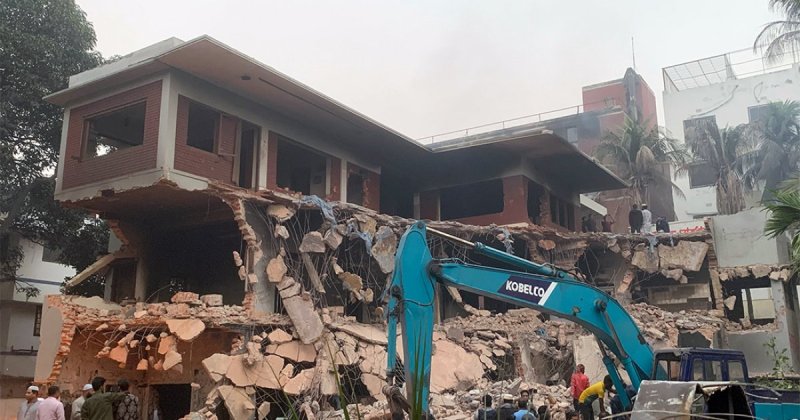
On March 7, the government sent armoured vehicles to Dhanmondi 32, to the burned and devastated house of Bangabandhu, preventing people from showing respect to the Father of the Nation.
Through this action, the government sent a message that dissenting views will be suppressed. By obstructing the study of the independent Bengali nation’s history, the new duo of Tarique Rahman and Gen Wakar-uz-Zaman disrespected the very month of independence.
Bangabandhu’s historic speech on March 7 immediately prepared the Bengali people for the Liberation War. In that speech, he described the political history of the just struggle to establish the right of self-determination for Bengalis.

After this speech, control across Bangladesh effectively passed from the Pakistanis to the Bengalis. It was essentially this call that began the preparations for the Liberation War.
Following the brutal genocide carried out by Pakistani forces on the night of March 25, the armed people’s war formally began in the early hours of March 26 through organised resistance.
The March 7 speech not only transformed the inhabitants of East Bengal (then East Pakistan) into a “free Bengali nation,” but also united people across class, caste, religion, and gender—except for the families associated with Razakar, Al-Badr, and Al-Shams collaborators. It created unity among Bengalis worldwide regarding the question of Bangladesh’s independence.
Bengalis across the world joined the determination of the people of East Bengal for freedom. On that historic day in 1971, the thunderous voice of Bangabandhu Sheikh Mujibur Rahman spread the message of independence to every corner of Bangladesh.
Yet the public has been prevented from observing the formal commemorations of March 7 since last year. Even the political government of Tarique Rahman suppressed dissent by sending military armored vehicles.
During the 15 and a half years of Awami League rule, the nation celebrated March 7 with great ceremony. The interruption that began during the 18-month interim government has continued under the new BNP government.
After former Prime Minister Sheikh Hasina was exiled to India on August 5, 2024, following a military uprising, the Awami League has found itself in perhaps the most cornered position in its history.
During Sheikh Hasina’s years in power, March 7—recognized by UNESCO as part of the “World Documentary Heritage”—was observed every year through various programs. After the political change, the interim government of Muhammad Yunus decided to cancel eight national observances, including March 7.
On that historic day in 1971, Bangabandhu addressed a sea of people at the Racecourse Ground (now Suhrawardy Udyan) and summarized 23 years of deprivation in just 19 minutes.
He declared, “Since we have given blood, we will give more blood. Inshallah, we will free the people of this country. This time the struggle is for our liberation; this time the struggle is for independence.”
When Pakistani forces launched their attack on March 25, the Liberation War began following the direction he had given. After nine months of bloody struggle against Pakistani rulers and their local collaborators, independence was achieved.
Recognising its importance, UNESCO granted the speech the status of World Documentary Heritage.
On March 7, 1971, Dhaka—the capital of East Pakistan—became a city of processions. People travelled on foot, by bus, boat, and train from across the country to gather at the Racecourse Ground. The vast field overflowed with millions of people, regardless of religion, caste, or background.
The crowd listening to Bangabandhu turned the Racecourse into a sea of humanity. Protesters holding bamboo sticks roared with thunderous voices. Countless red flags bearing the map of Bengal waved in the air.
Arrangements had been made by Dhaka Radio to broadcast the speech live, and the transmission initially began. However, the military authorities ordered it to stop. In protest, all Bengali staff left the radio station, halting broadcasts altogether. Later that night, Pakistan’s military authorities were forced to allow the full speech to be aired.
After the speech was broadcast, effective control across Bangladesh shifted to Bengalis rather than Pakistanis. In many places, people erased the words “East Pakistan” and replaced them with “Bangladesh.”
The March 7 speech must be remembered because it is an inseparable part of the nation’s liberation struggle. It united the Bengali people, gave direction to the Liberation War, inspired a new outlook, and instilled courage and confidence.
Its powerful words spread among everyone who heard it—whether in person or on the radio. The rhythm of the speech carried the intensity of poetry and the spirit of a warrior.
There can be no comparison to that awakening speech of Bangabandhu. No creative poem could capture the moment of its creation, and it is impossible to reproduce that moment in history. The convergence of public aspiration and the message of the speech produced one result: the birth of the independent Bengali nation and Bangladesh.
That speech united Bengalis into a fortress of courage, determination, and heroism, setting a clear and immediate goal—to fight for the liberation of their motherland. It remains an inseparable part of the Bengali nation, a treasure of Bengalis worldwide, and a part of world history.
If any political government or authoritarian regime stands against the nation’s history, one day the military will have to answer to the people. The history of a nation and a state does not change because of a government.
ALSO READ: Fuel trap: Bangladesh will fall into the debt cycle again
Have Gen Wakar-uz-Zaman and his military forgotten that they are accountable to the nation? The independent Bengali people once fought a people’s war against the Pakistani army. They may also choose to ignore the armored vehicles at Dhanmondi 32.
(The writer is a political and economic analyst)