










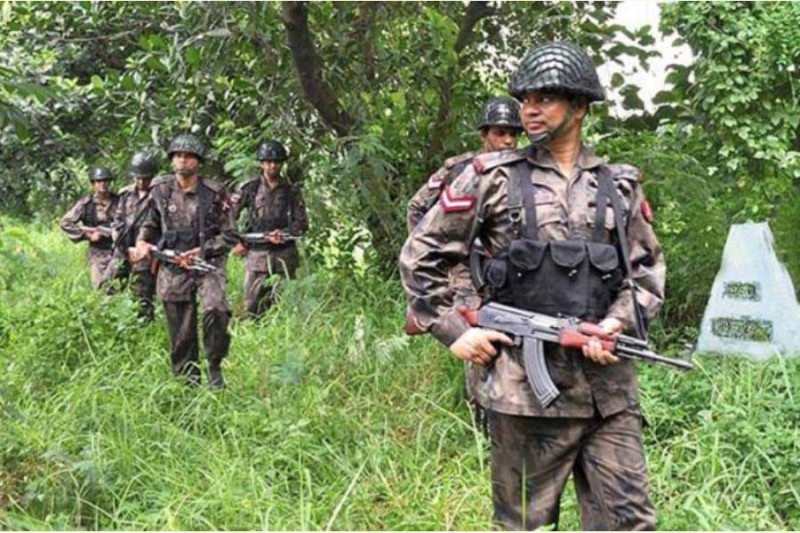
Even as Bangladesh’s defence forces continue to maintain an aggressive posture on military hardware acquisitions, the Border Guard Bangladesh (BGB) has middle- and long-term plans to arm itself with surveillance drones aimed at deepening its offensive capabilities on the India-Bangladesh border.
On December 25, 2025, the BGB headquarters in Dhaka’s Peelkhana issued three tenders seeking bids from international suppliers for quadcopter drone surveillance systems, fixed-wing surveillance drones and corresponding drone control devices.
While this move assumes significance in the backdrop of reports that Bangladesh plans to sign a BDT 608 crore government-to-government agreement with China to establish a military drone manufacturing facility to enhance its air defence capabilities, there are other concrete moves to procure advanced Turkish Bayrakter drones that will bolster its air force’s offensive reach and depth.
This has been in the works since the Mohammad Yunus-led interim regime seized power in a US-backed regime change operation in August 2024. More recently, on January 6, the Bangladesh Finance Ministry approved a project proposal that sought to establish a manufacturing plant and technology transfer for drones.
The Bangladesh Air Force will implement the project while the China Electronics Technology Group Corporation (CETC) International, a state-owned Chinese defence electronics conglomerate, will provide technological know-how and support for establishing the plant.
The BGB seeks to arm itself with military quadcopter drones which have advanced vertical take-off and landing (VTOL) capabilities and are deployed to enhance situational awareness, reconnaissance and combat capabilities on the battlefield.

Northeast News had reported in April 2025 that the Bangladesh Army was on an overdrive to strengthen its weaponry, including drones and anti-drone systems. An April 10 a “restricted” office order issued by the Armed Forces Division under the Chief Adviser’s Office showed that five Army officers, led by a major general, met representatives of Fushan Electronic Technology Ltd between April 13 and 18 and discussed the technology transfer for military grade drones and anti-drone systems.
Bangladesh possesses some Turkish-made drones, including the Bayraktar TB-2 variant, which were deployed along the India-Bangladesh border across the Meghalaya sector in December 2024. While the sightings were few and far between, the surveillance-capable UAVs were said to have conducted some sorties within Bangladeshi airspace.
At that time, Indian intelligence agencies as well as the Border Security Force (BSF) observed that some of the drone missions lasted over 20 hours at a stretch, a phenomenon that sources said was “unusual”.
The Bayraktar TB-2 variant is a medium-altitude long-endurance unmanned combat aerial vehicle (UCAV) capable of remotely controlled or autonomous flight operations.
As part of its continuing drive to build strong military ties with Turkey, Bangladesh Air Chief Marshal Hasan Mahmud Khan was in Istanbul between October 1 and 5. The visit was on the invitation of Turkish Air Force (Türk Hava Kuvvetleri) chief General Ziya Cemal Kadıoğlu.
ALSO READ: Pakistan Higher Education Commission officials in Dhaka to deepen ties with Bangladeshi universities
While ACM Khan’s visit was centred around potential defence acquisitions, but he is said to have discussed plans to procure Bayraktar TB2 drones from Turkey. Bangladesh already possesses several Bayraktar TB2 drones but is keen to enlarge its UAV fleet.