










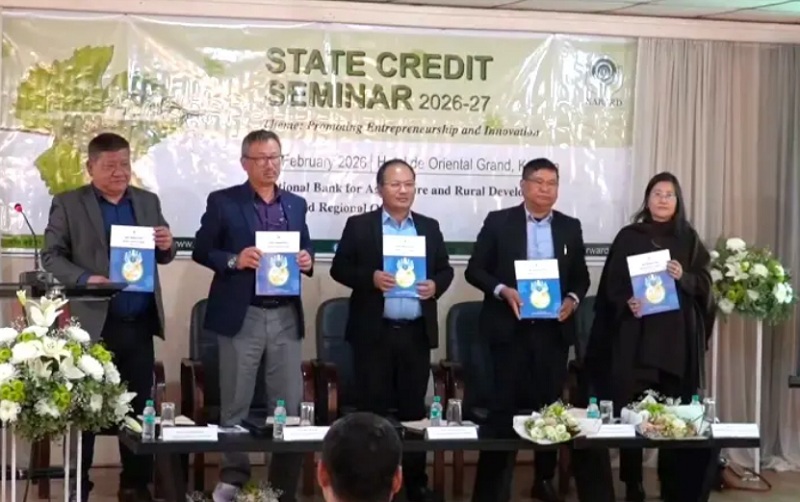
Kohima: The Nagaland government has called for a shift towards outcome-oriented credit planning to ensure that financial strategies translate into tangible improvements in rural livelihoods across the state.
Addressing the State Credit Seminar 2026–27, Finance Department Additional Secretary Imtimenla said agriculture and allied sectors remain the backbone of Nagaland’s economy but continue to face challenges such as low institutional investment, fragmented landholdings, difficult terrain and weak market linkages.
She stressed that credit planning must move beyond a routine compliance exercise and become an outcome-driven tool with a direct impact on rural livelihoods.
She called for customised credit products for terraced farming, horticulture, livestock, fisheries, agro-forestry and agri-entrepreneurship, with a focus on supporting the entire value chain.
Addressing the seminar, National Bank for Agriculture and Rural Development (Nabard) General Manager and Officer-in-Charge P. Bulte said the institution has prepared potential-linked credit plans (PLPs) for all 17 districts of Nagaland, including newly created districts for the first time.
The programme, organised by Nabard, was held on the theme “Promoting Entrepreneurship and Innovation.”

Experts at the programme highlighted the need for outcome-oriented, inclusive and data-driven credit planning to strengthen Nagaland’s rural economy.
Bulte said the preparation of the State Focus Paper is a shared responsibility of Nabard, line departments and banks, and requires close coordination and timely data sharing.
He said AgriStack, the farmer registry, is a priority and that credible digital data will enable more targeted credit delivery and support sustainable development.
Imtimenla also highlighted the Chief Minister’s Micro Finance Initiative (CMFFI) as a key instrument to expand formal credit access and strengthen monitoring at the state and district levels.
Cooperation Department Commissioner and Secretary Orenthung Lotha pointed to challenges related to data gaps, landholding complexities under Article 371A and the digitisation of cooperatives.
He said initiatives such as the Nagaland Integrated Information System and PACS computerisation are expected to improve data reliability and institutional efficiency.
Lotha said that employability remains a concern despite high literacy levels and called for convergence between government programmes and banking support to promote youth engagement in cooperative, green and entrepreneurial sectors.
State-Level Bankers’ Committee coordinator H. Lalhlimpuia said the seminar marked the culmination of Nabard’s PLP exercise and noted that separate district-wise PLPs were prepared for the first time despite data constraints.
ALSO READ: Nagaland CM announces ex gratia after Kohima bus tragedy
He emphasised the need for accurate, granular data from departments and banks for effective credit planning and highlighted the role of DCC and BLBC meetings in strengthening district-level inputs.