










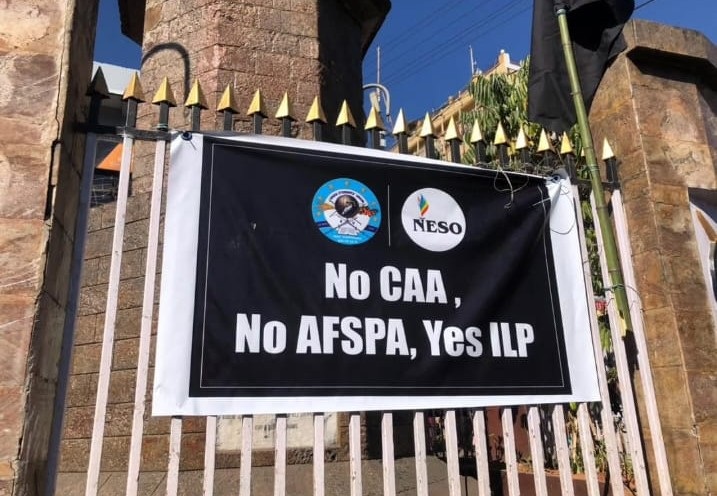
Kohima: Protests against the Citizenship Amendment Act (CAA) flared across the Northeast on Thursday as the Naga Students’ Federation (NSF) marked ‘North East Black Day’ in Kohima, joining demonstrations held simultaneously by member groups of the North East Students’ Organisation (NESO).
The day-long protests were organised to coincide with the anniversary of the Act’s passage in Parliament in 2019.
Addressing demonstrators, NSF general secretary Kenilo Kent said the region’s coordinated observance reflected a united stand of resistance.
“We stand together in collective defiance along with the rest of the Northeast,” he said, alleging that the CAA is discriminatory and poses a direct threat to the identity and survival of indigenous communities.
He described the northeastern homeland as the cradle of culture, history and identity, warning that the law undermines indigenous rights.
NESO secretary general Mutsikhoyo Yhobu reiterated that student bodies have opposed the Act from the beginning.

“The entire Northeast is observing this black day against the imposition of the CAA,” he said, adding that despite exemptions granted to ILP-covered states, the region remains vulnerable.
Yhobu said the symbolic observance was meant to send a clear message to the Centre that the people of the Northeast “do not want this Citizenship Amendment Act”.
ALSO READ: Meghalaya: Pahamsyiem EMRS begins 2025 session as state starts work on synthetic track
Student leaders from other states echoed similar concerns.
All Arunachal Pradesh Students’ Union (AAPSU) vice president (protocol) Nabam Gandhi called the law “socially and economically damaging”, arguing that the unique demographic sensitivities of tribal-dominated states were ignored.
He criticised the ILP exemption as “a chocolate” offered to pacify indigenous communities, warning that the permit regime could be withdrawn at any time, paving the way for unchecked migration and the erosion of tribal cultures, customs and natural resources.
The protest in Kohima culminated with the symbolic burning of CAA documents, led by Yhobu, in what NESO described as a public expression of dissent against the Act’s implementation in the Northeast.