










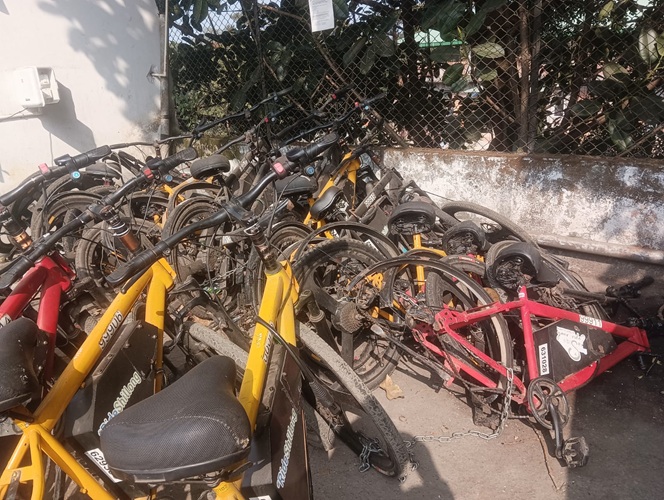
Shillong: What was paraded as a symbol of green mobility and progressive urban planning has quietly collapsed into neglect. Of the 20-plus electric bicycles launched with much fanfare by the Meghalaya government last year, at least 13 are now non-functional, abandoned to rust and decay.
In August 2025, Chief Minister Conrad K Sangma, accompanied by fitness icon Milind Soman, unveiled ‘Ride Shillong’, a public electric bicycle-sharing scheme touted as a solution to traffic congestion, pollution and sedentary lifestyles.
The optics were perfect. The promises were lofty. The delivery, however, has been painfully hollow.
Months later, photographs of the e-bikes in battered, shabby condition are circulating widely, exposing a grim reality: public money spent, publicity secured, and then silence.

The cycles lie unused, broken and ignored, raising uncomfortable questions about how many other government initiatives have met the same fate– launched with enthusiasm, then left to die from sheer apathy.

The project, backed by the Ministry of Housing and Urban Affairs, GIZ under the India-Germany cooperation framework, Meghalaya Tourism and the Green Urban Mobility Partnership, was meant to showcase Shillong as a pedestrian- and cyclist-friendly city.
Instead, it has become yet another example of how grand visions collapse when maintenance, accountability and follow-through are treated as afterthoughts.
What is perhaps most damning is not that the bicycles stopped working, but that no visible effort has been made to fix them. No urgency. No explanation. No repair. Just a quiet acceptance that public-funded assets can rot in plain sight without consequence.
‘Ride Shillong’ was supposed to move the city forward. Instead, it now stands as a rolling or rather, immobile reminder of governance that prioritises launches over longevity, optics over outcomes, and announcements over accountability.