










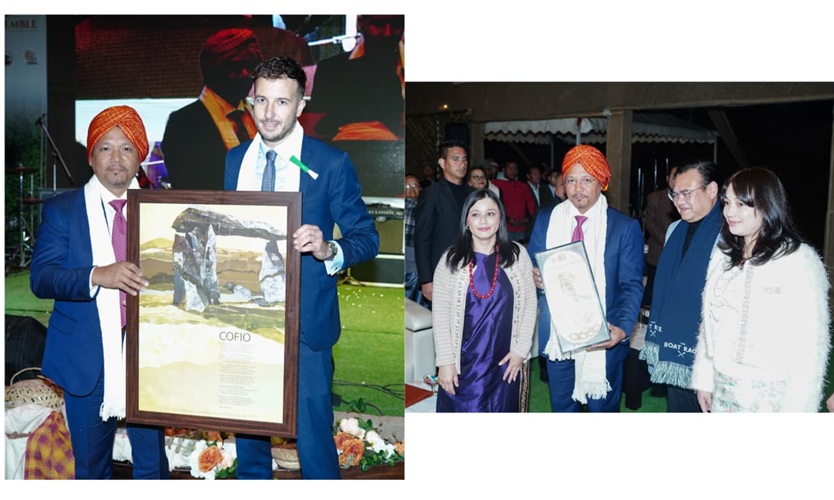
Shillong: The fourth edition of the Tri Hills Ensemble, a festival celebrating the culture, craft and cuisine of the Khasi, Jaintia and Garo communities, was inaugurated at Ward’s Lake on Wednesday by Chief Minister Conrad K. Sangma.
Organised by the Department of Arts and Culture, the event also marked a renewed cultural partnership between Meghalaya and Wales.
The inaugural function was attended by Arts & Culture Minister Sanbor Shullai, Adviser Paul Lyngdoh, Chief Secretary Dr. Shakil P. Ahammed, Principal Secretary Frederick R. Kharkongor, and other senior officials.
Eoghan O’Regan, Head of the Welsh Government in India, also joined the event, underscoring the growing ties between the two regions.
This year’s edition places a strong emphasis on reviving traditional boating in Darrang and Dawki, symbolised through the ceremonial handing over of oars to local boatmen.
Speaking at the event, the chief minister said the festival reconnects the State to its cultural foundations and reflects the theme “Rivers, Roots and Revival,” aimed at rediscovering traditions such as rowing and boat races once popular in border river communities.

He added that while Meghalaya continues to register rapid economic growth, the preservation of cultural identity must remain central to development.
Sangma highlighted the need for detailed documentation of tribal histories, languages and art forms, noting gaps in recorded knowledge.
Citing the intricate drum beats of the Wangala festival as an example, he called for more research through initiatives such as the Chief Minister’s Research Grant.
He also urged schools to feature plays on tribal freedom heroes to inspire pride among younger generations.
Arts and Culture Minister Sanbor Shullai said the festival honours the linguistic, musical, culinary and craft traditions of the three major tribes.
He noted that the Meghalaya Arts and Heritage Awards recognise both established custodians of culture and emerging young achievers.
He welcomed the revival of traditional boat races as a collective effort to keep heritage alive.
Adviser Paul Lyngdoh said the lineup of performances reflects the depth of Meghalaya’s traditions and emphasised the importance of anchoring young performers to their roots, especially in an era increasingly shaped by artificial intelligence.
Chief Secretary Dr. Shakil P. Ahammed underlined the role of archaeological research and music in acknowledging the State’s past.
He said the Chief Minister’s Research Grant has supported 48 scholars working on indigenous knowledge systems, traditional practices and applied heritage research.
He stressed that cultural identity and environmental preservation are essential in attracting tourism, a key revenue source for the State.
Welsh Government representative Eoghan O’Regan spoke of the longstanding bond between Meghalaya and Wales, rooted in the legacy of Thomas Jones, who introduced the Khasi language to written form.
He said the cultural spirit shared by both regions is reflected in the Welsh expression “amarhid,” meaning “still here.”
He highlighted ongoing cultural exchanges, including Khasi musicians studying the Welsh harp and collaborations between artists in both regions.
In his welcome address, Principal Secretary Frederick Kharkongor described the revival of river traditions as a restoration of living heritage.
He outlined ongoing collaborative projects and research initiatives, including the “Revisiting Our Roots” programme tracing the migratory origins of the three tribes, and introduced the State’s first Mega Arts and Heritage Awards.
The evening featured performances by Khasi Cymru, Ground Breakers of Khatsaw Phra College, the State Institute of Arts & Culture, and Bhutanese rock band Baby Floyd.
Awards were presented to individuals and groups contributing to language promotion, indigenous cuisine, folklore, community libraries, craftsmanship and performing arts.
The event also saw several releases, including a preview of the film Crafting Technique of the Saitar, new research articles under the CMRG, online library membership registration, the Rasong National Tribal Festival Report, and books translated into Biate alongside works by local authors.