










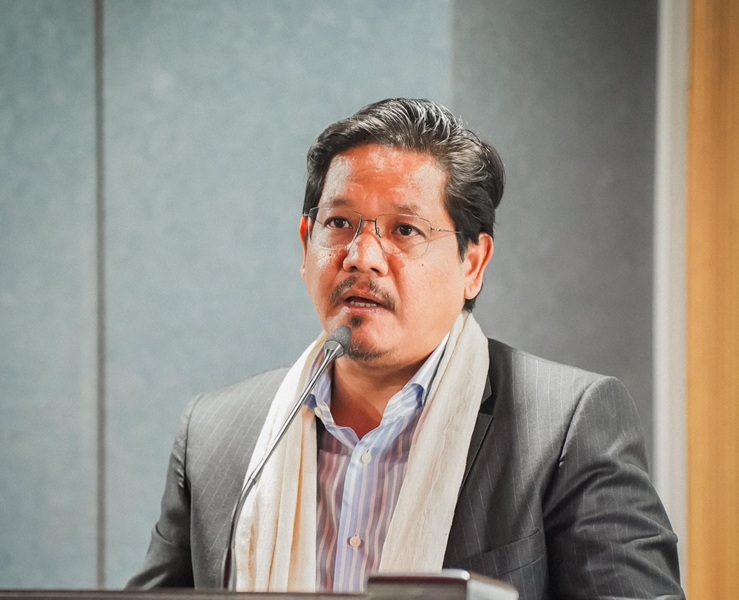
Shillong: Chief Minister Conrad K. Sangma informed the Meghalaya Assembly on Monday that the state currently has six officially notified elephant corridors, with three additional routes under consideration.
He, however, underlined that there is no absolute solution to prevent elephant herds from moving along traditional paths that have existed for generations.
Replying to a question from NPP legislator Rupert Momin, who flagged recurring crop destruction caused by elephants migrating from Assam, the chief minister said the government’s approach is focused on reducing risks and human-animal conflict rather than attempting complete restriction of animal movement.
He explained that regular awareness programmes are being conducted in vulnerable areas, voluntary community protection squads are being supported, and food-based plantations are being developed along corridor zones to create natural deterrents, described as a “sausage barrier,” aimed at lowering the frequency of encounters between people and elephants.
On a request for setting up a wildlife office at Wageasi-Dainadubi, Sangma said proposals for establishing new beat and range offices are under active examination in coordination with the planning and finance departments.
UDP legislator O Suin raised concerns over a herd that had remained in the Mawsynram region for nearly a year, damaging paddy fields, arecanut plantations and residential houses.

In response, the chief minister assured the House that the matter would be reviewed and that project-based support would be considered.
He also noted that a beat office has already been proposed for the Ranikor area.
Sangma further stated that the government would gather detailed inputs from local legislators to ensure protection of both human settlements and wildlife.
ALSO READ: Agatha Sangma honoured with National Leadership Award in New Delhi
Providing an overview of protected areas in the state, he listed four wildlife sanctuaries—Nongkhyllem Wildlife Sanctuary, Siju Wildlife Sanctuary, Baghmara Wildlife Sanctuary and Narpuh Wildlife Sanctuary—along with two national parks, Balpakram National Park and Nokrek National Park.
He added that new sanctuaries are being proposed at Baghmara and Riatkhwan.
Responding to concerns on catchment area protection raised by UDP leader Renikton Lyngdoh Tongkhar, Sangma said sites in Mawkyrwat and other districts are under review, while the Shillong and Tura catchment zones already fall under protected status.
He also highlighted a wider conservation strategy that includes anti-poaching patrols, inter-agency intelligence sharing, seizures and prosecutions, the promotion of community reserves, and the strengthening of volunteer protection squads as part of the state’s long-term wildlife and biodiversity protection framework.