










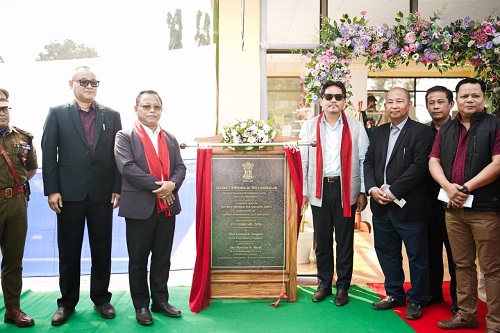
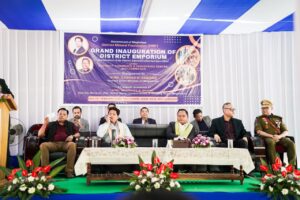
Williamnagar: The Government of Meghalaya on Friday inaugurated a District Emporium at the District Commerce & Industries Centre (DCIC), Williamnagar, in a move aimed at strengthening local entrepreneurship and promoting indigenous handicrafts and locally produced goods in East Garo Hills.
The emporium was formally inaugurated by Meghalaya Chief Minister Conrad K. Sangma in the presence of Marcuise N. Marak, Minister for Public Health Engineering, Soil & Water Conservation and Housing, along with senior officials of the district administration, local entrepreneurs, artisans, and members of the public.

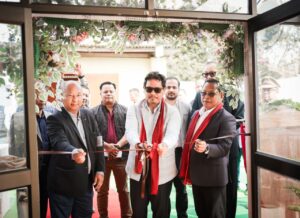
The inaugural programme began with unveiling of the commemorative plaque and a walkthrough of the emporium showcasing locally manufactured and industrial products.
Addressing the gathering, CM Sangma highlighted the urgent need to create large-scale livelihood opportunities for the state’s youth. He noted that between 50,000 and 60,000 young people enter the workforce in Meghalaya every year, while government job vacancies number only around 1,200 to 2,000 annually.

“Our plans and policies must address this reality. If we do not create opportunities for our youth, it will result in economic, social and political pressures,” he said.
CM Conrad Sangma reiterated the state’s long-term development roadmap of building a 10-billion-dollar economy, stating that the vision focuses not merely on growth, but about creating sustainable livelihood opportunities through key sectors such as tourism, agriculture, industry and commerce, and information technology.
Also Read: NSS review meeting held at NEHU, MY Bharat Budget Quest 2026 posters released
The Chief Minister highlighted several major initiatives of the DCIC, including the ₹25-crore food processing unit at Tikrikilla, which supplies Nokma ice cream using raw materials sourced from local farmers; the ₹20-crore rubber processing unit at Songsak; and a ₹25-crore freezing and drying plant expected to be completed by April-May, which will support pineapple, orange and banana farmers across Garo Hills. He also referred to the Rongara processing unit that manufactures A’wang chips as an example of value addition to local produce.
Stressing the importance of expanding market access, he said similar emporiums should be established across the state and suggested partnerships with self-help groups and private entrepreneurs to manage them professionally.
He urged young people to adopt an entrepreneurial mindset, encouraging them to “be business and enterprise minded and take calculated risks,” while also outlining the growing livelihood opportunities emerging in the tourism sector.
Speaking on the occasion, Marcuise N. Marak described the emporium as “a small yet significant boost for Williamnagar,” noting that the district is home to many skilled artisans who now have a dedicated platform to display and sell their products.

The emporium has been established under the District Mineral Foundation (DMF) and implemented by the District Administration of East Garo Hills. It aims to provide a dedicated platform for local artisans, entrepreneurs, and small businesses to display and market their products.
The initiative is expected to enhance livelihoods, generate employment opportunities, and contribute to the sustained growth of the district’s local economy.