










By Sangita Dutta Gupta, M Manjula & Tania Ghosh
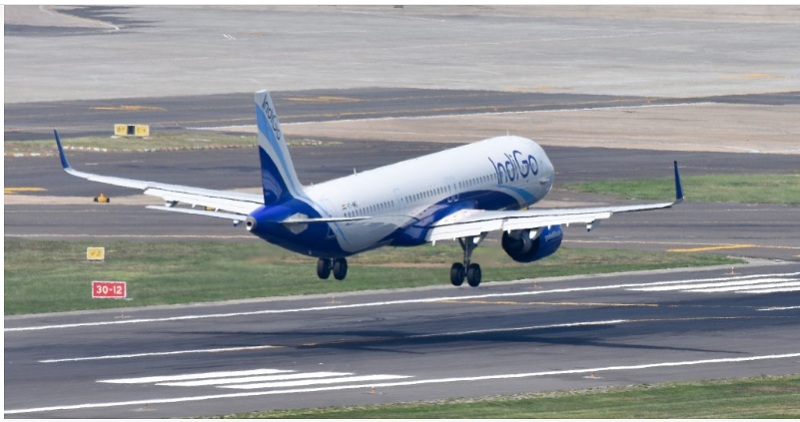
The recent crisis involving IndiGo has exposed deep structural problems in India’s aviation sector.
What unfolded early this year was not merely an operational lapse or a temporary disruption, but a reflection of the power imbalance in a high-demand aviation market with two dominant players.
Sixty percent of India’s domestic market share is held by IndiGo; out of nearly 900 domestic routes, IndiGo is the only carrier on 514 routes.
Together with Air India, the two carriers control a staggering 86 percent of the market.
By itself, high market concentration is not proof of monopoly.

But it does create grounds for business practices that may fall under the Abuse of Dominant Position clause in India’s Competition Act, 2002.
For instance, in the recent crisis, it created a situation where the airline made decisions that severely inconvenienced passengers and compromised their welfare – flight cancellations and subsequent charging of exorbitant prices – without worrying that it would lose customers.
The Competition Commission of India (CCI) has decided to investigate IndiGo under this clause.
The immediate reason for the crisis lay in the airline’s non-adherence to the Flight Duty Time Limit (FDTL) regulations, announced early January. These guidelines were designed to ensure safety by preventing pilot fatigue, a critical concern in aviation worldwide.
Airlines such as IndiGo had enough time to prepare for the transition, adjust crew schedules, hire appropriately, and strengthen operations. Yet, they delayed implementation, creating a situation where operational capacity was strained to the breaking point.
By failing to prepare for a well-anticipated regulatory change, IndiGo and other carriers left regulators with no option but to put FTDL regulations in abeyance.
Trouble in the skies
If found guilty by the CCI, under Section 4 of the Competition Act, IndiGo can be penalised for up to 10 percent of its total revenues, and depending on the findings, the CCI can also order structural remedies, including changes to business practices or removal of certain routes from its network.
Here, one might be reminded of IndiGo’s past encounters with the CCI, where no anti-competitive intent could be established. In 2015, when IndiGo was accused of poaching pilots from other airlines, the matter was investigated under Section 4 of the Competition Act. The regulatory body concluded that there was no evidence of anti-competitive intent.
In 2018, in a separate case against IndiGo, Spice Jet and Jet Airways, the CCI found that they had colluded over fuel surcharge rates on cargo flights, and fined them.
In 2020, in yet another case, the CCI found no evidence of collusion over ticket prices by IndiGo, SpiceJet, GoAir, Air India and Jet Airways.
Monopoly practice or policy failure?
Post-liberalisation, with the entry of several private players, the monopoly of Indian Airlines and Air India on air transport was diluted.
As of January 2008, there were 14 scheduled and 70 non-scheduled airlines in India. This included several low-cost carriers such as Deccan, Go-Air, and Spice-Jet.
IndiGo entered the market in 2006.
These low-cost carriers changed the aviation industry: multiple slab tariffs allowed the entry of a whole new segment of air travellers.
Increased passenger volumes compelled incumbent full-service airlines to revisit their cost structures and pricing strategies.
The market share of nine major airlines ranged from 1 percent to 23 percent, with IndiGo accounting for 9 percent. In terms of fleet size, Jet airways was the biggest player next to Indian Airlines, with IndiGo operating just 7 aircrafts in 2007.
From that modest beginning, to today’s position of a dominant carrier, IndiGo’s journey is about business acumen and well thought out strategies that helped the carrier outlive a policy space that failed to adapt to the emerging competitive environment.
In the early 2000s, the aviation sector faced several structural challenges.
Though the modernisation and privatisation of airports improved infrastructure, it was accompanied by extremely high user fees and airport development fees. The User Development Fees varies across airports and is passed on to both the passengers and carriers, affecting profitability of carriers.
ATF accounts for more than 40 percent of the operating expenses of carriers, and volatility in ATF prices have implications for profitability. Add to this the stringent compliance regime and multiple administrative reporting procedures for The Directorate General of Civil Aviation (DGCA), Airports Authority of India, and the Ministry of Civil Aviation.
In short, the Indian aviation sector can be described as high on investment, and low on what is referred to as ‘ease of doing business’.
At play was also IndiGo’s business strategy of aggressive bulk purchases and advance ordering, that locked airplane manufacturer discounts, and ensured an inventory of new fuel-efficient aircrafts in a volatile fuel cost environment. This enabled IndiGo to achieve significant cost advantages over competitors and maintain consistently low operating expenses.
A modern, fuel-efficient fleet also meant higher reliability and quicker turnaround times.
The carrier was consistent on its low cost approach and maintained a highly homogenized single-type fleet. The dividends came in the form of simplified training requirements, savings on training costs and overall cost efficiency.
The airlines also took advantage of the emerging markets, and continued to deliver on its brand positioning as a reliable and cheap option.
Other airlines failed to respond to the new competitive environment and the adverse policy landscape. Their exit, including that of Jet Airways, created a vacuum that IndiGo swiftly filled.
Thus IndiGo’s growth is an outcome of tight financial prudence and a competitive edge despite an unfavourable aviation policy regime.
The going was good, until it was not.
Healthy competition: a policy mandate for sustainability
A recent estimate pegs the growth of the Indian airline industry at 104.24 percent, and passenger capacity at 1 billion per annum.
With the government’s UDAN scheme democratizing air travel and bridging the infrastructure gap, passenger traffic in the country is expected to grow six-fold. By 2040, the airline fleet is predicted to grow to 2359 – it stood at 400 in 2014 – and generate 25 million jobs by 2040.
But consumer welfare in aviation – or any other industry — depends on healthy competition. Ideally, India needs at least three to four strong players to absorb shocks, maintain service standards, and give customers viable alternatives.
With air travel becoming essential for millions of Indians, this is no longer just a business concern. It is a public interest issue.
Besides, the recent crisis raises concerns not just about airline accountability, but also regulatory oversight.
The Directorate General of Civil Aviation (DGCA) must enforce stricter compliance, monitor airline preparedness, and act decisively when service lapses cause widespread public hardship.
IndiGo’s dominance may have grown organically, but its responsibilities have grown equally. It cannot be allowed to evade accountability for the turmoil it created.
Only then can the aviation sector function with reliability, fairness, and resilience.
Sangita Dutta Gupta is Professor, Economics at BML Munjal University, Haryana. M Manjula is Faculty, Azim Premji University, Bengaluru. Tania Ghosh is Assistant Professor, Shri Shikshayatan College, Kolkata.
Originally published under Creative Commons by 360info™.