










Guwahati: Community-based conservation initiatives have begun showing encouraging results in reducing human-animal conflict (HAC) in and around Pobitora Wildlife Sanctuary in Assam’s Morigaon district, one of the world’s highest-density habitats of the one-horned rhinoceros.
Pobitora Wildlife Sanctuary, spread over 38.81 square kilometres with a core area of about 16 sq km, is home to 107 rhinos as per the latest census.
Located barely 35 km from Guwahati and surrounded by densely populated villages, the sanctuary has long faced challenges in balancing wildlife protection with the livelihoods of local agrarian communities.
Conservation efforts in the area have remained heavily dependent on the cooperation of villagers, who frequently face crop damage and safety risks due to nocturnal movement of wildlife such as Asiatic buffaloes and rhinos into human settlements.
To address these challenges, biodiversity conservation organisation Aaranyak, with support from the IUCN Conservation Action Group and in collaboration with the Assam Forest Department, launched a multi-pronged initiative last year aimed at mitigating HAC while strengthening community support for rhino conservation.
Under the programme, Aaranyak researchers from the Rhino Research and Conservation Division have been working closely with forest officials and local residents to identify and implement practical conflict-mitigation measures.

One of the key interventions has been the installation of solar street lights in nine highly conflict-prone villages.
According to Aaranyak Deputy Director Dr Deba Kumar Dutta, these villages recorded zero incidents of human-animal conflict last year, with the lighting helping prevent night-time encounters between villagers and stray wildlife, particularly buffaloes.
The success of the initiative has prompted demands for similar installations from at least 20 additional villages in the Pobitora landscape.
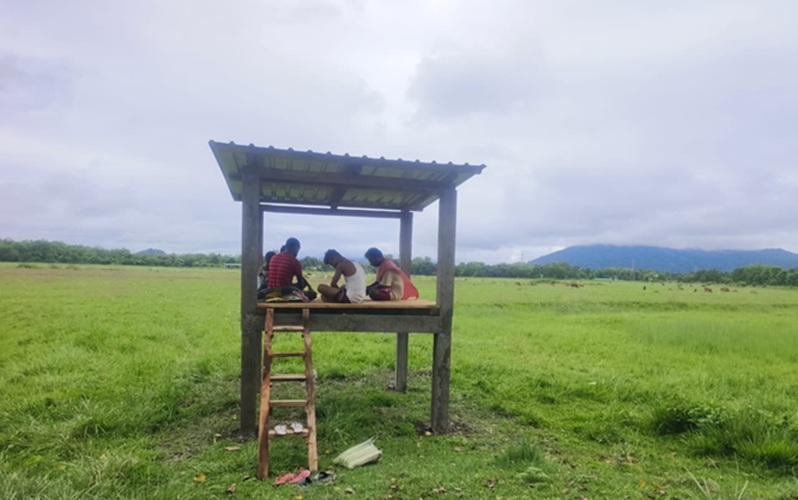
To further protect crops and farmers, Aaranyak has facilitated the construction of four raised concrete watch platforms in Muroibari, Tamulidoba, Amaramul and Goronga (Kamarpur).
These structures allow farmers to keep vigil over their fields at night in relative safety and have also been used by forest staff to monitor rhinos that occasionally stray beyond the sanctuary boundary.
The organisation has also helped form 15 community-based anti-depredation squads, comprising a total of 120 volunteers across 28 conflict-prone villages.
Each squad includes eight to ten members who conduct night patrols and monitor wildlife movement in coordination with forest department personnel.
Torchlights have been provided to both the volunteers and frontline forest staff to aid night surveillance.
ALSO READ: ‘Home Alone’, ‘Schitt’s Creek’ fame and comedy icon Catherine O’Hara passes away at 71
“The squads monitor stray animals from raised platforms and during patrols, alerting villagers and coordinating closely with forest officials,” said Pankaj Sharma, secretary of the Muroibari anti-depredation squad.
In addition to conflict mitigation, Aaranyak has initiated a pilot livelihood programme focused on cultivating cash crops such as Bhoot Jolokia among women in affected villages.
The low-cost, climate-resilient model is designed to protect crops from unseasonal rain and excessive heat, with the aim of supplementing household income and reducing dependence on vulnerable agricultural practices.
Forest officials and conservationists say the community-driven approach has not only reduced conflict incidents but has also reinforced trust and cooperation between villagers and wildlife authorities, a critical factor in safeguarding Pobitora’s globally significant rhino population.