










In 1908, when thousands of women marched through the streets demanding shorter working hours, fair wages and the right to vote, they probably did not imagine that their determination would spark a global movement celebrated more than a century later.
What began as a protest for dignity and equality eventually evolved into what the world now observes every year on March 8— International Women’s Day.
Today, the day is not only about celebration but also about remembering the women who dared to challenge conventions and open doors for future generations.
Their stories are found in grand revolutions and political movements, but also in quiet moments of courage — like stepping into a cockpit when very few women had done so before.
One such story unfolded in India in 1985, far from the busy corridors of global politics. It involved a small aircraft, a flight carrying just 44 passengers, and a group of women who quietly made aviation history.
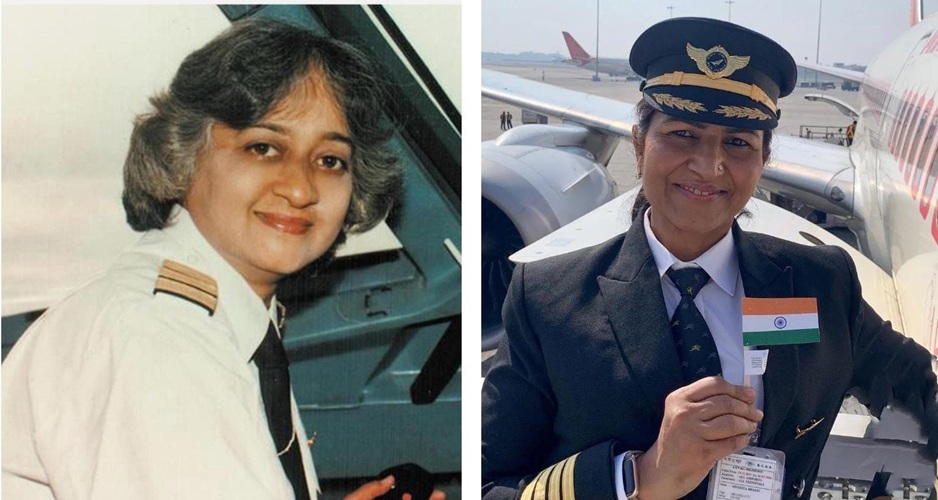
At a time when aviation was overwhelmingly dominated by men, an Air India flight bound for Silchar took off with the world’s first all-women crew.

The aircraft was commanded by Saudamini Deshmukh, while the co-pilot was Nivedita Bhasin.
The journey lasted only about an hour and a half before landing safely at Silchar’s Kumbhirgram Airport in Assam.
Yet the flight travelled much farther than the distance on the map, it carried with it a powerful message about ambition, determination and the courage to dream.
In 1985, India was still finding its footing in terms of gender equality in many professions.
Women pilots were rare, and the idea of an entire commercial flight crewed by women was groundbreaking.
ALSO READ: Is Gen Waker-uz-Zaman aiming to become supreme commander of Bangladesh’s armed forces
For the passengers aboard that aircraft, it might have seemed like just another routine flight. For aviation history, however, it marked a milestone.
Captain Saudamini Deshmukh’s journey into aviation itself was one of persistence.
She became associated with the International Women Pilots Association in the early 1970s and later became a charter member of the India Section of The Ninety-Nines, an international organisation of women pilots.
Determined to pursue her passion, she travelled to the United States to complete her flying training in the late 1970s, receiving support from experienced aviators in Los Angeles.
She joined Indian Airlines as a trainee pilot in January 1980 — a significant achievement at a time when the cockpit was largely a male preserve.
Over the years, she continued to break barriers. In July 1988, she became the first Indian woman to captain a jet aircraft.
Her co-pilot on that historic 1985 flight, Nivedita Bhasin, would also go on to carve out an extraordinary career.
Born in 1963, Bhasin made global aviation history on January 1, 1990, when she became the youngest woman in the world to command a commercial jet aircraft at the age of 26.
Stories like these remind us that progress often comes in small, determined steps.
The early women who marched in 1908 fought for rights that many take for granted today.
Decades later, women like Deshmukh and Bhasin carried that spirit forward — not with protest banners, but with flight controls in their hands.
Today, women fly fighter jets, command commercial airlines, lead global companies, head governments and explore space.
So, on International Women’s Day, while the world celebrates progress and empowerment, it is also worth remembering that sometimes history is made quietly — perhaps on a modest aircraft carrying just 44 passengers, soaring over the clouds, guided by women who believed the sky was never the limit.