









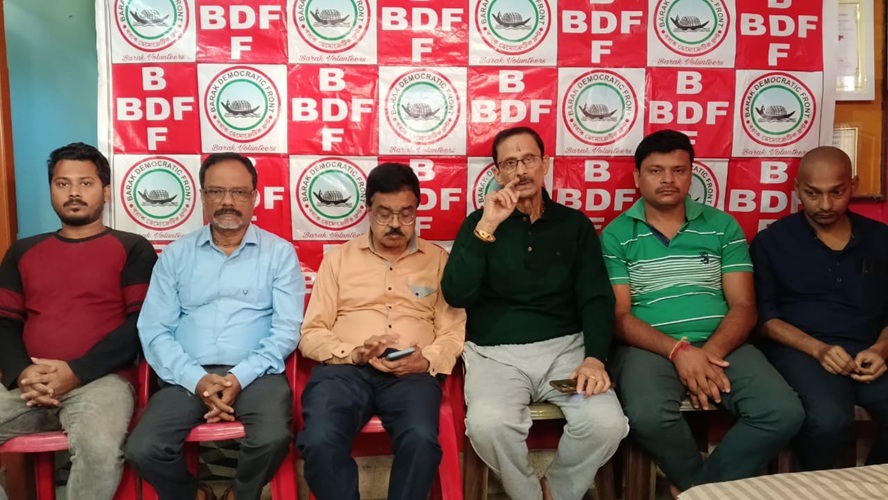
With the Assam Legislative Assembly elections drawing closer, the Barak Democratic Front (BDF) has sought a clear stand from the state government on long-pending issues affecting the Barak Valley, warning that voters will judge the ruling dispensation on its response to what the party described as persistent deprivation and discrimination.
In a press statement, BDF chief convenor Pradip Dutta Roy raised concerns over the valley’s preparedness ahead of the monsoon, recalling that flood-related hardships and communication breakdowns remain an annual ordeal.
He said renovation of drainage channels, including Rangi Khal and other canals in Silchar and Karimganj announced after the 2022 floods, remains incomplete, with barely 30 per cent of the work executed.
He alleged that substandard construction had led to the collapse of guard walls at several locations and criticised the government’s handling of weakened embankments and non-functional sluice gates.
Roy also pointed to the lack of progress under the proposed “Namami Barak” programme, stating that dredging of the Barak River has stalled due to the absence of political will.
Rail and road connectivity disruptions during the monsoon continue without any effective alternative arrangements, he said, adding that the Chandranathpur–Lanka railway line, projected as an alternative route, has not even been initiated.

He further questioned the future of the six-lane Panchgram–Barapani road project, noting that even after more than two decades, there is no concrete assurance about its completion or effectiveness, particularly in the landslide-prone Dima Hasao district.
Describing Silchar as a peripheral and underdeveloped city, Roy said repeated demands to include Silchar–Guwahati and Silchar–Kolkata air routes under the Centre’s UDAN scheme to keep fares affordable have been ignored.
Instead, he said, an unnecessary Silchar–Agartala flight was introduced while key routes such as Silchar–Imphal were discontinued.
He added that despite renovation work, concerns persist over the long-term safety of the Gammon Bridge at Badarpur.
Roy maintained that unless floods and connectivity are addressed comprehensively, sustainable development of the Barak Valley will remain elusive.
He also highlighted delays in projects such as the proposed elevated corridor in Silchar and the Multi-Modal Logistics Park in Cachar district, saying the lack of intent has become evident.
Referring to the BJP’s Vision Document up to 2025, which promised High Court benches in both Silchar and Dibrugarh, Roy questioned why progress has been made only in Dibrugarh.
While the Chief Minister recently announced a High Court bench in Dibrugarh and declared it Assam’s second capital, no similar move has been indicated for Silchar, despite it being the state’s second-largest city by population and geographically distant from Guwahati.
He also noted that construction of the mini-secretariat in Silchar remains incomplete.
BDF media cell convenor Joydeep Bhattacharjee said the creation of a separate Barak Development Department reflected official recognition of the valley’s backwardness, but alleged that no visible efforts are being made toward industrial growth and employment generation.
He recalled assurances to develop an industrial hub on the abandoned Panchgram paper mill land and to promote ethanol plants using bamboo resources, but said none of these proposals have translated into action.
He also pointed to the absence of plans for CNG or other gas-based industries.
Employment, Bhattacharjee said, continues to be a major concern, with limited opportunities for both educated and unskilled youth.
While recruitment from the valley into government jobs has seen a marginal increase, he termed it grossly inadequate and reiterated the demand for reserving Class III and Class IV posts for local candidates, a provision already backed by legislation but yet to be implemented.
He added that private-sector employment prospects remain extremely limited.
BDF convenor Hrishikesh Dey highlighted the distress in the tea industry, the valley’s only major industrial sector, attributing its decline to floods, rising costs, lack of investment and weak infrastructure.
He warned that without immediate government intervention, several tea gardens could shut down.
ALSO READ: Jamaat-e-Islami chief’s ‘anti-women’ X post sparks outrage in Bangladesh, party claims hack
Agriculture, he said, is also in crisis due to recurring floods and droughts, low incomes and the absence of planned support for alternative crops and resilient infrastructure.
Dey further noted delays in renaming the railway station as “Bhasha Shahid Station” and the lack of progress on the proposed Vivekananda Cultural Centre, despite land allocation.
Tourism projects such as the development of Bhuvan Pahar with a ropeway, zoo and science museum remain unimplemented, while a recently announced agricultural university needs time-bound execution, he said.
While acknowledging positive steps such as new bridges over the Barak River and improvements in internal roads, BDF leaders demanded that the government publicly clarify its position on all outstanding issues before the elections.
The party said it would appeal to voters based on the government’s response.
The statement was issued on behalf of the Barak Democratic Front by convenor Debayan Deb.